Have faith

Centered black serif text says, “Good things are going to happen. Have faith. Stay positive.” The words are imposed over a color-saturated photo of the sun shining over some mountains. The source is “Power of Positivity.”

Just to clear this up: faith ≠ positivity.

I don’t have a whole lot more to say about this specific macro, but clearly I do still have a lot to say on this general topic.

This post is going to look like some navel-gazing nonsense, and it isn’t not navel-gazing nonsense, but I think there are also one or two salient considerations for living in this fucked up race to the rock bottom of human history. 

(I’ll stand by “human” history for the general trajectory of the world, but my observations here are very grounded in the U.S. of A.)

I once read an article that highlighted an interesting distinction between trust and faith, with more relevance to interpersonal relationships than to invisible deities.

The article suggested that faith can be viewed as a larger container for trust, as faith offers a way to help navigate our questions of trust when we feel that we lack sufficient evidence to accept or believe another person.

Folks who have a lot of faith in relationships, broadly, could stand to sometimes raise the bar for what creates trust because they’re apt to offer good faith where evidence has shown that trust may not be warranted. Kind of like what contemporary Christianity wants you to do: have faith in spite of apparent evidence to the contrary.

These folks may be susceptible to being taken advantage of in their close relationships.

Folks who struggle to have trust in relationships can also struggle to have faith in people, and may become a bit over-dependent on and over-demanding for hard, unambiguous facts and solid evidence. Kind of like what can get you excommunicated from a lot of Christian churches. 

These folks could stand to spend some effort building a bigger faith container in order to sometimes hold a little more trust

They are less likely to be taken advantage of in their close relationships, but they’re also probably not letting anybody get all that close in the first place.

In short, the article proposed that it’s necessary to have faith in order to build trust, rather than the other way around, because leading with trust means that faith will only ever be big enough to contain whatever trust is already there.

I tend to demand a lot of evidence because I feel like faith isn’t actually real

Sometimes I require what is probably an excessive amount of tangible evidence to accept things that ought to be apparent with just a little bit of faith. And this ends up placing an undue amount of weight onto individual pieces of evidence, because they’re being forced to serve a larger function than they were ever intended to by anyone unknowingly providing said evidence. 

An exaggerated example would be something like, “You did one thing that I didn’t like, and that is solid evidence that I shouldn’t have trusted you any of the many other times you did things I did like!” 

(To the best of my recollection I have never actually said that to anyone, but if I’m being honest, variants totally come up in my thought patterns when I’m real dysregulated.)

It occurred to me that I have kind of been denying myself the option of having faith in other people, even while I’m actually putting a lot of trust in them.

The article also suggested that difficulty in trusting or having faith in others stems from difficulty in trusting or having faith in oneself. 

And my initial reaction (as it often is with that kind of claim) was “Psh, I have way more faith in myself than I do in other people, even if it’s just faith that I will still be fine even after I inevitably fuck up.”

But then the article expounded with this perspective I hadn’t encountered before (it was even actually bolded in the original context):

If the information you’re gathering (“do they meet my standards or not?”) is serving to confuse your decision-making rather than aid you in making informed choices for yourself, it is more likely a problem of trusting your ability to act appropriately based on what you know, not your ability to accurately discern information and come to know things in the first place.” 

Dang. 

Called out.

(Citation note: the original author goes online by The Loving Avoidant, and I acknowledge that the line I am quoting came from my Patreon subscription to their work. I don’t think it’s one of the pieces that’s freely available, so if you are interested in finding the full article I’m quoting, I think you can purchase specific articles as PDFs. Or just subscribe.)

I tend to fall more firmly into the “not trusting myself to act appropriately based on what I know” category than into the “not discerning information and coming to know things in the first place” category, so that was fun to notice. 

I’ve sometimes written long essays that have eventually turned into blog posts or articles because I don’t trust my ability to respond appropriately to things I am pretty sure I have perceived. 

Much more recently, I saw something online that parenthetically and consistently included the word vulnerability after the word trust, and I wondered about that choice.

In fact, that’s what made me revisit this faith vs. trust distinction in the first place. I just decided to tie it to a draft for a boring PoP macro that hadn’t inspired much prose. 

It seemed like the content creator was suggesting that trust requires vulnerability, rather than framing the terms as synonymous. 

It seemed off to me at first, but it’s grown on me.

Just repurposing my own sentence from above: “folks who struggle to be vulnerable in relationships can also tend to struggle with having faith in people…” I mean, that tracks. 

Vulnerability doesn’t directly need to map onto trust across the board, but struggling to be vulnerable does translate pretty directly to struggling to be trusting, which still translates to not having a whole lot of faith in people.

So if vulnerability is comparable to trust here, what is the larger container that holds the vulnerability? 

Is it safety? Or security?

Oh, balls, I think that’s what it is. 

It’s a little semantically squidgy, because I can see faith and trust as being potentially interchangeable words in many contexts. Not that they mean exactly the same thing, but they can overlap sufficiently that there are a lot of possible sentences where the fine-grained distinction isn’t going to matter a whole lot.

For me, it feels weird to use vulnerability and security interchangeably in most contexts. (But maybe that’s just highlighting some of my own issues.)

“I trust you” and “I have faith in you” are reasonably comparable sentences.

“I feel vulnerable with you” and “I feel secure with you” do not align so much. 

But I suppose “I feel able to be vulnerable with you” and “I feel secure with you” is more similar to the trust/faith pairing. 

I confirmed the etymology of vulnerable, and the Latin root literally translates to “capable of being wounded.” 

And honestly, I like the meaning of “I feel able to be capable of being wounded with you” better than “I feel capable of being wounded with you.”

Vulnerableable just isn’t a viable option. 

So maybe my issue with vulnerability is mostly just about English morphology. Let’s say that.

Anyway, back to substituting vulnerability/security for trust/faith from the previous paragraphs:

It’s necessary to be able to have security in order to develop the capacity for vulnerability, rather than the other way around, because leading with vulnerability means that the security container is only ever big enough to contain whatever vulnerability has already been placed there.

And sometimes I require an excessive amount of tangible evidence of safety to accept things that ought to be comfortable with just a little bit of security. 

Which places an undue amount of weight onto individual pieces of evidence that vulnerability is okay, because they’re being forced to serve a larger function than they were ever intended to be seen as by anyone else. 

Imagine another person being like, “I was literally just not being a dick to you when you said something that seemed emotionally sensitive – I kinda thought that was a low bar?” and meanwhile in my own brain, I’m like internally sobbing “HOW IS IT EVEN POSSIBLE TO FEEL THIS SAFE.”

Fuck, that works out really well – I was honestly kind of hoping it would flop when I tried to develop it.

Before I came up with security above, I considered a sort of opposite version of faux-vulnerability, faux-security, faux-trust, and faux-faith. 

And for that version, I initially thought about defensiveness (rather than security) as the larger container that holds vulnerability in that earlier metaphor.

But that’s kinda rough.

It would position defensiveness as being analogous to faith, which doesn’t exactly seem aspirational to me, but it kind of is for a lot of folks

What a lot of folks call faith, when we bring in religion or other big picture ideologies, isn’t something that I actually want. That’s more like “blind acceptance and unquestioning allegiance,” which is more like that earlier description of someone who could stand to raise their trust bar because their huge faith container kinda hasn’t overflowed to the point of necessitating useful boundaries. 

Actually, that helps with labeling: that approach to faith is more like “unboundaried trust.”

And when that’s encouraged as aspirational, and we have a comparable thing going on with vulnerability and security, that results in “unboundaried vulnerability” filling in the role of security.

Like, “I will accept an unending amount of excruciating pain and consider it to be the result of appropriate and admirable vulnerability, without having really experienced circumstances under which someone in a position to hurt me elected not to.”

This is a framework in which “willingness to put up with anything” is a substitute for security. And within that framework, in which security is defined as something inherently not all that secure, defensiveness does seem like an appropriate container to hold it in. 

In a framing where we allow security to be a larger container that holds vulnerability, there’s presumably space for protection, which feels like a better umbrella for defensiveness to fall under. 

If I continue to run with this parallel (which I clearly am): difficulty in being vulnerable or feeling secure with others stems from difficulty in being vulnerable or feeling secure with oneself.

Okay, that’s kind of on the nose. I won’t even push back like I initially did with trust. 

I once had a long, slow anxiety attack when a friend told me that “the door is always open.” 

I had been having trouble opening up about a topic that was pretty emotionally charged, but which I had attempted to initiate conversation about in the first place. 

I had understood, in principle, that it was a vulnerable subject for me, but I expected myself to just feel a little uncomfortable and then barrel through the awkward disclosure to reach the side of connection. (Also not necessarily an awesome approach, but I manage a lot of things by barreling through them.)

Instead, I literally physically couldn’t make it through my own semi-planned sentences – I choked and stammered and teared up and ended up muttering something like “never mind” and bolted from the conversation, more than once. 

That part wasn’t even the anxiety attack I referenced at the start of this section. My vulnerability-induced behavior was just what led to the open door offer, after I followed up to apologize for being weird.

When my friend told me that the door was always open, I felt like I should feel warm and fuzzy, but it also kind of felt like I was experiencing warm fuzziness while underwater and running out of oxygen. I was appreciative of the offer, and I understood how I should feel good about that, but instead I was deeply unsettled and increasingly anxious.

When I tried to explain my reaction to my partner, I said something like, “You know how military vets with PTSD can have trouble relaxing in, like, pleasant restaurant situations? It seems kind of like that,  but just with my sense of emotional safety and not actual physical safety,” and he just kind of looked at me for a beat and blinked a couple of times and so reassure him that I was fine, I was like, “I just couldn’t think of any other analogies that work better than PTSD.”

So anyway, that eventually led to sort of a breakthrough moment in therapy that doesn’t need to be unpacked here. 

The reason for bringing it up at all is that, as a result of being offered a space in which to be vulnerable, I learned to recognize some of the roots of my intense aversion to feeling vulnerable. 

Which was basically like, “woah, my security container is not nearly big enough for that kind of vulnerability!”

I panicked and spiraled about that open door offer so much that it altered my perception of what emotional safety even meant to me, because I realized that I kind of didn’t believe that emotional safety could be real, and so the offer to go through an “open door” felt like a trap. 

After writing a lot of rambly words to my friend, I eventually followed up to simply say “It turns out that I’m afraid of open doors.”

I still say this to myself. 

There is an immature but well-practiced part of my brain that responds to anxiety, distress, confusion, anger, and plenty of other unpleasant but informative emotions by slamming shut all the metaphorical relationship doors in my life that appear to be open at any given time, and then locking my own door for good measure. 

Fortunately, this mostly happens in my own mind, where it doesn’t actually impose all that volatility on my actual relationship dynamics. I do a lot of internal processing.

I’m finally to the point where I can sometimes speak gently to myself earlier in my process, and even inquire, “Hey – what feels scary about leaving that door open a crack? What might happen if we didn’t act like we have to close it right now?” 

But that’s mostly just about my own door.

For me to walk fully through someone else’s open door without taking any kind of defensive stance? 

That’s still a work in progress.

I am practicing trust, and I am practicing vulnerability, and fucking up at both of them is actually part of the process of expanding my available resources. 

My respective faith and security containers are still being renovated.

I have often wondered about advice that encourages the practice of vulnerability for people who may not have ever actually experienced security. It’s like encouraging someone to have faith without giving them an opportunity to have basic trust.

(Says the recovering Catholic who always kind of thought that Doubting Thomas got a bad rap.)

As with vulnerability and security above, faith as a container should allow space for both doubt and trust. But for folks with that unboundaried trust I mentioned earlier, it makes sense that doubt might feel like a more logical container for trust than faith.

Isn’t that kind of something that’s been happening on a national scale, for a long time? 

When we encourage vulnerability that isn’t grounded in security, and faith that isn’t grounded in trust, we wind up with folks who consider their own defensiveness and doubt to be evidence of their security and faith rather than a barrier. (E.g., “I feel mad at you, and my anger validates that you are wrong and makes me feel more secure in my own beliefs; I do not need to interrogate my own defensiveness in order to step into security” or “I have doubts about your worldview, and those questions validate my belief in my own worldview; I do not need to interrogate my own doubts in order to step into faith.”) 

In that framework, it makes sense to want to eradicate the discomfort of “negative” feelings and just “stay positive.” But just as security needs to hold space for both vulnerability and defensiveness, and faith needs to hold space for both trust and doubt, it also seems to be the case that optimism needs to hold space for both positivity and negativity.

We’re all going to need to learn to cross some uncomfortable thresholds in the coming years.

I’m still afraid of open doors, but frankly, I don’t think that I’m the only one.

And knowing that makes it a little bit easier to keep my own metaphorical relationship door open sometimes, even just a crack, even when I feel like boarding it up.

But I’m just a low-profile crank who enjoys introspection.

(Also, to be clear, I’m only suggesting that it’s worth keeping my metaphorical relationship door open for relationships with more or less well-meaning people who my brain wants to vilify in the midst of panicking that nothing is safe; I’m not suggesting some inane shit like we all just need to learn to get along better with fascists.)

I think it’s worth recognizing that the practice of vulnerability and of trust looks different for folks who already have experience with security and faith than for folks whose capacity for the respective latter (vulnerability / trust) does not exceed the in-the-moment existence of the former (security / faith).

That way, maybe we could adjust the ways we encourage people to “allow yourself to be vulnerable” and to “just trust the process” so that they promote growth rather than panic attacks. (Not that panic attacks can’t eventually be part of a growth process, but I’m just saying let’s not try to create more of them.)

And conversely, maybe we could adjust the ways we encourage folks to “develop security” and “have faith” when we don’t even know what the fuck that looks like for our own selves.

P.S.

Thanks, AI.

What You Choose

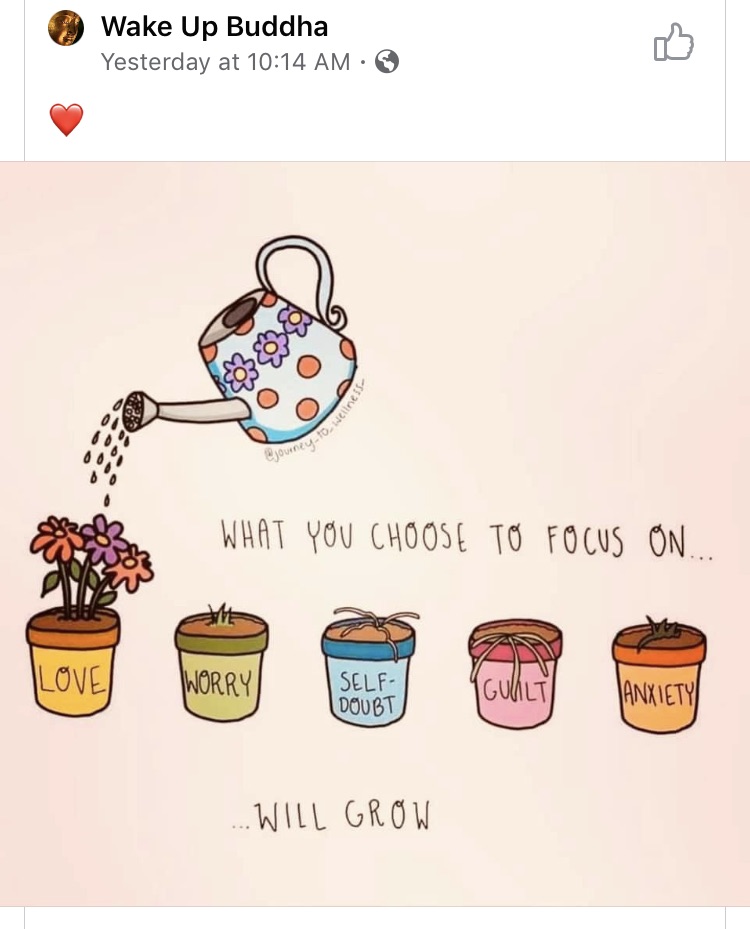
A cartoon watering can hovers over a row of cartoon flower pots labelled 'love,' 'worry,' 'self-doubt,' 'guilt,' and 'anxiety.' The 'love' pot is directly under the watering can and is being sprinkled with water droplets, and has three pink daisies growing out of it. The other four pots contain various kinds of wilty, dying leaves. The black all-caps handwritten font reads, "What you choose to focus on... will grow." The sharer is "Wake Up Buddha," and in small gray text underneath the watering can it says @journey.to.wellness.
A cartoon watering can hovers over a row of cartoon flower pots labelled ‘love,’ ‘worry,’ ‘self-doubt,’ ‘guilt,’ and ‘anxiety.’ The ‘love’ pot is directly under the watering can and is being sprinkled with water droplets, and has three pink daisies growing out of it. The other four pots contain various kinds of wilty, dying leaves. The black all-caps handwritten font reads, “What you choose to focus on… will grow.” The sharer is “Wake Up Buddha,” and in small gray text underneath the watering can it says @journey.to.wellness.

Buddhist-lite-inspired Christian types are surprisingly pro-choice when it comes to things like poverty, trauma, and mental health.

Anyway, unrelated, I have a few queries here.

I’m getting three takeaways out of this illustration:

1) we have way more “bad” emotions than “good” emotions available to choose from

2) focusing on “good” feelings means that the “bad” ones will eventually not be problems anymore

3) “bad” feelings are conscious choices

And so, my queries are thus:

1) Why is “love” the only positive plant this person owns?

I promise I get that this little cartoon is not meant to be either comprehensive or literal, but the analogy should still track within the framework in which the image exists, right?

And contrary to what The Beatles told your parents and/or grandparents, love is not all you need.

Wouldn’t things like faith, confidence, pride, and peace be good to water? But they don’t even have their own metaphorical pots.

And love isn’t exactly mutually exclusive with any of these things, anyway. They can and do functionally coexist.

I mean, “love” is also not necessarily mutually exclusive with “hate” (which doesn’t have a pot in this representation), but at least the visual of watering a “love” plant instead of a “hate” plant would be less ambiguous than watering only the “love” plant at the expense of the rest of the potted plants in the greenhouse of your mind.

2) Do we really want to murder our guilt through neglect?

I don’t see a shame pot anywhere in this picture, but that would probably be a healthier emotional-state-plant-metaphor to neglect.

The difference between “guilt” and “shame” is commonly understood, in the world of popular psychology, as the difference between thinking that “I did bad” and thinking that “I am bad.”

It has been argued that guilt can actually be a positive motivator.

Not that it’s good to seek or wallow in guilt, or to use guilt trips to manipulate other people into giving you your own way. But feeling regret about our own inappropriate behavior can actually help encourage us to make amends for it.

Broadly, guilt is more likely than shame to produce positive outcomes.

Unless what the guilt produces is shame.

In which case there will probably either be more behavior that induces that same guilt, or avoidance of things that induce that same guilt, either of which will probably result in more shame.

Talk about your vicious cycles.

So anyway, if you’ve chosen to dehydrate your guilt, I think that might just make you a sociopath*. 

I don’t see “worry” and “anxiety” as fully synonymous, but I do feel like their respective plants would bear similar fruit.

Or at least, they would, if it wasn’t your responsibility to choose to let them die. 

After splitting hairs about the difference between “guilt” and “shame,” I had to google the difference between “worry” and “anxiety.” A common thread seemed to be that “worry” is grounded in circumstances where it’s realistic to be concerned, whereas the experience of “anxiety” is more generalized and not necessarily centered around an accurate or likely outcome.

So the relationship seems fairly similar to that between “guilt” and “shame,” in that one is a realistic response capable of motivating a proactive behavior: i.e., apologizing for hurting someone’s feelings (guilt), or going back inside to make sure you turned off the oven because you can’t remember if you did (worry).

The other is maladaptive and/or hypersensitive and likely to lead to self-defeating or harmful behaviors: i.e., giving the cold shoulder to an already-hurting person after defensively insisting that your actions couldn’t possibly have caused harm because that wasn’t your intention (shame), or checking the oven multiple times before leaving for work but still fixating all day on the possibility that your house might burn down while you’re gone (anxiety).

I appreciate how those definitions allow space for a whole spectrum in between something that’s pretty reasonable and potentially even helpful, and something that’s pretty fucked up and potentially quite damaging.

Within that framework, the complementary side of the spectrum to “love” seems more like it might be something like “obsession” rather than “hate.”

And just to stay consistent with the plant metaphor, biodiversity is actually good for plants. Complex complementary relationships with other plants are broadly good for plants.

So maybe rather than scorching our brain soil with pesticides to try and eradicate “negative” metaphorical-feelings-plants, it’s worth at least sometimes tending to all the metaphorical-feelings-plants instead?

3) What does this really tell us about our underlying perception of human nature?

I think that this crabby bitch right here actually and ironically has a much more positive worldview than the creator of this cute cartoon.

Because I don’t think we’re full of shitty weeds that we have to kill off in order to nurture our more beautiful parts.

I think we come into our own consciousness full of a beautiful ecosystem of intricately interlocking parts that need one another in order to thrive.

Now, I don’t believe that whoever created this li’l doodle and paired it up with this text was going for anything deeper than “put your energy into the things that help rather than into the things that hurt,” which is really not such a terrible message to perpetuate.

But the fact that it’s represented as “let the bad plants inside of you die” rather than “you are full of plants – take care of them!” feels darker than that.

So I kinda low-key think that the symbolism this person innocently chose to use probably feels a lot more intuitive to folks who believe that human beings are inherently tainted (say, for example, by the stain of Original Sin), and that people have to work hard to choose to be good, and that lots of people simply choose to water that bunch of shitty weeds they came into the world with instead of dedicating themselves to watering the Love Daisies of the Lord.

I’m not saying that I think that’s what the macro creator was trying to convey.

But it does kinda seem like it lives underneath what they chose to focus on.

And let’s remember to keep looking underneath, in general.

*I am trying to be mindful about how I’m using clinical labels, but it’s my understanding that “sociopathy” is actually not a DSM-official diagnosis. “Anti-social personality disorder” would be the most approximate diagnostic label, I think. At any rate, sociopathy is a general enough concept for which “lack of ability to feel guilt” is literally often included in the definition, and there are certainly several robust and important potential tangents that could be developed here, but alas, they are in fact tangential in the context of this fairly fluffy post.

The Greatest Lessons

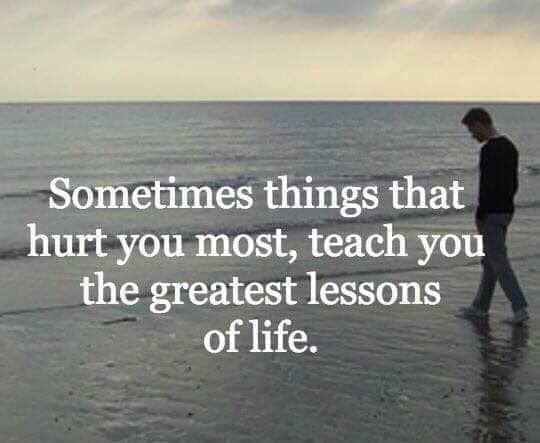
A photo of the shoreline of a large calm body of water, in a very muted grey color palette. On the right side of the image, a person in a long-sleeved shirt and long pants (indicating that the cool color scheme aligns with a chilly temperature) walks toward the tide with their head bowed. The white serif font reads, "Sometimes things that hurt you most, teach you the greatest lessons of life." I forgot to save the image with source attribution, but Power of Positivity or Positive Outlooks would be pretty safe guesses.
A photo of the shoreline of a large calm body of water, in a very muted grey color palette. On the right side of the image, a person in a long-sleeved shirt and long pants (indicating that the cool color scheme aligns with a chilly temperature) walks toward the tide with their head bowed. The white serif font reads, “Sometimes things that hurt you most, teach you the greatest lessons of life.” I forgot to save the image with source attribution, but Power of Positivity or Positive Outlooks would be pretty safe guesses.

This was originally posted in 2020, and wow has this edit evolved from what was kind of a throwaway post.

Mmm.

*nods*

Reeeeeeeally makes you think.

*gazes contemplatively at the horizon*

. . .

Wait.

What if…

What if we could learn super important things under pleasant conditions?

And what if it’s okay to be suspicious of people who would rather sugarcoat the thing that’s hurting you than just acknowledge that it sucks that you’ve been hurt?

In 2018, starting therapy for the first time kicked off a sort of slow-motion Jenga tower collapse for my mental health that has ultimately been pretty beneficial.

I was never going to address my underlying foundational issues if I never even acknowledged having built an elaborate infrastructure on top of them.

I went in because I was a li’l down and have since covered severe depression, anxiety, neurodivergence, trauma, complex trauma, masking, closeting, disorganized attachment, dissociation, dysregulation, grief, a whole lot of suppressed rage, and (crucially for this post) burnout.

Jenga!

But that’s not actually the focus of this post. At least, not directly.

I’m bringing up all that business to highlight how I actually failed to learn some important life lessons, for several decades, on account of the things that were hurting me the most.

Whereas the reasons that I am doing relatively well today can be attributed to the things that did not actually hurt me.

In terms of “things that hurt,” September 2024 was a doozy for me.

It definitely could have been much worse, but just as certainly, it was not awesome.

It’s already a rough month for me, emotionally, because it’s a sad anniversary.

Then, this September started out with my partner and me getting COVID.

I had to miss an opportunity I’d really been looking forward to, and eventually ended up not hosting any of several get-togethers I’d been planning for a while.

Disappointing, but not dire.

The month ended with the most destructive climate disaster in the recorded history of the United States of America hitting the entire region I’ve recently begun to call home.

Ultimately, on a personal level, I am doing okay.

The fact that I am doing (more or less) (relative to the situation) (as much as possible under the circumstances) okay cannot be attributed to either coronavirus or the fact that there was a hurricane in the mountains.

I will not give those bitches the credit of being my mentors.

My Hurricane Helene story is not at all dramatic. 

A part of me is oddly ashamed of this fact, as though my experience had to be more harrowing in order to be worth sharing.

But I’m pretty sure that’s also the part of me that didn’t think I merited therapy in 2018 because I was regularly going to the gym and doing my job.

Honestly, I slept through the worst of the storm. 

I woke up early with no power.

I texted with my coworkers to confirm that everyone was okay, and to accomplish what little we could without electricity and with inconsistent (ultimately nonexistent) internet access.

I optimistically and/or naively believed that I might miss as many as several hours of work that morning. 

After I stopped being able to send or receive texts, I lay down on my couch, pulled up a blanket, and just listened to the wind and rain. 

I’m originally from the Midwest. I’ve seen a storm or two.

What I could see from my window hardly looked like a full-blown run-for-cover situation. The trees were swaying and I assumed there would be some downed branches, but I wasn’t particularly worried about my own safety. 

My yard had a little temporary stream running through it, but it was just traveling through to a drainpipe, on down the hill, and even beyond the neighboring properties.

I took a little underwhelming video, told myself it would all be blown over by the afternoon, and dozed for several hours, confident that my phone would wake me with text notifications as soon as it was time to get back to work. 

I figured that I would still be able to keep my noon haircut appointment the next day. 

It was several days before I really understood what had even happened.

Prior to Helene, some friends had invited us along for a beach trip.

We hadn’t yet decided about our plans, but after spending a few surreal and disjointed days at home without power, internet, or water, we took them up on the offered room in their rental. 

The first time we stopped at a “normal” grocery store in South Carolina, I was overwhelmed by the abundant humming, availability, and functionality of everything around me.

I teared up and then accidentally made eye contact with a random employee, whose facial expression changed from nonchalance to what looked like active concern. I quickly looked away and walked toward the cheese island as though I had a purpose.

Looking back through the pictures from our “vacation,” my eyes consistently look tired and dull.

Still, for our early October wedding anniversary, I wanted to dress up and go somewhere nice to eat, like we always do, because I was eager to have something pleasant to look forward to.

I wore a shrug that I’d purchased in a building full of beautiful art, the insides of which have since been completely devastated by a flood of muddy water.

Getting ready to go out for seafood, I imagined the charming little garment being swept along the current with all the other art-turned-debris, and it seemed almost blasphemous to wear it because its existence felt unexpectedly sacred.  

I am able to work remotely, but some people at my workplace need to be on-site.

For those staff, the organization was able to acquire lots of port-a-potties for the weeks it is taking for the local water system to be repaired.

One of the johns apparently has a disco ball hanging in it. The subject has come up a few times in various meetings.

I alternate between finding this depressing and finding it encouraging, but in either case, I find it hilarious.

It is not practical for me to go there and get in the way of people with limited resources trying to accomplish important jobs, but I truly hope that someone captures some amazing photos of it, even (maybe especially?) if there’s visible poo.

Step aside, dumpster fire. If there is a more apt visual metaphor for life in America right now than a disco ball attempting to liven up up the atmosphere in an enclosed plastic emergency receptacle for human waste, I don’t know if I’m ready to see it.

As the scope of the impact of the storm became clearer, friends and relatives from other states reached out, asking how they could help.

My response would have seemed blunt to me ten years ago.

I keep repeating like a broken record that money is the most useful thing from afar, and that money should either go to organizations already doing good work in affected communities or to individuals/businesses that are less likely to receive significant support from better-resourced benefactors.

I understand how this response can feel disheartening for folks who do not have much money to spare.

I know that they would love to share their time and energy.

I know that they want to feel like they’ve done something substantive.

Of course the thing that people don’t have is more “useful” under capitalism than anything they are able to actually offer.

If I put every cent of every asset that I have in the world towards recovery efforts, it would hardly register on the scale of financial needs required for basic regional stability.

I understand that expressions like “sending good vibes” and “thoughts and prayers” are readily available constructs for people without access to a whole lot of practical means to help.

I love the humans behind these words, but I still resent hearing them.

I used to think it was cliché to say “there are no words” in response to terrible events, but I’ve grown to appreciate that framing when I encounter it in the wild.

It feels more like an acknowledgment than a dismissal.

It doesn’t land (at least for me) like a race to get to the other side of the thing there are no words for.

Even more than we tend to struggle, as a culture, with the idea that “there are no words,” it can be challenging to sit with the idea that “there is nothing to be done.”

When someone or something is gone forever, actions are pretty much always an acknowledgement of the reality of that agonizing divide between presence and absence.

Taking action requires at least some recognition that time will continue moving forward without that person or that place or that way of being, no matter how unfathomable that might seem.

Some actions are more focused on tending to the pain of the absence rather than on getting past it, but even those actions – engaging in ritual, offering food and care, creating memorials – serve as reminders that reality has shifted in a permanent and fundamental way. 

I actually don’t mean “there is nothing to be done” in a hopeless or despairing way, although I’m aware it can hit like that. 

I do not mean that there is nothing to do, moving forward. 

There is so much to do, and many people are doing it, to one end or another. 

What I mean is that there is nothing to be done about the fact that this thing has happened.

Nothing will take it away.

We are here. 

We are irrevocably in it.

After the initial frenzy of action required to just survive the event, we cannot bypass the reality of the impact that it has had by pretending to quickly get back to “normal” (a state that was already pretty tenuous).

Therapist Megan Devine has written that “there are some things that cannot be fixed – they can only be carried.”

She said that about individual grief, but it applies collectively. 

There is a lot of social pressure for us to bypass or erase the pain that accompanies the recognition of loss that manifests as a drive to find solutions, to move forward, to fix the gaps.

And to be clear, the efforts that people have already made to hold steady, offer support, clean up, and in many cases prepare for rebuilding are not what I am referring to when I say “social pressure to bypass.” That’s just survival in community, and it’s vitally important work.

Rather, there is something necessary and grounding about occupying the ineffable, uncomfortable space of acknowledgment in which there is nothing to be said and nothing to be done.

And this is what I think we are allowed and even encouraged to avoid.

I haven’t fully sat there yet, myself. I know that I still need to.

I have so much desire to fix things so that I won’t have to endure that space, but I also know that I will need to learn to carry all of this new brokenness forward.

I’ve just produced an awful lot of words on the subject of “not having words,” but that tracks for me. 

In part, I am writing to help process my own grief and anger, and this post is just a portion of that processing that I’m willing to polish up a bit and share with an (admittedly small) audience.

I am finding that I am slow to admit that this has been traumatic for me, on account of the fact that so many people have it so much worse.

I did not “deserve” to remain relatively unscathed because of any choices I made or because of any divine intervention.

My own wellbeing was just a semi-random combination of privilege and chance.

I have not lost any loved ones.

I have my health.

I have my home. 

I have my job.

I had a safe and comfortable place to go for part of the time that the basic utilities were out in my house.

How can I allow myself the luxury of tending to my own trauma when it’s so damn cushy?

But there is no benefit to this kind of competitive comparison.

The pervasive idea that we have to earn compassion from others through our own suffering (and that therefore when we have not suffered “enough,” according to whatever arbitrary metric we choose to enforce, we do not “deserve” certain forms of external support) is a myth that promotes division and props up exploitative systems.

And here’s where I’ll loop back around to that introductory bit about mental health and burnout.

I recently read in an article by social psychologist Devon Price that

“…clinical burnout sufferers typically push themselves through unpleasant circumstances and avoid asking for help. They’re also less likely to give up when placed under frustrating circumstances, instead throttling the gas in hopes that their problems can be fixed with extra effort. They become hyperactive, unable to rest or enjoy holidays, their bodies wired to treat work as the solution to every problem.”

Price also writes about the importance of rest in recuperation:

“clinical burnout sufferers may require a year or more of rest following treatment before they can feel better…”

Anecdotally, I can affirm that it took lots of emotional turmoil, monumental personal effort, and an incredible amount of external support to get my life situation into the kind of shape where I could access the kind of rest that actually felt restorative.

I did all that work while still burned out and before resting, and it’s definitely taken more than a year to start to feel the benefit of that rest.

For all the growth and healing I’ve experienced in the past three years, when I contemplate hypothetically attempting to step back into my previous lifestyle, I can feel myself shutting down physically, emotionally, and cognitively.

The vast majority of people who experience burnout do not ever get a hint of a fraction of the time and space they would need to legitimately “heal” from that kind of trauma.

Rather than using my own story as a means of indulgently downplaying my actual needs – “poor me, I don’t have it hard enough to justify taking up any space!” – I am sharing it here to stress how everyone will need more time to come to grips with and to recover from Helene than they probably feel like they are entitled or able to have, and certainly more than they will actually get.

Even someone with the relative security, privilege, protection, stability, and institutional support that I have will require far more time and rest than I am yet able to admit.

That’s not an appeal for sympathy.

I am both fine and not fine, which is actually fine.

Rather, it is a realistic description of the actual circumstances that thousands of Appalachians (and others in disaster-affected areas) will be facing in the coming months and years, long after the flurry of news coverage has died down on a national scale.

People will not be given, nor are they likely to give themselves, nearly enough time or space to process what has happened.

And that’s just for the folks who happened to fare reasonably well.

Everyone will be inclined to dismiss their own trauma, and there are a lot of systems in place to encourage that.

Of course, this has also been the case for most people in most catastrophes for most of the history of humanity.

(And there’s that effort to downplay by comparison, as though the fact that other terrible things have happened somehow makes this terrible thing matter or hurt less than it does.)

I have been hesitant to write about anything helpful that I actually have done, because for me to do that as an individual, it feels like humble-bragging at an exceptionally tacky time for an ego trip.

Then again, I feel like if I don’t acknowledge or document anything I’ve done, it looks like all I have done is think and type and be reasonably comfortable.

I really have done things to contribute to society and support other people, and I’m also well-situated in my day job to support some important work that needs to be done by people with better qualifications than me.

In an earlier draft of this post, I included a long list of things that are gone or severely damaged, but I moved that to a different piece of writing that may or may not end up on this blog.

This post is meant to convey that, in the process of creating proactive reframes to cope with horrible events, it’s important to avoid elevating the things that hurt over the things that help.

Any lessons that I have learned from pain have, in fact, been fairly shitty.

The “greatest lessons” have consistently come from the things that actively helped me heal (even when those lessons have come by apparently passive routes, like “taking more breaks,” or when they have been accompanied by their own unique kinds of discomfort).

That has been true for burnout, and it will be relevant for Helene recovery (both of which will be ongoing for the foreseeable future, for myself and for others).

And so instead of listing what hurts right now (which is easy enough to do), I’m including a list of things I’ve noticed that have felt healing.

Of course if I expanded this little list beyond my firsthand experience, to include beautiful and inspiring things that humans in this area have done over the past few weeks, it would be enormous and include much more dramatic examples.

But my own stories are small.

They aren’t exactly headline material.

They’re just unremarkable, achievable, invaluable little moments where acknowledgement, connection, and soothing could unfold in the first couple of days after the storm.

When the power was out for days, our next-door neighbors grilled a bunch of meat from their freezer and made up plates to share around the neighborhood.

Other neighbors offered the use of their gas range to make coffee.

Someone hailed me from their window to offer me shelf-stable food because they were heading out of town.

A pastor gave us a case of water bottles when we just happened to walk past his house.

Friends going out of town to stay with family offered to pick up any essentials we might need or want. 

A coworker gifted me with cash to use while power wasn’t working at most stores. 

Someone from a food truck offered us breakfast burritos in a Food Lion parking lot on a day that we had not properly planned to make sure that we would get lunch. Our initial reflexive response was to politely decline, but we reconsidered, and there was wisdom in accepting hot eggs from a stranger.

Because some of the things I’ve written above could easily be misconstrued, and because this is Pith Rant, I’ll be obnoxiously direct and repetitive in my conclusion here.

Yes, I did choose not to include a litany of terrible things in this post, and yes, I did instead choose to highlight a list of pleasant things.

No, I am not suggesting that simply focusing on the positives is a sufficient or helpful response to any kind of tragedy.

I am challenging the idea that pain and suffering are our “greatest” teachers, and I am challenging the ways in which that fear-driven mentality is actually often used to justify indifference towards the pain and suffering of others who “had to be taught lessons.”

The “greatest lessons” may be uncomfortable, but they don’t actually have to hurt.

We did not actually have to learn that climate change is dangerous through so much loss (not just from Helene, although that has been the focus of this post).

The current state of affairs was never inevitable.

Choices have been made by people in positions of power and influence.

No one specifically chose for a clusterfuck of circumstances to develop into a hurricane traveling along a mountain range in the aftermath of already massive flooding, but certain people have chosen to continue exacerbating the anthropogenic side of climate change with zero concern for the loss of quality of life and loss of actual life that always has and will continue to most directly affect other people.

Although I cannot personally speak for the individual values of anyone with enough money to be held directly accountable for the increased frequency and severity of “natural” disasters, I think that it is fair to assert that these kinds of folks are at some level motivated by fear of experiencing the kind of hurt, loss, and suffering that their choices have perpetuated.

The urge to defensively hoard resources comes from a scarcity mindset, among other things, and “scarcity mindset” is a lesson that we learn from trauma.

It’s really not the best lesson, but it’ll sure get ya through the night.

(That’s massively oversimplified, but I’m trying to wrap this up.)

In general, the lessons we learn from pain teach us to try to avoid more pain at all costs.

The lessons we learn from recovery are what allow us to grow alongside the presence and inevitability of pain.

Nothing has ever been fine, friends.

And yet here we are.

I’m not really following any best practices for enhancing the visibility or general appeal of this blog, because it takes a lot of time and energy to keep up with all that, and it does not always make sense in my own life to allocate time and energy to this particular hobby space.

For what it’s worth with my limited influence, here are a few organizations doing important work who will do good things with Hurricane recovery dollars for much longer than the few weeks immediately following the event:

How You Make Others Feel

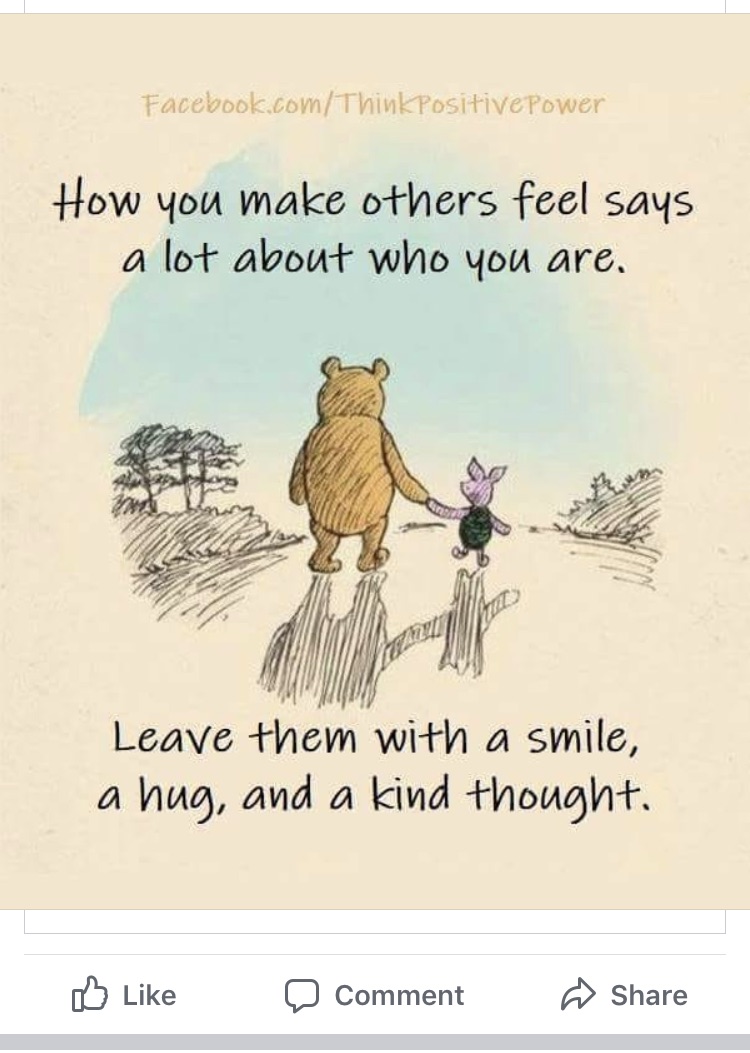
A colored pencil drawing of the characters Winnie the Pooh and Piglet holding hands and walking toward the horizon, from the old-school book representation rather than the Disney cartoon. The sans serif text overlaid on the image (the words of which may or may not have come from the source, but the way they're printed on the page was certainly added for the internet) says, "How you make others feel says a lot about who you are. Leave them with a smile, a hug, and a kind thought." The source is a Facebook group called ThinkPositivePower.
A colored pencil drawing of the characters Winnie the Pooh and Piglet holding hands and walking toward the horizon, from the old-school book representation rather than the Disney cartoon. The sans serif text overlaid on the image (the words of which may or may not have come from the source, but the way they’re printed on the page was certainly added for the internet) says, “How you make others feel says a lot about who you are. Leave them with a smile, a hug, and a kind thought.” The source is a Facebook group called ThinkPositivePower.

This is an update of a post that was originally published in April, 2020.

Not to quibble*, but I don’t think any of the things on that list are actually feelings.

They’re all actions.

Specifically, these are all actions, and not the impact of those actions.

I mean, I’m assuming that [leaving someone with] “a kind thought” means the act of saying words to convey your kind thought to a recipient rather than just thinking kind thoughts in your own mind after you’ve hugged and smiled at them, but idk if that was the intent.

In any case, Positive Power Pooh sez you are responsible for other people’s feelings.

However:

It bears repeating that you can’t make people feel a particular way about how you’ve acted towards them.

(Get it? BEARS repeating, because Pooh is a bear?…)

If your actions leave other people feeling warm and fuzzy and happy, it doesn’t necessarily mean that your actions were “good.” (See: “enabling.”)

If your actions leave other people feeling uncomfortable or challenged, it doesn’t necessarily mean that your actions were “bad.” (See: “boundaries.”)

You don’t need to take my word for it, but it’s really not the worst thing if you let go of the belief that you’re capable of making people feel the way you want them to feel by doing things at them that you wish they’d do for you.

The faux-stoicism of toxic masculinity merits a whole-ass analysis of its own, and I won’t derail this short post by going there, but I do want to be clear that I am not on the side of the folks who think that austere emotionally masturbatory Joker macros are super deep when I say this:

How other people feel in response to your actions (not your feelings) generally says a lot more about them than it does about you. And it’s their work to navigate their feelings in ways that are hopefully in alignment with their own values, goals, and emotional needs.

Maybe instead, just leave people with a clear impression of who you are and what you’re about, which may or may not include smiles and hugs (which are perfectly nice in plenty of contexts, but are not necessarily desirable across the board), and trust that their feelings about you are going to provide them with information that will inform their next steps, even if those steps are not the ones you’d prefer for them to take.

Sorry, Piglet. Time to learn about codependence.

*j/k, always be quibbling

What’s in My Cup?

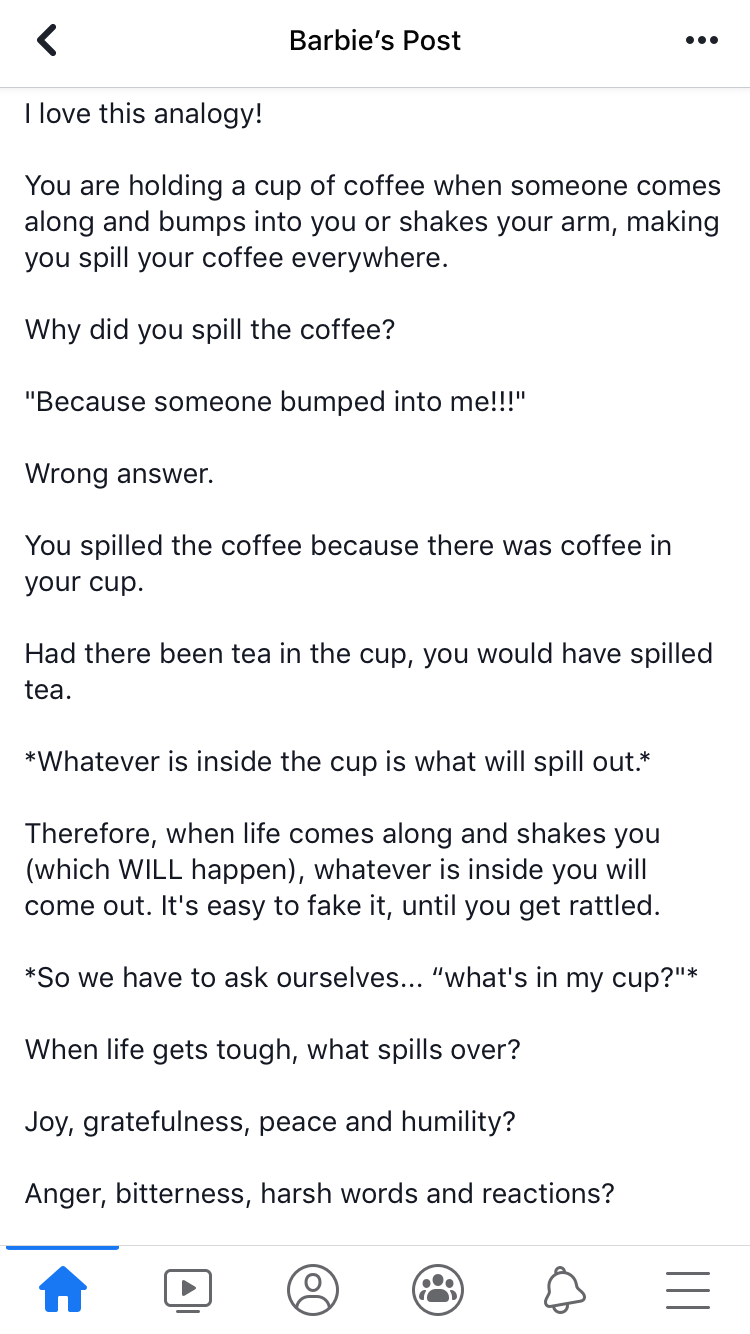
Screenshots of a short story along with an accompanying image, which is a point-of-view photo of a hand holding a coffee cup that is dramatically spilling its coffee. The coffee drinker appears to have been walking along a wooden pier. 

The story is transcribed in the post below.
Screenshots of a short story along with an accompanying image, which is a point-of-view photo of a hand holding a coffee cup that is dramatically spilling its coffee. The coffee drinker appears to have been walking along a wooden pier. 

The story is transcribed
in the post below.

For convenience, the full text from the image above is transcribed here, with a bit of additional commentary before the complete post.

“I love this analogy! 

You are holding a cup of coffee when someone comes along and bumps into you or shakes your arm, making you spill your coffee everywhere.

Why did you spill the coffee?


‘Because someone bumped into me!’


Wrong answer.


You spilled the coffee because there was coffee in your cup.


Had there been tea in the cup, you would have spilled tea.


*Whatever is inside the cup is what will spill out.*


Therefore, when life comes along and shakes you (which WILL happen), whatever is inside you will come out. It’s easy to fake it, until you get rattled. 


*So we have to ask ourselves… ‘what’s in my cup?’*

When life gets tough, what spills over?

Joy, gratefulness, peace and humility?

Anger, bitterness, harsh words and reactions?

Today let’s work towards filling our cups with gratitude, forgiveness, joy, words of affirmation; and kindness, gentleness and love for others.

(Shared from a friend whose cup is full of goodness and inspiration.)”

The post is from Facebook and is attributed to a Barbie, who I think is the original writer whose post went viral. I always remove identifiable information that connects the post back to people I know who just shared content they didn’t create.

This was really popular in my social media for awhile, even from folks who don’t typically share inspirational “Power of Positivity” type stuff.

At first, I wasn’t sure why I was so annoyed. 

Since I responded with irritation, though, it must mean that I am full of irritants?

Post hoc ergo propter hoc.

Or, maybe I was irritated because I don’t need any more shame surrounding the experience of having regular emotions. It’s actually a normal human thing to experience “negative” emotions and act in ways that reflect them.

Like, generally don’t be a dick to people on purpose, but that’s very different from letting someone know that their actions (bumping into you) had a consequence that created a problem for you (spilled coffee). 

The moral of the story seems like a shallow interpretation of various philosophies that require a great deal of self-awareness, commitment, and self-control.

Although to be fair, I’m sure that the majority of people sharing this on their Facebook pages are already boddisatvas, so do I really have a leg to stand on?

I’m just over here with my cup full of criticism, unable to experience joy or gratefulness.

I went ahead and paraphrased the underlying message that was getting to me:

if you’ve ever regretted your behavior in a stressful situation, that’s a reminder that you haven’t figured out how to empty your brain of the toxic feelings that make you bad at being a good person, and it means that you still have to learn how to create more consistently not-unpleasant feeling experiences inside your brain and heart.

The message here suggests that the bumper is irrelevant. The responsibility is all yours. You were carrying a cup full of coffee – what did you expect would happen?

It’s likely that most people would experience initial surprise and dismay after being unexpectedly bumped, regardless of the context, but the follow up to that bump as an expression of anger (“Weren’t you even looking?”) or empathy (“Are you okay?”) really does depend on the context and manner in which the bumping occurred.

Broadly, I do not advocate for yelling at people before attempting to practice compassionate curiosity.

I do, however, think that it’s unreasonable to talk about life as though simply “not feeling mad” is a perfectly viable option for anyone in any context experiencing incidental or serious inconveniences.

The fairly sound advice to manage your own reactions rather than manipulating those around you into behaving differently is often twisted to mean “other people’s actions don’t matter,” but of course they do.

I mean, does this coffee situation seem like a wholly innocent accident? Was the bumper clearly distracted and/or being careless? Was the bumper actively being an asshole?

The repetition of the message that “other people’s actions don’t matter” enables people to act like their own actions also don’t have consequences that negatively affect others.

That cup metaphor really isn’t cutting it for me, either.

In life, that “bump or shake” outlined in the anecdote is inevitable, and I agree with their choice to go all-caps on WILL.

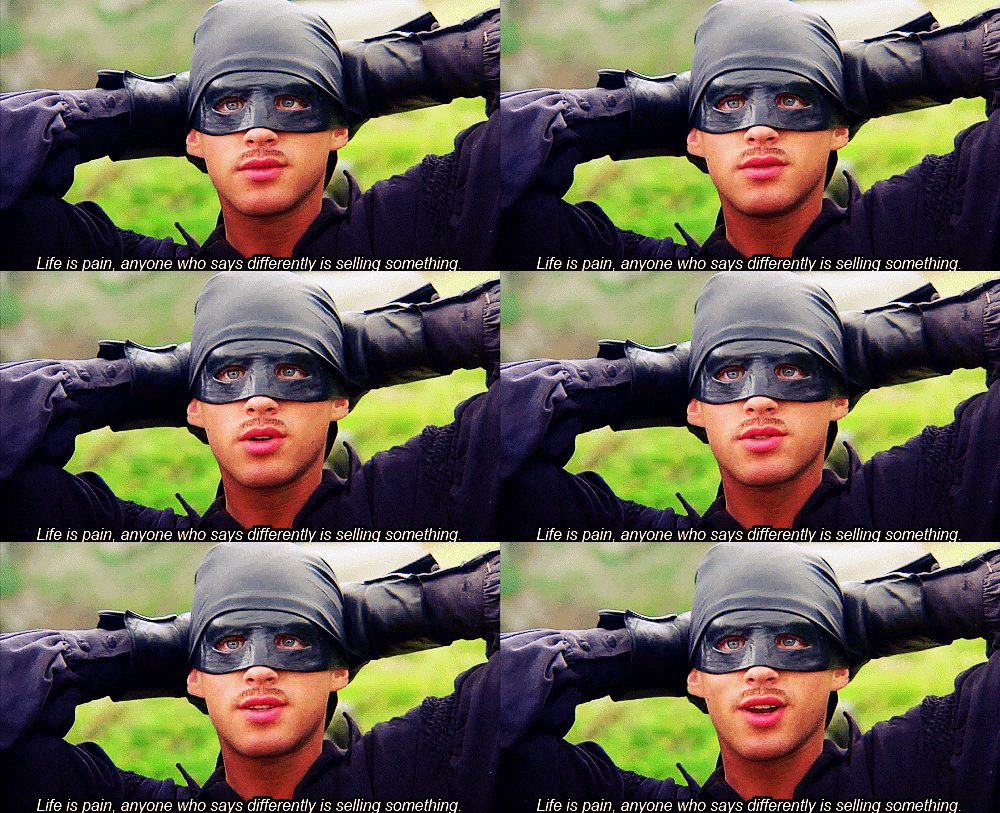
Shit happens. Life is pain.

Animated gif of actor Carey Elwes as The Man in Black in the film “The Princess Bride,” mouthing the words “Life is pain,” with a caption that reads, “Life is pain; anyone who says different is selling something.”

If we rigorously stick to the cup of coffee metaphor, what does a “good” outcome look like?

I understand that the metaphor is meant to end at “what’s in your cup” rather than “what happens after it’s out of your cup,” but I just think that’s a weak extension, since the advice that you allegedly learn something about what’s in your cup only becomes transparent once it’s spilled all over the place. 

I’d say that whether you’ve spilled coffee, tea, or a cocktail, the spilled version of a metaphorical liquid is always going to be less good than it was while it was in a container.

Commit to your metaphors, people.

What does a spill of “joy, gratefulness, peace and humility” even translate to in terms of beverages?

Is it water that turns into wine?

Is it water that happens to land on a fresh food stain and gently erase it without a Tide pen?

Is it coffee that miraculously guides itself into an exhausted person’s cup?

The cup in the story is a diversion from the aftermath of the spill, but it’s important to address cleanup at some point, eh?

Maybe the implication is that you should actually carry nothing in your cup, in order to avoid unfortunate spills.

Honestly, that feels like a legitimately Buddhist interpretation of the presented story, even though it’s also probably not the intended takeaway.

The moral of this little story is only focused on what’s inside the cup, to the willful exclusion of the realities that exist outside the cup, because if what’s inside is okay, then what happens outside should be okay, too.

And here we are again: consequences don’t matter as much as feelings.

You have either positive or negative feelings inside of you, and it can only be one kind or the other, and spilling them doesn’t matter if they’re the right kinds of feelings.

The spilled coffee of kindness apparently doesn’t stain as badly as the spilled coffee of resentment.

Real talk: let’s not discount the idea that we can reveal fundamental truths about who we are during trying times.

But that’s just another reason that this metaphor is so inaccurate.

This little story describes coffee that spills everywhere, and the chosen image shows a pretty dramatic splatter range.

The kinds of high-stakes scenarios that extend us beyond our habitus and force revelations about our true selves are not comparable to incidental elbow bumps that cause a few drops of coffee to spill harmlessly onto the boardwalk, or maybe make your hand temporarily sticky.

We’re talking about spraying a wide and erratic black coffee pattern across your new white shirt. We’re talking about soaked socks and squelchy coffee feet. We’re talking about staining the clothes of innocent bystanders who didn’t even have coffee in the first place. We’re talking about wasted money, which, even for a cheap cup of coffee, is much less negligible for some than for others. We’re talking about shorting out your phone.

All that isn’t just mildly inconvenient. It fucking sucks.

But the expository text suggests that little “oopsy!” bumps and big “aw, fuck” bumps are basically comparable in terms of your reactions.

My cup can often be found to be brimming with a steamy, frothy blend of anxiety, depressive rumination, self criticism, and sweet hazelnut-flavored indecision, precariously poured over a generous double shot of hot, black, simmering rage.

And yet under some of the most severely stressful circumstances in my life, I’ve found myself to be focused, calm, helpful, decisive, and efficient.

It would be nice to believe that this is because underneath the angry latte of my coping mechanisms, I’m actually filled with healthy, delicious virtue.

But I don’t think that’s true.

My anxiety exists to prepare me for intensity and chaos.

However, I don’t really live a lifestyle or have a career that actually calls for finely-honed disaster response skills. It’s exceptional when I have to engage with a real situation that resembles my brain’s preemptive catastrophizing.

I suspect that at least part of the reason I’m able to be proactive, calm, and magnanimous in dire circumstances is that I have already anticipated dire circumstances.

In other words, I think I’ve (sometimes) been able to comport myself gracefully in the midst of life’s major bumps because I’m full of anxiety, and not because I was so much more full of patience and compassion than the people futilely having panic attacks around me.

I’m not advocating for flipping the fuck out over minor inconveniences. But, sometimes when a minor inconvenience is your last straw for the day, it’s okay to just go ahead and let that anger out of your system in the way that it emerges, without worrying about whether you’re handling it responsibly or elegantly.

For most humans, emotions aren’t, like, discrete and distinct from the rest of our lived experience. There’s a huge difference between pretending to not have the feelings that you’re actually having, and accepting that your feelings might not reflect the best performance of your ideal best self at any given moment.

I don’t love ending with pithy advice, but it’s sort of hard to avoid in this self-help-adjacent genre, so here goes.

You’re not a joyless ingrate for getting mad and then sounding mad, and sweetness doesn’t exist without the co-existence of bitterness.

Your reactions to things are not wrong or bad. They just are.

Sure, take stock of your behavior. Are you consistently lashing out or punching down after minor setbacks? Then check yourself! Talk it out! Do a therapy thing, whatever that means for you! Try to discover the functional roots of at least some of your issues!

But maybe don’t aim to have an empty cup that never inconveniences anyone else. Go ahead and carry around stuff that you know has the potential to make a mess sometimes, and be prepared to actually deal with the aftermath instead of vaguely philosophizing about how you wouldn’t have made a mess if you’d been a better person in the first place.

Those are some harsh words, Barbie. But I assure you that they didn’t spill accidentally – I intentionally elected to pour them out this way.

Reach out and love

Content note: depression

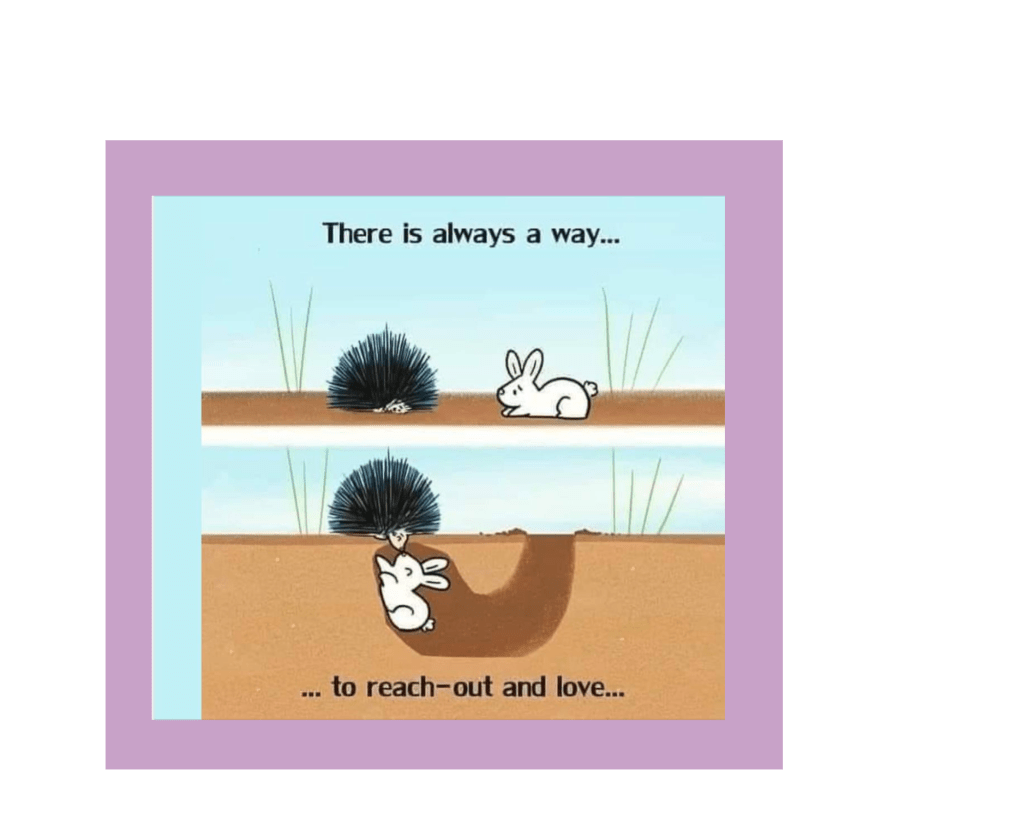
A two-panel cartoon. The top panel features a porcupine curled up into a spiky ball on the left, and a concerned-looking white bunny rabbit on the right. The bottom panel shows that the rabbit has dug a tunnel underground and is meeting the porcupine nose-to-nose, from underground, because the porcupine is still in a ball with its face pointing down. The black san-serif text says "There is always a way..." at the top and "...to reach out and love..." on the bottom." The original creation source was not included in the screenshot.
ID: A two-panel cartoon. The top panel features a porcupine curled up into a spiky ball on the left, and a concerned-looking white bunny rabbit on the right. The bottom panel shows that the rabbit has dug a tunnel underground and is meeting the porcupine nose-to-nose, from underground, because the porcupine is still in a ball with its face pointing down. The black san-serif text says “There is always a way…” at the top and “…to reach out and love…” on the bottom.” The original creation source was not included in the screenshot.

That stupid porcupine clearly doesn’t have any idea what it’s doing, so if it’s going to get its shit together, it clearly needs to be saved from itself by a concerned, selfless, innocent, absolutely informed, and incidentally adorable bystander.

We don’t need to see the comic where the bunny cries at the still-depressed porcupine for not appreciating all the hard work it took for the bunny to dig that intimate face hole, because that would just not be realistic.

So, that was my off-the-cuff “Hi, I’m a porcupine” response.

But seriously.

How the fuck is this comic supposed to be about a heroic bunny instead of a sad porcupine?

Why is it hard to imagine that the bunny could show love by recognizing and respecting the porcupine’s fairly unambiguously unavailable body language?

The message here is 100% about making the bunny feel better about believing that it’s helped the porcupine, regardless of the actual impact of its well-meaning actions or whether the porcupine really appreciated them.

Superficial armchair analysis of attachment styles is all the rage these days among self-help and pop-psych types (oh hai), but I’ll begrudgingly admit that it’s popular for a reason.

The utility of the Attachment Theory framework renders it susceptible to the reductive chicanery of confident Insta-experts who’ve probably only read the cliffs notes of the blurb of a review of any source material about Attachment Theory.

But then again, you’ll have that with all kinds of worthwhile concepts, like “practicing gratitude,” “setting boundaries,” and “self care.”

And, for as snooty as I sound in those preceding paragraphs, it’s not like I have the professional chops or an appropriately exhaustive literature review in my back pocket to Prove My Own Superiority.

I’m just an angry ex-academic who likes to poke holes in things.

At any rate, for readers who aren’t familiar with popular Attachment discourses, here’s a reductive informal introduction that will allow you to read this blog post without any additional research but is absolutely insufficient for anything else, so please don’t quote me to your therapist as though I’m an authoritative resource:

A fundamental idea behind attachment theory is that our early interactions with caretakers provide the basis for and inform the development of our relational patterns as we grow into independent humans.

Although there is some variation in the specific labels that are used, how they’re defined, and how to apply the concepts, Attachment Styles are commonly divided into four categories: Secure, Anxious, Avoidant, and Disorganized. (Not my preferred framing, but again, my goal is just to give a brief overview that will help contextualize my argument about this comic rather than to offer a comprehensive review of the entire history of the theory.)

A significant limitation to this simplified, popular framing is that a lot of advice basically boils down to, “There are three really bad attachment styles, and one good one that we should all aspire to achieve. Also, among those three bad ones, there’s one that’s extra super bad.” (Oh hai.)

A nuanced understanding of the theoretical framework demonstrates that these categories are not discrete, fixed, absolute, or mutually exclusive.

But if you Google the topic, you’ll come across all kinds of grids and checklists that frame them as though they are.

Unsurprisingly, I don’t find that helpful.

The idea that there are permanently, fundamentally “securely attached” people is just as problematic as the idea that there are “healthy” people who are fundamentally better at existing in human bodies than “unhealthy” people.

Even the Healthiest person will get sick or injured or experience the natural wear-and-tear of aging. They’ll be affected by their environment, and they’ll sometimes make choices that aren’t perfectly Healthy, after all.

(Then again, I also tend to lean into the reasoning that “we’re all going to die some time” when judgements of other people’s Unhealthy Choices arise, so, grain of salt if you want to think you’ll be able to out-health my conclusions.)

By the same token, a securely attached person doesn’t not experience anxiety – they just navigate it differently, in a way that doesn’t always overtly read as anxious.

(Then again, I tend to lean into the reasoning that “we’re all bound fuck up at some point” in discussions of Ideal Personal Development and Relational Success, so, grain of salt if you want to think you’ve already Done All the Work and Done It Right.)

No one person is absolutely only one way all the time, with all people and across all circumstances (and the existence of hypothetical exceptions here does not negate the generalizability of this statement).

And really, all three of the insecure categories are defined by varying degrees of and responses to anxiety.

Overtly Anxious-leaning types will broadly tend to cling to or seek connection when they sense a relational threat. Avoidant-leaning types will broadly tend to push back or seek isolation when they sense a relational threat. Disorganized types will fluctuate between these types of responses with more frequency and possibly more intensity than will their more predominantly Anxious or Avoidant counterparts.

I’ll be the first to admit that this cursory introduction is lacking, so please go and do your own research if you’re interested in learning more (with healthy skepticism toward anything that makes it seem easy), and if you do already have a lot of knowledge on the subject and think that you could do a better job than me, please go ahead and do so in a space that works for you, and also please don’t share it with me.

An “Anxious/Avoidant” dynamic is fairly common in human relationships, romantic and otherwise.

I’ll continue leaning into this contrastive binary for most of my examples, with the consistent reminder that things are rarely so simple in real life.

This dynamic is at the heart of a lot of buddy comedies, where one party is emotional and messy in order to serve as a foil for another party who is reserved, tidy, and standoffish.

The Stick-in-the-Mud learns to let go and loosen up a little, but The Hot Mess doesn’t necessarily have to learn to calm their tits or get their shit together.

It’s more often the case that the stand-offish half of the duo is both more unsympathetic and more dynamic. They need to grow and learn to accept their chaotic friend/love interest, but the chaotic friend/love interest already intrinsically understands how to be emotionally open, so what other lesson could they possibly have to learn? It’s not like we should expect them to start self-soothing or respecting people’s boundaries or anything.

It makes sense that Anxious-leaning folks are more likely to make a sympathetic appeal on their own behalf, by revealing and even potentially emphasizing their relative defenselessness in a given situation.

Whereas Avoidant-leaning folks are far more likely to (wait for it) avoid exposing their weak spots and anxieties.

In reality, of course, just as not everyone who has overtly Avoidant tendencies is a heartless asshole, not everyone who has overtly Anxious tendencies is an emotional parasite.

The important thing to remember here is that we’re all capable of being parasites, and we’re all capable of being assholes!

(See if you reflexively responded either “Not me!” or “Oh god I’m both and that’s terrible!” and then have fun unpacking that. You’re welcome.)

On account of what a strongly negative reaction I had to this cute little comic, let’s examine what that extremely Anxious “emotional parasite” pattern can look like.

There’s a subcategory of folks with Anxious relational patterns who really seem (to cantankerous ol’ me) to come alive at the prospect of others’ misfortune, like “Here’s my time to shine!”

And, here let’s pause to take another moment to recognize that I am a miserable asshole with a transparent bias against an All-Anxious-All-the-Time modality (in terms of relational attachment, because I actually experience a lot of anxiety a lot of the time – I just index it and respond to it in less overtly Anxious ways in terms of a lot of interpersonal behavior.)

Here, I’m describing a specific subcategory of a relational style that is especially perplexing for Avoidant-leaning Me to engage with, not making one negative generalization that’s meant to characterize anyone who is on the more Anxious-leaning part of the attachment spectrum.

I’ll label this subcategory “Grief-Seeking Missiles.”

(Other labels I considered include “Emotional Vampires,” “Emotional Vultures,” and although “Ambulance Chasers” is a label with more overtly financial and legal implications, I’d contend that it still fits the general pattern of crisis-driven opportunism.)

I was never a fan, but I grew especially wary of GSM types while I was grieving the loss of my father.

At times when I actually would have liked to let go and be at least a little bit emotional, I felt compelled to appear more stoic because I could practically physically feel it when I was approached with this apparently eager anticipation for the satisfaction of my tears.

One simple and not-uncharitable explanation for the GSM relational pattern is that these folks treat others the way they want to be treated, and they are in serious need of being offered a little basic empathy. They want someone to be willing to encourage them to cry.

They want people to be focused on them and tend to their needs and check on them frequently and buy them flowers and remind them how much they’re loved.

And is that really so terrible?

Of course not.

It’s okay, and it can even be healthy, to want these things.

I’ve framed it in a way that could read as “selfish” above, but of course it’s really not the worst thing for a person to want recognition, validation, and even celebration. (And if your response to that is something like “Actually, yes it is!” you’re welcome, again – there’s another shiny new nugget to share with your therapist.)

The disconnect occurs because they can’t admit that they want these things, because at some level they think that it would make them greedy and bad people.

So this GSM subcategory of Anxious-leaning Attachment can manifest as a combination of jealousy and projection. They want the kind of attention they’re pouring out onto others (who haven’t necessarily sought it), while hoping for others to automatically reciprocate while also at some level resenting that “at least the porcupine has someone looking out for it.”

That kind of resentment would likely come across as petty if they said it out loud, so it’s reframed by the GSM as a combination of self-aggrandizement and patronizing pity.

“The poor thing just isn’t taking care of themself! Thank goodness I have such an enormous capacity for love and care, or they’d just keep suffering endlessly in silence with no one to offer them the support they so clearly need!”

If this description hits a nerve and you find yourself feeling defensive, I’d like to invite you to sit with that feeling and maybe even interrogate it a little, if you have the capacity.

(And, to be clear, saying “if you have the capacity” really isn’t meant as shade or as a challenge, although it could be used in those ways. I just don’t know where your emotional reserves are at today, friend. I don’t know how much energy you have to allocate to self-reflection. This is knowledge that only you have, and I’m not demanding that you push yourself in your own mind to prove your worth to an internet stranger who will never perceive, or care to try to perceive, the full scope of your depth and complexity.)

The GSM sub-category seems to be manifest in folks who, themselves, have significant emotional needs that are not being met. This merits empathy, but not necessarily attention, depending on the circumstance.

To be clear, I don’t disagree with the basic message of the words in this comic.

Having someone reach out can be vitally important for someone who is struggling to ask for help.

And there are always ways to show love to those who aren’t actively requesting it.

It’s just that digging yourself into a hole to demonstrate the strength of your desire to be the one who’s reached out before confirming that the hole is actually helpful is more likely to overstep than it is to Save the Emotional Day.

Also to be clear, it’s understandable that the bunny feels anxious about the fact that the porcupine (presumably a friend) doesn’t appear to be doing well.

It’s extremely reasonable to feel worried about people who are having a hard time, and even more especially worried about people you love who are having a hard time.

It’s just that managing your own anxiety about someone else’s discomfort by striving to deliver it straight into the face of an individual who was otherwise just existing adjacent to your anxiety isn’t necessarily going to help you manage your own anxious feelings any better the next time someone else is struggling, and meanwhile, there’s a good chance that the first person is still uncomfortable (and possibly now also annoyed).

I won’t pretend to have The One Advice to Rule Them All, but I would like to contribute a sincere suggestion that I, at least, have found helpful:

When you’re trying to decide what kind of outreach seems appropriate in a given situation with a particular person, run a quick self-scan to see if you’re actually addressing a concern of yours or theirs.

It can be hard to do this if you’re accustomed to perceiving yourself as a helper who never thinks of themselves, but like most things, it gets easier with practice.

And some people are likely to want exactly the same things that you do! In those cases, you will have great instincts to follow.

I cannot speak for all Avoidant-leaning folks, but for me, being asked about my preferences (whether by text, email, phone call, physical letter, or whatever) is just as good as (and usually actively better than) having to navigate the imposition of an inconvenient performative gesture that is clearly more about whoever is making that gesture than it is about me and my actual needs.

So if you’re not confident in your judgment, it’s truly okay to ask.

Brené Brown’s public-facing work has brought “vulnerability” to the forefront of popular discourse about relationships, and as with Attachment Theory jargon, it’s been a mixed blessing for folks with an interest in applied psychology.

I’ve both appreciated and struggled with her work.

This cartoon is a helpful demonstration of one of my stickier concerns.

Really, no one in this image has opted to be vulnerable.

And as I do value the importance of vulnerability in creating honest, intimate relationships, I am frustrated by simplistic advice like this that actually discourages its practice.

We’ll start with the porcupine, who is clearly demonstrating more defensive posturing.

I don’t think it’s fair to read the porcupine’s position as actively shameful or weak. All we can really tell from the image is that porcupine appears to be sad, and that it’s chosen to be alone. It’s protecting that choice with its natural spikes and with its body language.

But that bunny isn’t actually being vulnerable, either.

It’s avoiding the known threat of prickliness by relying on its own strength as a digger.

That is, it’s protecting itself by approaching the porcupine from a position of relative personal safety.

And to be clear, I don’t think that it’s fair to suggest that there is any shame in the bunny’s choice to not thoughtlessly embrace a face-full of quills.

Frankly, I don’t perceive any shame or weakness in either characters’ choice to protect themselves.

However, if the first image – that of the Avoidant porcupine and the Anxious bunny – were to be followed up by next steps that actually illustrate vulnerability, then it seems like the porcupine would have to uncurl on its own, and then seek out the bunny.

And the bunny would just have to be fucking patient and stay available, even if the porcupine’s outreach might happen at a time when the bunny didn’t feel all the way up for performing its dramatic outreach thing.

Realistically, of course, most of the work we do in life happens between these extremes.

It makes sense for the porcupine to sometimes meet the bunny halfway by offering some limited availability.

It makes sense for the bunny to follow up with the porcupine even after seeing that it initially appears to be closed off, with the recognition that it might not actually succeed at getting in when it wants to.

Relationships constantly call for active negotiation and situational adaptation.

If the basis for the relationship is pretty much always one party pulling away with the other party pretty much always reaching out, that’s more likely to generate fragile tension than comfortable balance.

And then again, there’s value in accepting our partners (romantic, friendly, professional, and otherwise) just the way that they are.

As an Avoidant-leaning person, I can confirm that there is a lot more “accept and respect Anxious people’s anxiety” propaganda out there than there is “accept and respect Avoidant people’s distance” propaganda.

(This is at least in part because more overtly Anxious types are often more open to requesting and even potentially demanding acceptance, while more overtly Avoidant types are often more likely to just shut down the possibility that they should have to ask for acceptance in the first place.)

Story time!

I have adopted a number of pet rats over the course of my adult life.

Recently, my partner had a couple from our current brood perching on his shoulders, and I was talking to him with several feet of space between us.

I noticed one of the girls kind of wiggling her butt, not unlike a cat about to pounce on prey. In fact, rats also do this when they are preparing to leap forward. I noted the movement, but my brain just said, “There’s no way she can jump as far as my shoulder. She’ll give up when she realizes that,” and I dismissed the thought.

I started to turn to walk away at just about the same time that she chose to go for it, and tried to jump from his shoulder to mine.

Naturally, I was startled by the sudden movement, and turned my body towards my partner and this unexpected furry projectile. It was a pretty long distance for her to make anyway, but had I not moved, she probably would have succeeded.

As it was, my face ended up in the position my shoulder had occupied a moment before, and all four of her sharp little feet landed between my upper lip and my chin.

Needless to say, this was not the solid landing she’d been aiming for, and she sort of rebounded off of my chin and I was able to catch her before she fell all the way to the floor.

After the initial shock wore off, we started laughing, but then my partner was like, “Oh god, you should go take care of your face.”

It looked a lot worse than it really was. The scratches were shallow, and they fully healed within a few days. But in the immediate aftermath, when I had four bloody lines dominating the lower half of my face, it looked pretty intense (and honestly, also pretty bad-ass).

There are ways that this little incident doesn’t quite work within a vulnerability framework, because it was just surprising bad timing. It’s not like I chose to bravely offer up my face as an alternative to a more dangerous landing site or something.

Everyone involved was just startled and awkward.

But isn’t that more representative of how a lot of real-life vulnerability unfolds, rather than through dramatic moments and heroic, self-sacrificing gestures?

I wasn’t prepared to protect myself because I didn’t expect to be hurt, and she wasn’t prepared to be aware of my boundaries because she didn’t expect me to be vulnerable in the first place. She wanted a familiar landing place, and I just expected to not have a rat on my shoulder.

I’ve accepted that I have pets (as do many pet owners) who are capable of scratching my face, biting my fingers, and generally causing me a reasonable amount of inconvenience and physical pain.

The fact is that I didn’t really mind what happened to my face, and frankly, I’m glad that she landed on me instead of the floor. Rats are quite resilient, and she probably would have been fine, but it still would have been a long, hard fall.

I’m a really jumpy person, though. I could have just as easily reflexively knocked her out of the air.

Again, I’m not trying to take a ton of credit for making a conscious choice not to hit her out of shock, but then again, I know that I have also tensed up and (mildly) lashed out at plenty of people for doing far less physically threatening things around me.

So what about these situations where we have every reason to expect to be safe, and we get hurt anyway, and we don’t use that as an excuse to armor up the next time we find ourselves back in a similar environment?

So I guess the moral of this story is that it seems like the push and pull of distance and pursuit isn’t a great place to look for practical examples of genuinely vulnerable practices.

Understanding that different kinds of behaviors are apt to feel vulnerable to different people is an important part of interpreting the significance of someone else’s actions.

Bunnies certainly aren’t all bad, but neither are they all great.

And porcupines aren’t necessarily awesome, but they’re also not necessarily terrible.

Context matters.

There really are always ways to reach out and to love folks, but it doesn’t always look particularly cute at a glance, and that’s more than okay.

And leaving your prickly porcupine friends the fuck alone when they choose to show you their prickles might just be the most loving thing you can do for them.

But you could really just ask them what they prefer.

Happiness is an Inside Job

Content note: ableism, transphobia, racism

A light pink rectangle with a blue and teal decorative floral pattern at the top. The black sanserif text says, 'Happiness is an inside job. Don't assign anyone else that much power over your life. -Mandy Hale' This actual quote is attributed to Mandy Hale. At the bottom of the rectangle, there is a blue-gray bar with a white image and white text. The image is on the left side, and is a logo that appears to be an abstract rendering of leaves with a circle around them, with possibly a sun or moon - a smaller circle floating above the leaves. The text says "Barbara Vercruysse" in a script font, and then "Start the Life of Your Dreams" in a sanserif font beneath.
[A light pink rectangle with a blue and teal decorative floral pattern at the top. The black sanserif text says, ‘Happiness is an inside job. Don’t assign anyone else that much power over your life. -Mandy Hale’ This actual quote is attributed to Mandy Hale. At the bottom of the rectangle, there is a blue-gray bar with a white image and white text. The image is on the left side, and is a logo that appears to be an abstract rendering of leaves with a circle around them, with possibly a sun or moon – a smaller circle floating above the leaves. The text says “Barbara Vercruysse” in a script font, and then “Start the Life of Your Dreams” in a sanserif font beneath.]

I Googled Barbara so you don’t have to.

On one hand, this woman is just doing her thing and living her life. In this economy, we all gotta get paid.

On the other hand, she’s a rich white lady who pays her bills by reassuring other rich white people that everyone is personally, individually responsible for their own ability to thrive.

I kind of wanted to see how much she charges for her services so I clicked on “shop,” thinking that it would include information about how to book a session or begin a wellness journey.

It’s an actual shop with products, though.

Her shop is called “Barbara’s Empire of Love.”

Among other things, you can purchase inspiration cards, a daily success journal, and a gratitude journal.

They’re branded with pink flowers – cherry blossoms, I think.

I eventually did find information about courses you can enroll in, and unsurprisingly, they aren’t cheap.

There’s a baseline assumption on her site that it’s not going to put you out significantly to spend $50 (which was approximately the conversion rate from British pounds to US dollars at the time of my Googling) on a spiral-bound planner.

I think she means well enough, in her Barbara way.

But as a generally well-meaning white cis woman myself, I recognize that “meaning well” doesn’t cut the mustard when it comes to actions that inflict real harm.

And I contend that there is real harm in profiting off of the message that one can choose to not be affected by adverse social conditions.

As is always the case here at Pith Rant, there are more generous interpretations available for the messages I feature.

I also recognize that the actual quote is attributed to Mandy Hale, and was only shared by Barbara Vercruyess, but Babs or a fan of Babs decided to add her stamp of approval to that message and promote it via social media, so we’ll leave Mandy alone for now.

I acknowledge that many viewers of this message and my response may think, “But I think it just means…” or “What about…”

And I have heard those concerns.

And I’m sticking to my angry metaphorical guns.

To wit:

By acknowledging that systemic racism is a thing, one isn’t “assigning power” to racists.

By recognizing the existence of heteronormativity, one isn’t “assigning power” to the straights, and observing that pervasive transphobia permits medical malpractice to flourish is not the same as “assigning power” to transphobic doctors.

It sucks, but these people already have power.

Racists who write laws that get passed are exerting the power they have to propagate white supremacist beliefs.

Homophobes who refuse to issue marriage licenses to same sex couples are reaching for any power they can grasp to prevent Big Gay Weddings.

Doctors who ignore their patients’ pronouns are reminding their trans or nonbinary patients that powerful institutions can choose to deny them security, protection, and/or comfort.

Messages like the one on display here absolutely prop up logic like:

“It’s their own fault if they let people treat them that way; I sure wouldn’t let someone control my life like that.”

The thing is:

Assholes.

Have.

Power.

Assholes tend to seek power.

They treat people shittily, and it has shitty consequences.

This does not mean that it’s therefore fine for directly affected folks (and also less directly affected folks – hi there, you’re not exempt!) to give up and acquiesce to injustice simply because hierarchical power structures create exploitable situations.

It means that it’s ridiculous to suggest that an individual can simply think and feel their way beyond a deeply entrenched social pattern that informs the actions of people who are, in fact, relatively powerful.

I do not mean that it is impossible for marginalized folx to be happy or successful as long as powerful assholes exist.

I mean that it’s okay to recognize that broad institutional support and the absence of naked aggression makes happiness easier and more sustainable.

So, yes.

Happiness is an inside job.

Because people who have power and influence over important structures that shape your life don’t necessarily care about your happiness.

They will not seek it for you. They will not lift a finger on behalf of your actual happiness. So in that sense, it is indeed up to you to find and protect your own happiness.

The part of the quote that I am fighting against is the idea that you’ve let someone take advantage of your circumstances in order to disenfranchise you.

If you’re rich enough to be preoccupied by the perfection of your own pursuit of happiness, you probably are exerting power over someone else’s life in a way that limits their access to the kind of stability that enables happiness.

I had a separate post going for this second macro, but it’s helpful to see them together:

A vertical rectangle with a solid green background on the top half and a solid purple background on the bottom half. The top half, with the green background, has an oval shape that appears to have abstract green, purple, and yellow are in it. The serif text changes color - the first two words are magenta, and appear on the green half, and the rest of the words are white and appear over the purple background. The message says, "My happy thoughts help create my healthy body." I apparently didn't save any information about the creator or sharer of this one, but as you'll see in the blog post below, there are many instantiations available.
[A vertical rectangle with a solid green background on the top half and a solid purple background on the bottom half. The top half, with the green background, has an oval shape that appears to have abstract green, purple, and yellow are in it. The serif text changes color – the first two words are magenta, and appear on the green half, and the rest of the words are white and appear over the purple background. The message says, “My happy thoughts help create my healthy body.” I apparently didn’t save any information about the creator or sharer of this one, but as you’ll see in the blog post below, there are many instantiations available.]

As though people with “unhealthy” bodies just didn’t remember to think the right way about their genetic and physiological makeup.

As though people with “unhealthy” bodies have allowed someone else to exert sufficient control over their minds that they are not able to make appropriately “healthy” thought choices of their own.

As though the existence of people who have, in fact, elected to put their own health and well-being on the back burner in order to pay bills for their families or prioritize the needs of others – thereby “choosing” an “unhealthy” body – somehow cancels out the existence or the rights of people who tried to take good care of their bodies but “failed.”

As though people can’t experience depression and mental illness at the same time as physical health.

I recognize that I’m using lots of black-and-white, either/or scenarios, but that’s really what this breed of macro encourages.

This second macro tries to soften its message with the word “help,” but I guarantee the other version exists (“My happy thoughts create my healthy body”).

(I actually Googled the sentence without the word “help,” but it still turned up variations of this exact same quote with different backgrounds. Elsewhere, the actual quote is attributed to one Louise Hay.)

To conclude:

Happiness is sure nice, and it’s good to feel happy sometimes.

There are lots of other feelings to experience, though. Sometimes happiness isn’t as valuable as discomfort, even if nice white ladies want you to embrace your personal happiness as an ultimate and all-consuming goal.

People who seek power over your life often suck (including those who want the power to remind you how happy you should be all the time), so it’s up to you to remember to connect with your own happiness.

No one has the right to take your happiness away from you, but shitty people are going to keep trying, regardless of whether or not you’ve given permission. That is, you are not “giving” or “assigning” anyone power by acknowledging that your needs are at odds with their wants.

Sometimes it’s best to ignore these people, but sometimes you can’t ignore the consequences of their behaviors (I write from America in the year 2022 where the right to abortion is no longer protected by the constitution).

Your mental and physical health can absolutely inform and interact with one another in a range of fascinating ways, but thoughts aren’t magic.

Health (in whatever way it manifests according to a vast array of different bodies and circumstances) promotes the ability to have and maintain happy thoughts.

That is, we will do better to increase “happiness” in the world by providing more and better health care for all people in all circumstances than we will by telling people that they are obligated to be happy in order to properly preserve their health.

Your own personal happiness may be an inside job, but don’t let smug assholes convince you that what’s on the outside doesn’t count.

Special Bonus Rant: How Are You Complicit? (Academic Edition)

Trigger Warning: reference to sexual assault

This isn’t the blog post where I’ll unpack issues with social media and blurry boundaries between personal and professional self-presentation, but I will lead with an acknowledgement that this type of blurry boundary is a complicated thing.

(Says the relatively anonymous blogger.)

I debated about whether to link to the original article here, and I’ve decided to go ahead. It’s not like the source text is too inappropriate to share, and it’s also not like this humdrum little blog is going to generate a lot of foot traffic for the original author one way or the other. 

So, here is the link to the article, titled “How Are You Complicit?”

I am avoiding naming the author directly in my post, which I think should prevent this blog from turning up in searches for his name, as I’m not interested in having any impact on this stranger’s actual career (as though I even could if I wanted to, but weird things happen on the internet) or frankly bothering him at all.

He’s just a guy promoting his own dude thoughts in the interest of his public and professional image, which is a pretty reasonable thing for an aspiring academic to do.

I’m clarifying all this because I haven’t read this person’s actual academic scholarship, and I don’t know them personally, so my response here is purely based on this one article they wrote that I happened to encounter one day when I was already feeling cross, and little bit of casual poking around on their website after I started writing out an impromptu rant that turned into this blog post. They’re not, like, my nemesis or something.

Although I do not imagine that the article’s author would enjoy this post if they came across it, they’re still not my real target. My issue is with larger patterns and beliefs that happen to show up particularly clearly in this one little post of theirs.

So, just a reminder that everything on this blog should be taken with a grain of salt, and that the lives people live independently of my opinion have value and worth that my crabbiness cannot and should not be presumed to diminish.

The author interrogates the question “How are you complicit in creating the conditions in your lives that you say you don’t want?”

It’s a short article, but it does reference one outside source (i.e., the author of a book), in the context of a second source (i.e., said book author was interviewed for a podcast). 

Both that author and that interviewer appear to be square-jawed white men with lots of money. 

Incidentally, the author of the source article, the one who references only rich white men in developing his argument about how we are complicit in our own oppression, is an apparently white man who is an assistant professor. 

Assistant professors can hardly be presumed to be wealthy people (though exceptions exist), especially in the humanities and social sciences, but it remains an extremely privileged (even when tenuous) position in the buyer’s market of academia. 

This fellow talks a lot about leadership. He studies the learning practices of individuals in online and hybrid spaces. 

Just, you know, all the individuals.

Who would benefit from the perspective of rich white cis male CEOs.

Anyway, I’m particularly interested in the framing of the last clause of the question: “that you say you don’t want.”

I’m curious as to how this framing might differ from the standard fallacies of victim blaming:

“You say you didn’t want to have sex that night, but why did you wear sexy clothes and then keep talking to that guy who wouldn’t leave you alone?”

“You say you don’t think workers should be exploited, but why do you still work at a job where you yourself are exploited?”

Ah, the convenient threat of hypocrisy. 

To be clear, I’m not really so obtuse that I don’t understand how individuals can perpetuate patterns that keep them stuck in unfortunate situations.

Of course self-sabotage is a thing. 

Of course unhealthy and unproductive patterns can create frustrating personal ruts. 

But this is hardly an either/or situation, and the context of academia is a particularly inappropriate setting in which to imply that it might be. 

How hard is to begin from the premise that while most people can, indeed, take steps to do better (whatever that looks like relative to their own situations), it’s also true that their ability to successfully and consistently do better may still be hindered by social and logistical factors outside their control? 

Is that too much to ask?

The author continues:

“…we are taking part in the things that make us mad, sad, or unhappy.” 

Buddy, that’s just called living

(Italics for emphasis! Like a confident leader would do!)

Now, I recognize that this article is vague because it’s meant to be a quick little think piece, and not like a well-researched manifesto. The author is personally keeping up with the creation of daily content, so of course each individual post isn’t going to be exhaustively reviewed and revised and polished.

Still, if I were to be asked for feedback on that article as a draft, I’d ask for some specific examples to support at least a few of the sweeping generalizations.

Specific examples like

“What are some problems you’ve invited into your life?”

“Under what circumstances have you been unwilling or unable to make a personal change?”

“What are some times when you accepted responsibility for your actions and for your circumstances?”

“What are some examples of times you placed responsibility on others?”

“What kinds of responsibilities belong to individuals?”

“Who dreads and fears doing what kinds of self-work?”

“What critical framework shapes the critical lens you recommend being applied to everyone’s lives and belief systems?”

“What are some examples of times you’ve been wrong or silly or stupid?”

“How are you defining both ‘responsibility’ and ‘complicity’?”

“What are some examples of burdens that have been passed on to you by others’ fear of failure?”

Just a few, off the top of my head. 

Then again, maybe me asking all these pointed questions just stems from my unwillingness to accept my own complicity in letting confident assholes make the kinds of important decisions that they’ve positioned themselves to make within a system that elevates that particular brand of uncritical confidence. 

“Doing self-work is often dreaded and feared,” the author opines.  

Look, I don’t have access to stats on this, so anecdotal evidence is the best I can do on the short notice I’m giving myself for this post. 

But anecdotally, I’d say that the vast majority of folx who have committed to doing the dreaded self-work of shouldering the responsibilities borne of unfavorable conditions are not the same folx who are writing books, intended to coach future business executives, with subtitles like Leadership and the Art of Growing Up.

I’m aware that it may seem redundant to complain about such a personal take on “self work.” How else can you work on your own self unless it’s personally? 

But “we don’t want to put a critical lens to our lives and belief systems,” he says dismissively about all humans. 

As though you – uniquely, individually, personally, solely you – are responsible for those belief systems that it may be time for you to challenge. 

And as though your conclusions about how you’ve chosen to bear the burden of your own responsibilities will be fundamentally better than how you were before you did that self-work, all because you knew from your own knowledge and feelings (but mostly knowledge, because feelings are just excuses for weakness) what substantive improvement would entail. 

As though the critical lens of your own opinion is sufficiently and appropriately tuned to meet or even exceed its own limitations. 

This author seems like someone who should know the difference between “criticism” as “the expression of disapproval of someone or something based on perceived faults or mistakes” and “Criticism” as “the analysis and judgement of the merits and faults of the object of study.” 

This post really seems to be leaning into the former definition. 

Which is really a less useful tool than the latter. 

And yet that former form of criticism is likely to be a familiar tool for people who’ve had inferiority imposed on them by external forces for their entire lives: they talk the wrong way. They look the wrong way. They feel feelings the wrong way. They get horny the wrong way. They handle money the wrong way. They manage their time the wrong way.

The kind of wealthy faux-Buddhist advice being peddled as wisdom here seems so fucking novel to white dudes who have never believed that something fundamental about their way of existing in the world is a problem to be fixed.

(Do I have to do the #notallwhitedudes business? If you’re a white dude reading this and you know you’re doing real work to resist patriarchy, you probably don’t need that reassurance in order to understand my point, eh?)

It can be true that there are some practical nuggets of actual wisdom hiding among the gross oversimplifications in an article like this one

AND

it can be true that this article is an uncritically selfish framing of what self-work means and why it matters. 

The weight-lifting analogy at the end reveals something the author probably didn’t intend.

It’s like doing self-work is about getting ideologically swole. Like the point of self-work is self-gain (and kind of getting off on the pain of getting there). Not “pass[ing] the burden on to others” is about your ability to shoulder that burden yourself, rather than about sparing others from the burden of your own irresponsibility. 

Then again, I suppose I could just be defensive that my own blog represents my complicity in sustaining toxic positivity, since I say I don’t like it but then I keep collecting tokens and taking the time to rage write about them. 

But honestly? In the end, I still choose to blame Jerry Colonna, author of Leadership and the Art of Growing Up, for every single one of my personal problems.

Walk Yourself Out of Your Bad Mood

Content note: reference to depression and suicide

 The background image is a muted-filtered dark photo of a winding asphalt walking path through a foggy wooded area. The white serif font reads, "WALK yourself out of your bad mood. Studies show that even a 10-minute walk immediately BOOSTS brain chemistry to increase happiness." -Karen Salmansohn." The macro itself is attributed to "Inspiring Quotes."
 The background image is a muted-filtered dark photo of a winding asphalt walking path through a foggy wooded area. The white serif font reads, “WALK yourself out of your bad mood. Studies show that even a 10-minute walk immediately BOOSTS brain chemistry to increase happiness.” -Karen Salmansohn.” The macro itself is attributed to “Inspiring Quotes.”

Fuck therapy, sad sacks.

Y’all obviously aren’t walking enough.

Who needs drugs to manage their mental illnesses when plain old movin’ your body parts will do the trick?

And just to preemptively address the anger I’ve created in the pro-walking community I’m imagining in my mind: please recognize your big feelings and take a few moments to sit with them. (That’s the kind of advice I’ve always resented, because it actually is pretty helpful.)

I’m not writing this up because I don’t think walks can ever be good for anyone’s mental state.

I advocate for movement when feeling funky, in all senses of the word.

And it’s true that the reasons walking can help boost your mood actually do boil down to “brain chemistry,” since chemical reactions in your brain literally inform your experience of every single thing.

But people don’t die by suicide because they’re a little grumpy about missing their evening constitutional.

Consider the possibility, if you have not experienced depression (or if you have experienced it in the past but feel better now) and you agree with the sentiments expressed in this macro, that you might be projecting your own experience onto people who are dealing with something very different from your own experience.

It may not have been the intent of the original author to go into full medication-shaming mode, but those sentiments are rampant in Positive Thinking Land.

I Googled the person that the quote is attributed to, and I had to go take a 10-minute walk to be able to review her site more charitably.

I will just say this: I came across another pithy quote macro on her site in which she introduces her proposal for coining the new word “blesson.”

This is indeed an unfortunate blending of “blessing” and “lesson,” which she defines as “what happens when you see the blessing in the lesson that your challenge taught you.”

I’m clearly not her target demographic. It looks like she probably offers some decent resources that aren’t entirely shame-based or victim-blamey, but her whole ethos is buried under so much toxic positivity that I can’t take the good parts seriously.

To each their own. If she has helped you in the past or seems helpful now, I do genuinely want for you to be helped. Please try to hold onto at least a kernel of the healthy skepticism I advocate for, but do what you need to do for you.

Onward.

We all know that Big Pharma sucks, right?

A lot of kinds of research-based evidence for medicating all kinds of mental health diagnoses are actually sketchy as hell.

And at the same time, casting aspersions on the people who have chosen to rely on available medication to make their lives feel more manageable is not going to cause the collapse of the legal drug industry any time soon.

I get the impression that arguments like this one – the old “have you tried NATURE?” schtick – are not about resistance to capitalist neoliberal oligarchy etc. as much as they are about preserving the moral high ground that appears to exist within the WellnessTM branch of that same oligarchy.

Psychiatry’s public-facing emphasis on brain chemistry is to some degree an effort to legitimize the medical reality of potentially life-threatening diagnoses like depression.

I mean, there’s also dirty money and institutional pressure to pathologize humans’ normal reactions to abnormally difficult situations.

You win some, you lose some.

Even if that emphasis on brain chemistry began as a tool of the pharmaceutical industry, it’s still true that the concept has helped muster more widespread support for letting people seek help for their problems.

Concepts like “brain chemistry” have also become part of public discourse because there are a lot of non-depressed people who prefer to assume that depressed people are just bad at existing.

It’s still important to legitimize the fact that depressed people need support, even if drug companies will inevitably exploit that information .

The point here is that there are lots of internet folx (who, it turns out, also exist in the non-internet world) who don’t believe in using medication to balance out “brain chemicals” because they are super sure that there are better ways to get un-depressed than “professional medical treatment.” 

I mean, sure.

Sweeping structural and systemic change that prioritizes individual security, access to health care, and an overall sense of purpose are really nice ways to combat depression.

Exercise, vegetables, water, and sleep are also pretty good.

It just also happens that the same WellnessTM Industry that promotes disproportionate numbers of images of fit, serene women doing yoga and drinking from recycled glass bottles is simultaneously invested in keeping the public focus off of neurotransmitters and back on “lifestyle choices.”

The connection between those narratives is very clearly highlighted in this macro.

Neither the Big Pharma or WellnessTM frameworks truly offers some kind of objectively moral high ground to shame other people for struggling to cope with this nonsense world. We’re all competing with way too many systems that are rigged against us to be able to push back against all of them and fully thrive in equal measure (as tempting as that sounds).

Anyway, in a conclusion that’s allowed me to bury the lede, let it not remain un-noted that neither a bad mood nor severe depression are just about “not enough happiness.”

More Than They Need to Know

An edited image of a person's silhouette in profile. They have long hair, and are facing towards the right half of the photo. In the background, a distant horizon line is visible. The entire image is grayscale, although with a bluish tinge to the gray. It's difficult for me to determine if the horizon line has low mountains or plateaus. Most of the background (behind the silhouette) is an overcast sky. The silhouette has had an image of puffy clouds and a crescent moon superimposed over / inside of the head, creating a surreal effect. The white sanserif font reads, "Stop telling people more than they need to know." It says "unknown" after the quote, and the whole image has been marked with the "Power of Positivity" logo at the bottom.
An edited image of a person’s silhouette in profile. They have long hair, and are facing towards the right half of the photo. In the background, a distant horizon line is visible. The entire image is grayscale, although with a bluish tinge to the gray. It’s difficult for me to determine if the horizon line has low mountains or plateaus. Most of the background (behind the silhouette) is an overcast sky. The silhouette has had an image of puffy clouds and a crescent moon superimposed over / inside of the head, creating a surreal effect. The white sanserif font reads, “Stop telling people more than they need to know.” It says “unknown” after the quote, and the whole image has been marked with the “Power of Positivity” logo at the bottom.

The relatively interesting image here (compared to, like, a generic sunset) makes the relationship between that image and the quote feel ambiguous.

It is good that their head is full of puffy clouds and moonbeams, or is it a cause for concern?

Is the silhouetted head giving the advice to other people? 

Like, is their head full of all kinds of beautiful things already, and they’re just like, “Please stop talking to me”?

Or is the silhouette the one to whom the advice is being given?

Like maybe they are under the impression that all the stuff they have in mind is super important, but they are actually just an insecure over-sharer? 

Variants of this piece of advice are pretty common, so I understand why the quote is simply credited as “Unknown.”

And Power of Positivity as an organization doesn’t seem too bothered about copyright or intellectual property, in general. 

When it comes to images, it seems like the basic attribution policy is to assume that the creator is “unknown.” 

Probably it’s because most of the photography is already in the public domain, but there are still usually other design choices being made. 

This image here, for instance, required at least two photos, and someone to put them together. 

At that point, why make the effort to specifically establish that the words originated from an unknown sources?

Your heart’s in the right place, anonymous macro creator, if a bit misguided. 

I get that you want to make it clear that you are not the brilliant philosopher-poet behind these words of pithy wisdom. 

You just felt compelled to design a space for those words to exist in a social media-friendly medium. 

But where do your design choices begin and end, my friend? 

Did you Photoshop the moon onto this person’s silhouette? 

Is it your own silhouette, or an image of a stranger from Shutterstock? 

Do you truly know, person who humbly acknowledged distance from the creation of these words, the face of the human whose profile graces your macro?

I have the sense that when the author of a quote is left unspecified in a context like this, it’s kind of implied that they’re either unknowable or so well-known that it there words can be expected to be common knowledge. (Including those situations where a quote is commonly but erroneously attributed to a very famous person.)

The advice in these anonymous words is actually potentially useful, but ironically it lacks sufficient context to account for how and why it’s useful.

A reductive but useful example of finding The Right Amount of Information is the IT classic: “Have you tried turning it off and back on again?”

Opening your conversation with tech support with a play-by-play of everything you’ve tried already, just to prove to them (but actually to yourself) that you’re not totally incompetent, is an example of “telling people more than they need to know.”

I imagine that most of us have put our foot in our mouths at some point, insisting something like “Of course it’s plugged in!” only to have to later sheepishly admit that it wasn’t.

But the person whose job it is to troubleshoot whatever is preventing you from getting your work done has no obligation to care about your pride or sense of self-worth. (Not that IT folx are uncaring, of course. Just that it would be unreasonable for them to invest that much emotional energy into each case.)

Then again, you often have to be able to explain your problem before they can begin to help you fix it.

My own anxiety often compels me to explain exactly how I arrived at any given decision to anyone I’m communicating with, so “telling people more than they need to know” is kind of my default. 

I’m aware that my process is not always efficient.

It’s been suggested by very patient and wise people at various points in my life that it’s okay if I provide just a little information to get started, and remember that whoever I’m talking to has the freedom to decide whether they have any follow-up questions about what they need or want to know. 

Apparently, it’s not a failure on my part for not having already predicted and preventatively addressed every conceivable reaction to my very normal bids for reasonable responses.  

Weird. 

I’m still getting used to it.

On the other hand, one of the reasons I developed a tendency to overcompensate with Too Much Information was how often people bring up things that I’ve already considered, dismissed, and/or attempted.

I know I’m always on about this whole “context matters” business, but…

stop framing situationally-specific advice as generalizable imperatives that are more likely to reinforce shame and silence among mentally ill and/or traumatized and/or marginalized folx who’ve developed those targeted behaviors as coping mechanisms than they are to promote understanding, mindfulness, or useful self-reflection.