
This is an update of a post that was originally published in April, 2020.

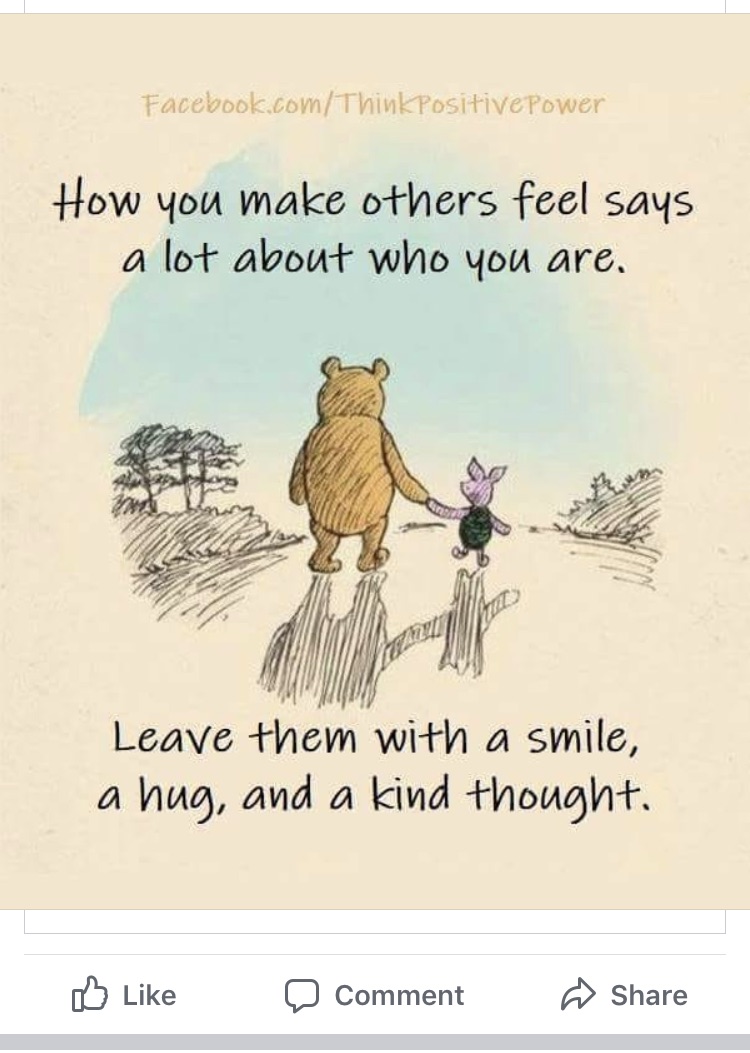
Not to quibble*, but I don’t think any of the things on that list are actually feelings.
They’re all actions.
Specifically, these are all actions, and not the impact of those actions.
I mean, I’m assuming that [leaving someone with] “a kind thought” means the act of saying words to convey your kind thought to a recipient rather than just thinking kind thoughts in your own mind after you’ve hugged and smiled at them, but idk if that was the intent.
In any case, Positive Power Pooh sez you are responsible for other people’s feelings.
However:
It bears repeating that you can’t make people feel a particular way about how you’ve acted towards them.
(Get it? BEARS repeating, because Pooh is a bear?…)
If your actions leave other people feeling warm and fuzzy and happy, it doesn’t necessarily mean that your actions were “good.” (See: “enabling.”)
If your actions leave other people feeling uncomfortable or challenged, it doesn’t necessarily mean that your actions were “bad.” (See: “boundaries.”)
You don’t need to take my word for it, but it’s really not the worst thing if you let go of the belief that you’re capable of making people feel the way you want them to feel by doing things at them that you wish they’d do for you.
The faux-stoicism of toxic masculinity merits a whole-ass analysis of its own, and I won’t derail this short post by going there, but I do want to be clear that I am not on the side of the folks who think that austere emotionally masturbatory Joker macros are super deep when I say this:
How other people feel in response to your actions (not your feelings) generally says a lot more about them than it does about you. And it’s their work to navigate their feelings in ways that are hopefully in alignment with their own values, goals, and emotional needs.
Maybe instead, just leave people with a clear impression of who you are and what you’re about, which may or may not include smiles and hugs (which are perfectly nice in plenty of contexts, but are not necessarily desirable across the board), and trust that their feelings about you are going to provide them with information that will inform their next steps, even if those steps are not the ones you’d prefer for them to take.
Sorry, Piglet. Time to learn about codependence.
*j/k, always be quibbling
 Pith Rant
You must be logged in to post a comment.