Buddhist-lite-inspired Christian types are surprisingly pro-choice when it comes to things like poverty, trauma, and mental health.
Anyway, unrelated, I have a few queries here.
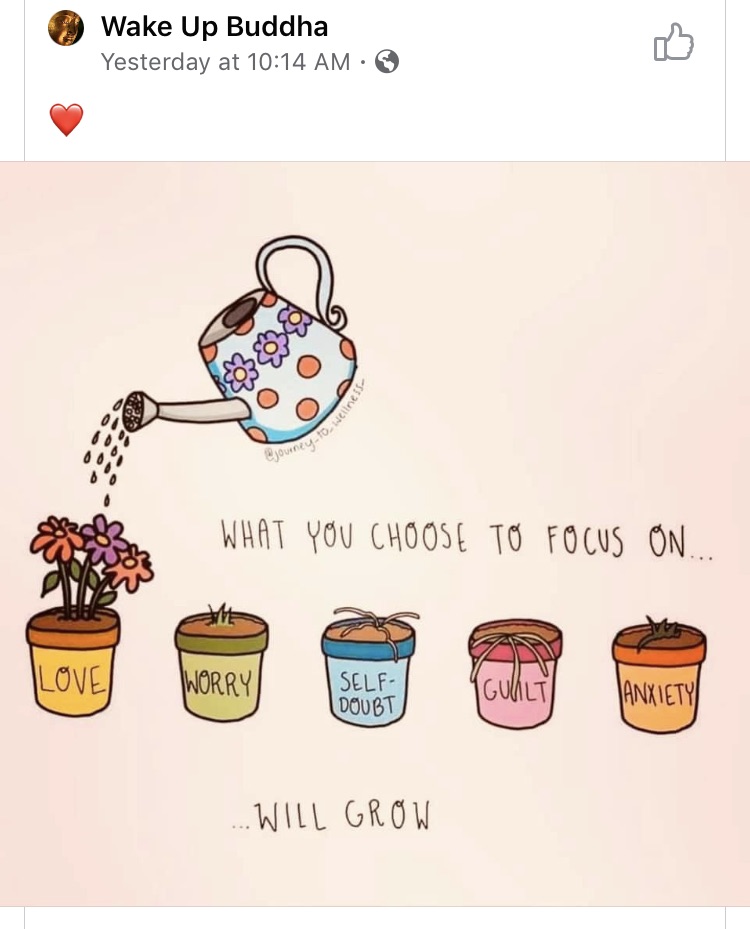
I’m getting three takeaways out of this illustration:
1) we have way more “bad” emotions than “good” emotions available to choose from
2) focusing on “good” feelings means that the “bad” ones will eventually not be problems anymore
3) “bad” feelings are conscious choices
And so, my queries are thus:
1) Why is “love” the only positive plant this person owns?
I promise I get that this little cartoon is not meant to be either comprehensive or literal, but the analogy should still track within the framework in which the image exists, right?
And contrary to what The Beatles told your parents and/or grandparents, love is not all you need.
Wouldn’t things like faith, confidence, pride, and peace be good to water? But they don’t even have their own metaphorical pots.
And love isn’t exactly mutually exclusive with any of these things, anyway. They can and do functionally coexist.
I mean, “love” is also not necessarily mutually exclusive with “hate” (which doesn’t have a pot in this representation), but at least the visual of watering a “love” plant instead of a “hate” plant would be less ambiguous than watering only the “love” plant at the expense of the rest of the potted plants in the greenhouse of your mind.
2) Do we really want to murder our guilt through neglect?
I don’t see a shame pot anywhere in this picture, but that would probably be a healthier emotional-state-plant-metaphor to neglect.
The difference between “guilt” and “shame” is commonly understood, in the world of popular psychology, as the difference between thinking that “I did bad” and thinking that “I am bad.”
It has been argued that guilt can actually be a positive motivator.
Not that it’s good to seek or wallow in guilt, or to use guilt trips to manipulate other people into giving you your own way. But feeling regret about our own inappropriate behavior can actually help encourage us to make amends for it.
Broadly, guilt is more likely than shame to produce positive outcomes.
Unless what the guilt produces is shame.
In which case there will probably either be more behavior that induces that same guilt, or avoidance of things that induce that same guilt, either of which will probably result in more shame.
Talk about your vicious cycles.
So anyway, if you’ve chosen to dehydrate your guilt, I think that might just make you a sociopath*.
I don’t see “worry” and “anxiety” as fully synonymous, but I do feel like their respective plants would bear similar fruit.
Or at least, they would, if it wasn’t your responsibility to choose to let them die.
After splitting hairs about the difference between “guilt” and “shame,” I had to google the difference between “worry” and “anxiety.” A common thread seemed to be that “worry” is grounded in circumstances where it’s realistic to be concerned, whereas the experience of “anxiety” is more generalized and not necessarily centered around an accurate or likely outcome.
So the relationship seems fairly similar to that between “guilt” and “shame,” in that one is a realistic response capable of motivating a proactive behavior: i.e., apologizing for hurting someone’s feelings (guilt), or going back inside to make sure you turned off the oven because you can’t remember if you did (worry).
The other is maladaptive and/or hypersensitive and likely to lead to self-defeating or harmful behaviors: i.e., giving the cold shoulder to an already-hurting person after defensively insisting that your actions couldn’t possibly have caused harm because that wasn’t your intention (shame), or checking the oven multiple times before leaving for work but still fixating all day on the possibility that your house might burn down while you’re gone (anxiety).
I appreciate how those definitions allow space for a whole spectrum in between something that’s pretty reasonable and potentially even helpful, and something that’s pretty fucked up and potentially quite damaging.
Within that framework, the complementary side of the spectrum to “love” seems more like it might be something like “obsession” rather than “hate.”
And just to stay consistent with the plant metaphor, biodiversity is actually good for plants. Complex complementary relationships with other plants are broadly good for plants.
So maybe rather than scorching our brain soil with pesticides to try and eradicate “negative” metaphorical-feelings-plants, it’s worth at least sometimes tending to all the metaphorical-feelings-plants instead?
3) What does this really tell us about our underlying perception of human nature?
I think that this crabby bitch right here actually and ironically has a much more positive worldview than the creator of this cute cartoon.
Because I don’t think we’re full of shitty weeds that we have to kill off in order to nurture our more beautiful parts.
I think we come into our own consciousness full of a beautiful ecosystem of intricately interlocking parts that need one another in order to thrive.
Now, I don’t believe that whoever created this li’l doodle and paired it up with this text was going for anything deeper than “put your energy into the things that help rather than into the things that hurt,” which is really not such a terrible message to perpetuate.
But the fact that it’s represented as “let the bad plants inside of you die” rather than “you are full of plants – take care of them!” feels darker than that.
So I kinda low-key think that the symbolism this person innocently chose to use probably feels a lot more intuitive to folks who believe that human beings are inherently tainted (say, for example, by the stain of Original Sin), and that people have to work hard to choose to be good, and that lots of people simply choose to water that bunch of shitty weeds they came into the world with instead of dedicating themselves to watering the Love Daisies of the Lord.
I’m not saying that I think that’s what the macro creator was trying to convey.
But it does kinda seem like it lives underneath what they chose to focus on.
And let’s remember to keep looking underneath, in general.
*I am trying to be mindful about how I’m using clinical labels, but it’s my understanding that “sociopathy” is actually not a DSM-official diagnosis. “Anti-social personality disorder” would be the most approximate diagnostic label, I think. At any rate, sociopathy is a general enough concept for which “lack of ability to feel guilt” is literally often included in the definition, and there are certainly several robust and important potential tangents that could be developed here, but alas, they are in fact tangential in the context of this fairly fluffy post.
 Pith Rant