The Greatest Lessons

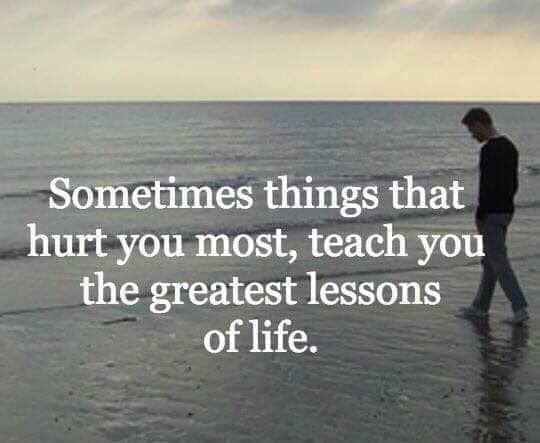
A photo of the shoreline of a large calm body of water, in a very muted grey color palette. On the right side of the image, a person in a long-sleeved shirt and long pants (indicating that the cool color scheme aligns with a chilly temperature) walks toward the tide with their head bowed. The white serif font reads, "Sometimes things that hurt you most, teach you the greatest lessons of life." I forgot to save the image with source attribution, but Power of Positivity or Positive Outlooks would be pretty safe guesses.
A photo of the shoreline of a large calm body of water, in a very muted grey color palette. On the right side of the image, a person in a long-sleeved shirt and long pants (indicating that the cool color scheme aligns with a chilly temperature) walks toward the tide with their head bowed. The white serif font reads, “Sometimes things that hurt you most, teach you the greatest lessons of life.” I forgot to save the image with source attribution, but Power of Positivity or Positive Outlooks would be pretty safe guesses.

This was originally posted in 2020, and wow has this edit evolved from what was kind of a throwaway post.

Mmm.

*nods*

Reeeeeeeally makes you think.

*gazes contemplatively at the horizon*

. . .

Wait.

What if…

What if we could learn super important things under pleasant conditions?

And what if it’s okay to be suspicious of people who would rather sugarcoat the thing that’s hurting you than just acknowledge that it sucks that you’ve been hurt?
In 2018, starting therapy for the first time kicked off a sort of slow-motion Jenga tower collapse for my mental health that has ultimately been pretty beneficial.

I was never going to address my underlying foundational issues if I never even acknowledged having built an elaborate infrastructure on top of them.

I went in because I was a li’l down and have since covered severe depression, anxiety, neurodivergence, trauma, complex trauma, masking, closeting, disorganized attachment, dissociation, dysregulation, grief, a whole lot of suppressed rage, and (crucially for this post) burnout.

Jenga!

But that’s not actually the focus of this post. At least, not directly.

I’m bringing up all that business to highlight how I actually failed to learn some important life lessons, for several decades, on account of the things that were hurting me the most.

Whereas the reasons that I am doing relatively well today can be attributed to the things that did not actually hurt me.

In terms of “things that hurt,” September 2024 was a doozy for me.

It definitely could have been much worse, but just as certainly, it was not awesome.

It’s already a rough month for me, emotionally, because it’s a sad anniversary.

Then, this September started out with my partner and me getting COVID.

I had to miss an opportunity I’d really been looking forward to, and eventually ended up not hosting any of several get-togethers I’d been planning for a while.

Disappointing, but not dire.

The month ended with the most destructive climate disaster in the recorded history of the United States of America hitting the entire region I’ve recently begun to call home.

Ultimately, on a personal level, I am doing okay.

The fact that I am doing (more or less) (relative to the situation) (as much as possible under the circumstances) okay cannot be attributed to either coronavirus or the fact that there was a hurricane in the mountains.

I will not give those bitches the credit of being my mentors.

My Hurricane Helene story is not at all dramatic. 

A part of me is oddly ashamed of this fact, as though my experience had to be more harrowing in order to be worth sharing.

But I’m pretty sure that’s also the part of me that didn’t think I merited therapy in 2018 because I was regularly going to the gym and doing my job.

Honestly, I slept through the worst of the storm. 

I woke up early with no power.

I texted with my coworkers to confirm that everyone was okay, and to accomplish what little we could without electricity and with inconsistent (ultimately nonexistent) internet access.

I optimistically and/or naively believed that I might miss as many as several hours of work that morning. 

After I stopped being able to send or receive texts, I lay down on my couch, pulled up a blanket, and just listened to the wind and rain. 

I’m originally from the Midwest. I’ve seen a storm or two.

What I could see from my window hardly looked like a full-blown run-for-cover situation. The trees were swaying and I assumed there would be some downed branches, but I wasn’t particularly worried about my own safety. 

My yard had a little temporary stream running through it, but it was just traveling through to a drainpipe, on down the hill, and even beyond the neighboring properties.

I took a little underwhelming video, told myself it would all be blown over by the afternoon, and dozed for several hours, confident that my phone would wake me with text notifications as soon as it was time to get back to work. 

I figured that I would still be able to keep my noon haircut appointment the next day. 

It was several days before I really understood what had even happened.

Prior to Helene, some friends had invited us along for a beach trip.

We hadn’t yet decided about our plans, but after spending a few surreal and disjointed days at home without power, internet, or water, we took them up on the offered room in their rental. 

The first time we stopped at a “normal” grocery store in South Carolina, I was overwhelmed by the abundant humming, availability, and functionality of everything around me.

I teared up and then accidentally made eye contact with a random employee, whose facial expression changed from nonchalance to what looked like active concern. I quickly looked away and walked toward the cheese island as though I had a purpose.

Looking back through the pictures from our “vacation,” my eyes consistently look tired and dull.

Still, for our early October wedding anniversary, I wanted to dress up and go somewhere nice to eat, like we always do, because I was eager to have something pleasant to look forward to.

I wore a shrug that I’d purchased in a building full of beautiful art, the insides of which have since been completely devastated by a flood of muddy water.

Getting ready to go out for seafood, I imagined the charming little garment being swept along the current with all the other art-turned-debris, and it seemed almost blasphemous to wear it because its existence felt unexpectedly sacred.  

I am able to work remotely, but some people at my workplace need to be on-site.

For those staff, the organization was able to acquire lots of port-a-potties for the weeks it is taking for the local water system to be repaired.

One of the johns apparently has a disco ball hanging in it. The subject has come up a few times in various meetings.

I alternate between finding this depressing and finding it encouraging, but in either case, I find it hilarious.

It is not practical for me to go there and get in the way of people with limited resources trying to accomplish important jobs, but I truly hope that someone captures some amazing photos of it, even (maybe especially?) if there’s visible poo.

Step aside, dumpster fire. If there is a more apt visual metaphor for life in America right now than a disco ball attempting to liven up up the atmosphere in an enclosed plastic emergency receptacle for human waste, I don’t know if I’m ready to see it.

As the scope of the impact of the storm became clearer, friends and relatives from other states reached out, asking how they could help.

My response would have seemed blunt to me ten years ago.

I keep repeating like a broken record that money is the most useful thing from afar, and that money should either go to organizations already doing good work in affected communities or to individuals/businesses that are less likely to receive significant support from better-resourced benefactors.

I understand how this response can feel disheartening for folks who do not have much money to spare.

I know that they would love to share their time and energy.

I know that they want to feel like they’ve done something substantive.

Of course the thing that people don’t have is more “useful” under capitalism than anything they are able to actually offer.

If I put every cent of every asset that I have in the world towards recovery efforts, it would hardly register on the scale of financial needs required for basic regional stability.

I understand that expressions like “sending good vibes” and “thoughts and prayers” are readily available constructs for people without access to a whole lot of practical means to help.

I love the humans behind these words, but I still resent hearing them.

I used to think it was cliché to say “there are no words” in response to terrible events, but I’ve grown to appreciate that framing when I encounter it in the wild.

It feels more like an acknowledgment than a dismissal.

It doesn’t land (at least for me) like a race to get to the other side of the thing there are no words for.

Even more than we tend to struggle, as a culture, with the idea that “there are no words,” it can be challenging to sit with the idea that “there is nothing to be done.”

When someone or something is gone forever, actions are pretty much always an acknowledgement of the reality of that agonizing divide between presence and absence.

Taking action requires at least some recognition that time will continue moving forward without that person or that place or that way of being, no matter how unfathomable that might seem.

Some actions are more focused on tending to the pain of the absence rather than on getting past it, but even those actions – engaging in ritual, offering food and care, creating memorials – serve as reminders that reality has shifted in a permanent and fundamental way. 

I actually don’t mean “there is nothing to be done” in a hopeless or despairing way, although I’m aware it can hit like that. 

I do not mean that there is nothing to do, moving forward. 

There is so much to do, and many people are doing it, to one end or another. 

What I mean is that there is nothing to be done about the fact that this thing has happened.

Nothing will take it away.

We are here. 

We are irrevocably in it.

After the initial frenzy of action required to just survive the event, we cannot bypass the reality of the impact that it has had by pretending to quickly get back to “normal” (a state that was already pretty tenuous).

Therapist Megan Devine has written that “there are some things that cannot be fixed – they can only be carried.”

She said that about individual grief, but it applies collectively. 

There is a lot of social pressure for us to bypass or erase the pain that accompanies the recognition of loss that manifests as a drive to find solutions, to move forward, to fix the gaps.

And to be clear, the efforts that people have already made to hold steady, offer support, clean up, and in many cases prepare for rebuilding are not what I am referring to when I say “social pressure to bypass.” That’s just survival in community, and it’s vitally important work.

Rather, there is something necessary and grounding about occupying the ineffable, uncomfortable space of acknowledgment in which there is nothing to be said and nothing to be done.

And this is what I think we are allowed and even encouraged to avoid.

I haven’t fully sat there yet, myself. I know that I still need to.

I have so much desire to fix things so that I won’t have to endure that space, but I also know that I will need to learn to carry all of this new brokenness forward.

I’ve just produced an awful lot of words on the subject of “not having words,” but that tracks for me. 

In part, I am writing to help process my own grief and anger, and this post is just a portion of that processing that I’m willing to polish up a bit and share with an (admittedly small) audience.

I am finding that I am slow to admit that this has been traumatic for me, on account of the fact that so many people have it so much worse.

I did not “deserve” to remain relatively unscathed because of any choices I made or because of any divine intervention.

My own wellbeing was just a semi-random combination of privilege and chance.

I have not lost any loved ones.

I have my health.

I have my home. 

I have my job.

I had a safe and comfortable place to go for part of the time that the basic utilities were out in my house.

How can I allow myself the luxury of tending to my own trauma when it’s so damn cushy?

But there is no benefit to this kind of competitive comparison.

The pervasive idea that we have to earn compassion from others through our own suffering (and that therefore when we have not suffered “enough,” according to whatever arbitrary metric we choose to enforce, we do not “deserve” certain forms of external support) is a myth that promotes division and props up exploitative systems.

And here’s where I’ll loop back around to that introductory bit about mental health and burnout.

I recently read in an article by social psychologist Devon Price that

“…clinical burnout sufferers typically push themselves through unpleasant circumstances and avoid asking for help. They’re also less likely to give up when placed under frustrating circumstances, instead throttling the gas in hopes that their problems can be fixed with extra effort. They become hyperactive, unable to rest or enjoy holidays, their bodies wired to treat work as the solution to every problem.”

Price also writes about the importance of rest in recuperation:

“clinical burnout sufferers may require a year or more of rest following treatment before they can feel better…”

Anecdotally, I can affirm that it took lots of emotional turmoil, monumental personal effort, and an incredible amount of external support to get my life situation into the kind of shape where I could access the kind of rest that actually felt restorative.

I did all that work while still burned out and before resting, and it’s definitely taken more than a year to start to feel the benefit of that rest.

For all the growth and healing I’ve experienced in the past three years, when I contemplate hypothetically attempting to step back into my previous lifestyle, I can feel myself shutting down physically, emotionally, and cognitively.

The vast majority of people who experience burnout do not ever get a hint of a fraction of the time and space they would need to legitimately “heal” from that kind of trauma.

Rather than using my own story as a means of indulgently downplaying my actual needs – “poor me, I don’t have it hard enough to justify taking up any space!” – I am sharing it here to stress how everyone will need more time to come to grips with and to recover from Helene than they probably feel like they are entitled or able to have, and certainly more than they will actually get.

Even someone with the relative security, privilege, protection, stability, and institutional support that I have will require far more time and rest than I am yet able to admit.

That’s not an appeal for sympathy.

I am both fine and not fine, which is actually fine.

Rather, it is a realistic description of the actual circumstances that thousands of Appalachians (and others in disaster-affected areas) will be facing in the coming months and years, long after the flurry of news coverage has died down on a national scale.

People will not be given, nor are they likely to give themselves, nearly enough time or space to process what has happened.

And that’s just for the folks who happened to fare reasonably well.

Everyone will be inclined to dismiss their own trauma, and there are a lot of systems in place to encourage that.

Of course, this has also been the case for most people in most catastrophes for most of the history of humanity.

(And there’s that effort to downplay by comparison, as though the fact that other terrible things have happened somehow makes this terrible thing matter or hurt less than it does.)

I have been hesitant to write about anything helpful that I actually have done, because for me to do that as an individual, it feels like humble-bragging at an exceptionally tacky time for an ego trip.

Then again, I feel like if I don’t acknowledge or document anything I’ve done, it looks like all I have done is think and type and be reasonably comfortable.

I really have done things to contribute to society and support other people, and I’m also well-situated in my day job to support some important work that needs to be done by people with better qualifications than me.

In an earlier draft of this post, I included a long list of things that are gone or severely damaged, but I moved that to a different piece of writing that may or may not end up on this blog.

This post is meant to convey that, in the process of creating proactive reframes to cope with horrible events, it’s important to avoid elevating the things that hurt over the things that help.

Any lessons that I have learned from pain have, in fact, been fairly shitty.

The “greatest lessons” have consistently come from the things that actively helped me heal (even when those lessons have come by apparently passive routes, like “taking more breaks,” or when they have been accompanied by their own unique kinds of discomfort).

That has been true for burnout, and it will be relevant for Helene recovery (both of which will be ongoing for the foreseeable future, for myself and for others).

And so instead of listing what hurts right now (which is easy enough to do), I’m including a list of things I’ve noticed that have felt healing.

Of course if I expanded this little list beyond my firsthand experience, to include beautiful and inspiring things that humans in this area have done over the past few weeks, it would be enormous and include much more dramatic examples.

But my own stories are small.

They aren’t exactly headline material.

They’re just unremarkable, achievable, invaluable little moments where acknowledgement, connection, and soothing could unfold in the first couple of days after the storm.

When the power was out for days, our next-door neighbors grilled a bunch of meat from their freezer and made up plates to share around the neighborhood.

Other neighbors offered the use of their gas range to make coffee.

Someone hailed me from their window to offer me shelf-stable food because they were heading out of town.

A pastor gave us a case of water bottles when we just happened to walk past his house.

Friends going out of town to stay with family offered to pick up any essentials we might need or want. 

A coworker gifted me with cash to use while power wasn’t working at most stores. 

Someone from a food truck offered us breakfast burritos in a Food Lion parking lot on a day that we had not properly planned to make sure that we would get lunch. Our initial reflexive response was to politely decline, but we reconsidered, and there was wisdom in accepting hot eggs from a stranger.

Because some of the things I’ve written above could easily be misconstrued, and because this is Pith Rant, I’ll be obnoxiously direct and repetitive in my conclusion here.

Yes, I did choose not to include a litany of terrible things in this post, and yes, I did instead choose to highlight a list of pleasant things.

No, I am not suggesting that simply focusing on the positives is a sufficient or helpful response to any kind of tragedy.

I am challenging the idea that pain and suffering are our “greatest” teachers, and I am challenging the ways in which that fear-driven mentality is actually often used to justify indifference towards the pain and suffering of others who “had to be taught lessons.”

The “greatest lessons” may be uncomfortable, but they don’t actually have to hurt.

We did not actually have to learn that climate change is dangerous through so much loss (not just from Helene, although that has been the focus of this post).

The current state of affairs was never inevitable.

Choices have been made by people in positions of power and influence.

No one specifically chose for a clusterfuck of circumstances to develop into a hurricane traveling along a mountain range in the aftermath of already massive flooding, but certain people have chosen to continue exacerbating the anthropogenic side of climate change with zero concern for the loss of quality of life and loss of actual life that always has and will continue to most directly affect other people.

Although I cannot personally speak for the individual values of anyone with enough money to be held directly accountable for the increased frequency and severity of “natural” disasters, I think that it is fair to assert that these kinds of folks are at some level motivated by fear of experiencing the kind of hurt, loss, and suffering that their choices have perpetuated.

The urge to defensively hoard resources comes from a scarcity mindset, among other things, and “scarcity mindset” is a lesson that we learn from trauma.

It’s really not the best lesson, but it’ll sure get ya through the night.

(That’s massively oversimplified, but I’m trying to wrap this up.)

In general, the lessons we learn from pain teach us to try to avoid more pain at all costs.

The lessons we learn from recovery are what allow us to grow alongside the presence and inevitability of pain.

Nothing has ever been fine, friends.

And yet here we are.

I’m not really following any best practices for enhancing the visibility or general appeal of this blog, because it takes a lot of time and energy to keep up with all that, and it does not always make sense in my own life to allocate time and energy to this particular hobby space.

For what it’s worth with my limited influence, here are a few organizations doing important work who will do good things with Hurricane recovery dollars for much longer than the few weeks immediately following the event:
What’s in My Cup?

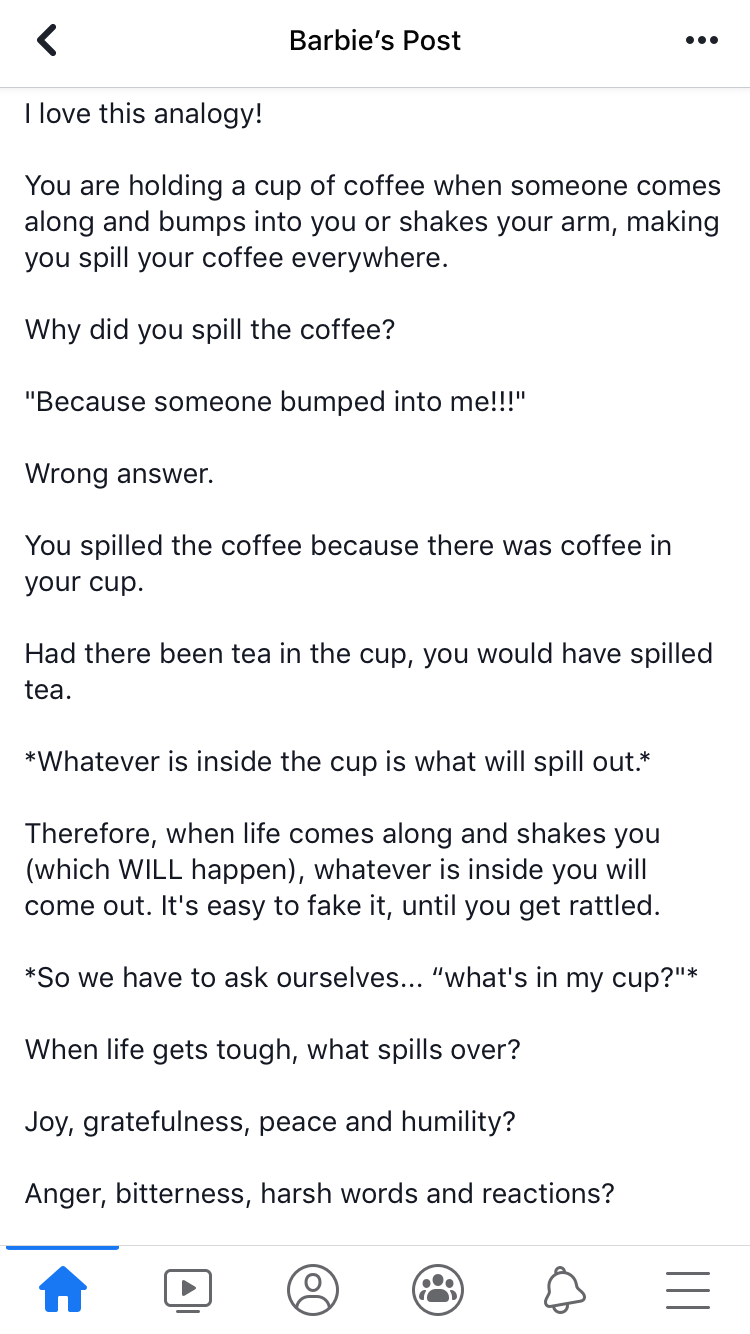
Screenshots of a short story along with an accompanying image, which is a point-of-view photo of a hand holding a coffee cup that is dramatically spilling its coffee. The coffee drinker appears to have been walking along a wooden pier. 

The story is transcribed in the post below.
Screenshots of a short story along with an accompanying image, which is a point-of-view photo of a hand holding a coffee cup that is dramatically spilling its coffee. The coffee drinker appears to have been walking along a wooden pier. 

The story is transcribed
in the post below.

For convenience, the full text from the image above is transcribed here, with a bit of additional commentary before the complete post.

“I love this analogy! 

You are holding a cup of coffee when someone comes along and bumps into you or shakes your arm, making you spill your coffee everywhere.

Why did you spill the coffee?


‘Because someone bumped into me!’


Wrong answer.


You spilled the coffee because there was coffee in your cup.


Had there been tea in the cup, you would have spilled tea.


*Whatever is inside the cup is what will spill out.*


Therefore, when life comes along and shakes you (which WILL happen), whatever is inside you will come out. It’s easy to fake it, until you get rattled. 


*So we have to ask ourselves… ‘what’s in my cup?’*

When life gets tough, what spills over?

Joy, gratefulness, peace and humility?

Anger, bitterness, harsh words and reactions?

Today let’s work towards filling our cups with gratitude, forgiveness, joy, words of affirmation; and kindness, gentleness and love for others.

(Shared from a friend whose cup is full of goodness and inspiration.)”

The post is from Facebook and is attributed to a Barbie, who I think is the original writer whose post went viral. I always remove identifiable information that connects the post back to people I know who just shared content they didn’t create.

This was really popular in my social media for awhile, even from folks who don’t typically share inspirational “Power of Positivity” type stuff.

At first, I wasn’t sure why I was so annoyed. 

Since I responded with irritation, though, it must mean that I am full of irritants?

Post hoc ergo propter hoc.

Or, maybe I was irritated because I don’t need any more shame surrounding the experience of having regular emotions. It’s actually a normal human thing to experience “negative” emotions and act in ways that reflect them.

Like, generally don’t be a dick to people on purpose, but that’s very different from letting someone know that their actions (bumping into you) had a consequence that created a problem for you (spilled coffee). 

The moral of the story seems like a shallow interpretation of various philosophies that require a great deal of self-awareness, commitment, and self-control.

Although to be fair, I’m sure that the majority of people sharing this on their Facebook pages are already boddisatvas, so do I really have a leg to stand on?

I’m just over here with my cup full of criticism, unable to experience joy or gratefulness.

I went ahead and paraphrased the underlying message that was getting to me:

if you’ve ever regretted your behavior in a stressful situation, that’s a reminder that you haven’t figured out how to empty your brain of the toxic feelings that make you bad at being a good person, and it means that you still have to learn how to create more consistently not-unpleasant feeling experiences inside your brain and heart.

The message here suggests that the bumper is irrelevant. The responsibility is all yours. You were carrying a cup full of coffee – what did you expect would happen?

It’s likely that most people would experience initial surprise and dismay after being unexpectedly bumped, regardless of the context, but the follow up to that bump as an expression of anger (“Weren’t you even looking?”) or empathy (“Are you okay?”) really does depend on the context and manner in which the bumping occurred.

Broadly, I do not advocate for yelling at people before attempting to practice compassionate curiosity.

I do, however, think that it’s unreasonable to talk about life as though simply “not feeling mad” is a perfectly viable option for anyone in any context experiencing incidental or serious inconveniences.

The fairly sound advice to manage your own reactions rather than manipulating those around you into behaving differently is often twisted to mean “other people’s actions don’t matter,” but of course they do.

I mean, does this coffee situation seem like a wholly innocent accident? Was the bumper clearly distracted and/or being careless? Was the bumper actively being an asshole?

The repetition of the message that “other people’s actions don’t matter” enables people to act like their own actions also don’t have consequences that negatively affect others.

That cup metaphor really isn’t cutting it for me, either.

In life, that “bump or shake” outlined in the anecdote is inevitable, and I agree with their choice to go all-caps on WILL.

Shit happens. Life is pain.

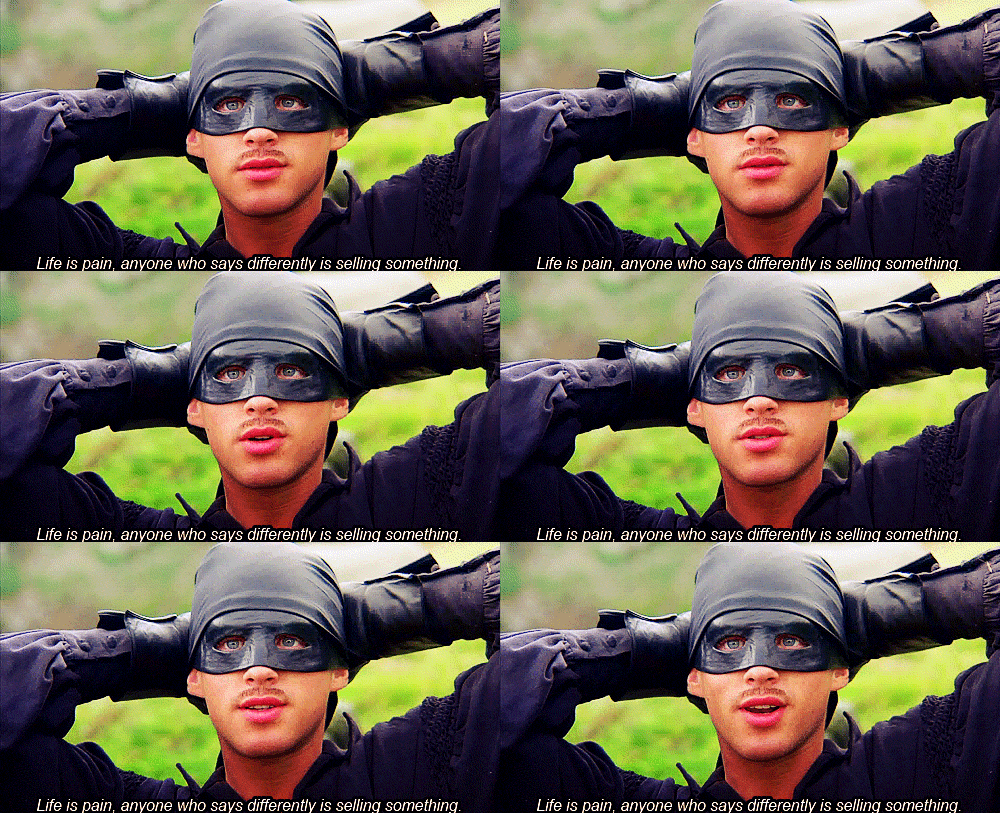
Animated gif of actor Carey Elwes as The Man in Black in the film “The Princess Bride,” mouthing the words “Life is pain,” with a caption that reads, “Life is pain; anyone who says different is selling something.”

If we rigorously stick to the cup of coffee metaphor, what does a “good” outcome look like?

I understand that the metaphor is meant to end at “what’s in your cup” rather than “what happens after it’s out of your cup,” but I just think that’s a weak extension, since the advice that you allegedly learn something about what’s in your cup only becomes transparent once it’s spilled all over the place. 

I’d say that whether you’ve spilled coffee, tea, or a cocktail, the spilled version of a metaphorical liquid is always going to be less good than it was while it was in a container.

Commit to your metaphors, people.

What does a spill of “joy, gratefulness, peace and humility” even translate to in terms of beverages?

Is it water that turns into wine?

Is it water that happens to land on a fresh food stain and gently erase it without a Tide pen?

Is it coffee that miraculously guides itself into an exhausted person’s cup?

The cup in the story is a diversion from the aftermath of the spill, but it’s important to address cleanup at some point, eh?

Maybe the implication is that you should actually carry nothing in your cup, in order to avoid unfortunate spills.

Honestly, that feels like a legitimately Buddhist interpretation of the presented story, even though it’s also probably not the intended takeaway.

The moral of this little story is only focused on what’s inside the cup, to the willful exclusion of the realities that exist outside the cup, because if what’s inside is okay, then what happens outside should be okay, too.

And here we are again: consequences don’t matter as much as feelings.

You have either positive or negative feelings inside of you, and it can only be one kind or the other, and spilling them doesn’t matter if they’re the right kinds of feelings.

The spilled coffee of kindness apparently doesn’t stain as badly as the spilled coffee of resentment.

Real talk: let’s not discount the idea that we can reveal fundamental truths about who we are during trying times.

But that’s just another reason that this metaphor is so inaccurate.

This little story describes coffee that spills everywhere, and the chosen image shows a pretty dramatic splatter range.

The kinds of high-stakes scenarios that extend us beyond our habitus and force revelations about our true selves are not comparable to incidental elbow bumps that cause a few drops of coffee to spill harmlessly onto the boardwalk, or maybe make your hand temporarily sticky.

We’re talking about spraying a wide and erratic black coffee pattern across your new white shirt. We’re talking about soaked socks and squelchy coffee feet. We’re talking about staining the clothes of innocent bystanders who didn’t even have coffee in the first place. We’re talking about wasted money, which, even for a cheap cup of coffee, is much less negligible for some than for others. We’re talking about shorting out your phone.

All that isn’t just mildly inconvenient. It fucking sucks.

But the expository text suggests that little “oopsy!” bumps and big “aw, fuck” bumps are basically comparable in terms of your reactions.

My cup can often be found to be brimming with a steamy, frothy blend of anxiety, depressive rumination, self criticism, and sweet hazelnut-flavored indecision, precariously poured over a generous double shot of hot, black, simmering rage.

And yet under some of the most severely stressful circumstances in my life, I’ve found myself to be focused, calm, helpful, decisive, and efficient.

It would be nice to believe that this is because underneath the angry latte of my coping mechanisms, I’m actually filled with healthy, delicious virtue.

But I don’t think that’s true.

My anxiety exists to prepare me for intensity and chaos.

However, I don’t really live a lifestyle or have a career that actually calls for finely-honed disaster response skills. It’s exceptional when I have to engage with a real situation that resembles my brain’s preemptive catastrophizing.

I suspect that at least part of the reason I’m able to be proactive, calm, and magnanimous in dire circumstances is that I have already anticipated dire circumstances.

In other words, I think I’ve (sometimes) been able to comport myself gracefully in the midst of life’s major bumps because I’m full of anxiety, and not because I was so much more full of patience and compassion than the people futilely having panic attacks around me.

I’m not advocating for flipping the fuck out over minor inconveniences. But, sometimes when a minor inconvenience is your last straw for the day, it’s okay to just go ahead and let that anger out of your system in the way that it emerges, without worrying about whether you’re handling it responsibly or elegantly.

For most humans, emotions aren’t, like, discrete and distinct from the rest of our lived experience. There’s a huge difference between pretending to not have the feelings that you’re actually having, and accepting that your feelings might not reflect the best performance of your ideal best self at any given moment.

I don’t love ending with pithy advice, but it’s sort of hard to avoid in this self-help-adjacent genre, so here goes.

You’re not a joyless ingrate for getting mad and then sounding mad, and sweetness doesn’t exist without the co-existence of bitterness.

Your reactions to things are not wrong or bad. They just are.

Sure, take stock of your behavior. Are you consistently lashing out or punching down after minor setbacks? Then check yourself! Talk it out! Do a therapy thing, whatever that means for you! Try to discover the functional roots of at least some of your issues!

But maybe don’t aim to have an empty cup that never inconveniences anyone else. Go ahead and carry around stuff that you know has the potential to make a mess sometimes, and be prepared to actually deal with the aftermath instead of vaguely philosophizing about how you wouldn’t have made a mess if you’d been a better person in the first place.

Those are some harsh words, Barbie. But I assure you that they didn’t spill accidentally – I intentionally elected to pour them out this way.

Happiness is an Inside Job

Content note: ableism, transphobia, racism

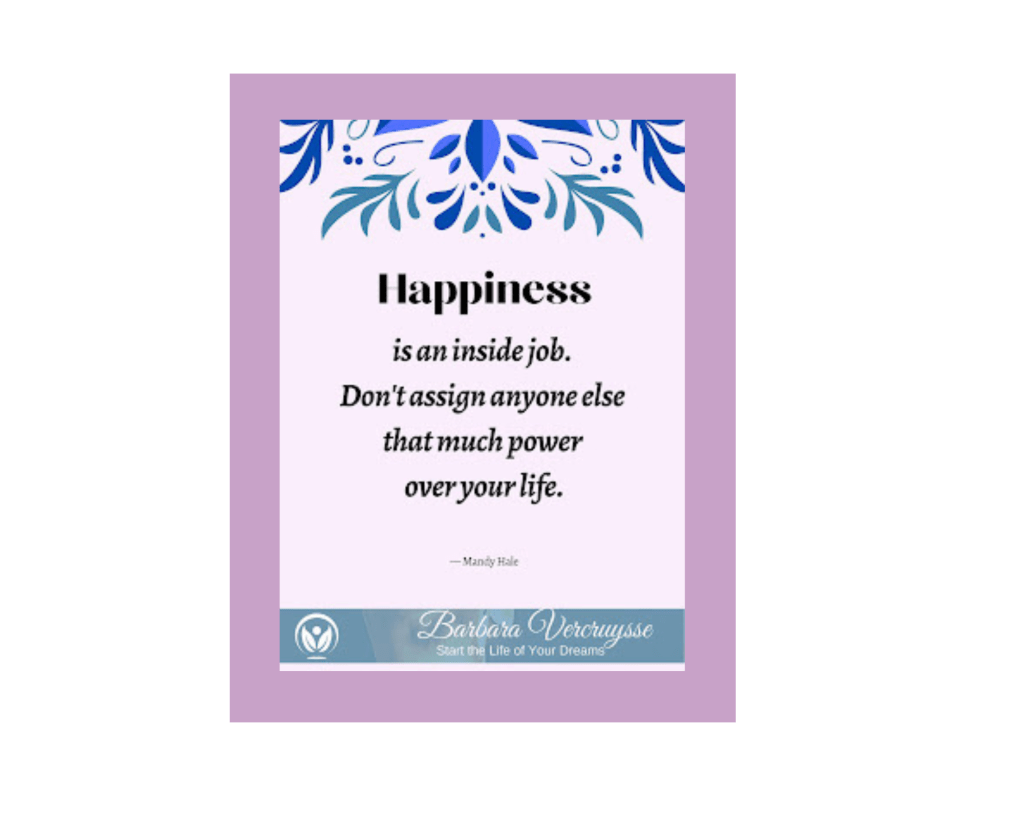
A light pink rectangle with a blue and teal decorative floral pattern at the top. The black sanserif text says, 'Happiness is an inside job. Don't assign anyone else that much power over your life. -Mandy Hale' This actual quote is attributed to Mandy Hale. At the bottom of the rectangle, there is a blue-gray bar with a white image and white text. The image is on the left side, and is a logo that appears to be an abstract rendering of leaves with a circle around them, with possibly a sun or moon - a smaller circle floating above the leaves. The text says "Barbara Vercruysse" in a script font, and then "Start the Life of Your Dreams" in a sanserif font beneath.
[A light pink rectangle with a blue and teal decorative floral pattern at the top. The black sanserif text says, ‘Happiness is an inside job. Don’t assign anyone else that much power over your life. -Mandy Hale’ This actual quote is attributed to Mandy Hale. At the bottom of the rectangle, there is a blue-gray bar with a white image and white text. The image is on the left side, and is a logo that appears to be an abstract rendering of leaves with a circle around them, with possibly a sun or moon – a smaller circle floating above the leaves. The text says “Barbara Vercruysse” in a script font, and then “Start the Life of Your Dreams” in a sanserif font beneath.]

I Googled Barbara so you don’t have to.

On one hand, this woman is just doing her thing and living her life. In this economy, we all gotta get paid.

On the other hand, she’s a rich white lady who pays her bills by reassuring other rich white people that everyone is personally, individually responsible for their own ability to thrive.

I kind of wanted to see how much she charges for her services so I clicked on “shop,” thinking that it would include information about how to book a session or begin a wellness journey.

It’s an actual shop with products, though.

Her shop is called “Barbara’s Empire of Love.”

Among other things, you can purchase inspiration cards, a daily success journal, and a gratitude journal.

They’re branded with pink flowers – cherry blossoms, I think.

I eventually did find information about courses you can enroll in, and unsurprisingly, they aren’t cheap.

There’s a baseline assumption on her site that it’s not going to put you out significantly to spend $50 (which was approximately the conversion rate from British pounds to US dollars at the time of my Googling) on a spiral-bound planner.

I think she means well enough, in her Barbara way.

But as a generally well-meaning white cis woman myself, I recognize that “meaning well” doesn’t cut the mustard when it comes to actions that inflict real harm.

And I contend that there is real harm in profiting off of the message that one can choose to not be affected by adverse social conditions.

As is always the case here at Pith Rant, there are more generous interpretations available for the messages I feature.

I also recognize that the actual quote is attributed to Mandy Hale, and was only shared by Barbara Vercruyess, but Babs or a fan of Babs decided to add her stamp of approval to that message and promote it via social media, so we’ll leave Mandy alone for now.

I acknowledge that many viewers of this message and my response may think, “But I think it just means…” or “What about…”

And I have heard those concerns.

And I’m sticking to my angry metaphorical guns.

To wit:

By acknowledging that systemic racism is a thing, one isn’t “assigning power” to racists.

By recognizing the existence of heteronormativity, one isn’t “assigning power” to the straights, and observing that pervasive transphobia permits medical malpractice to flourish is not the same as “assigning power” to transphobic doctors.

It sucks, but these people already have power.

Racists who write laws that get passed are exerting the power they have to propagate white supremacist beliefs.

Homophobes who refuse to issue marriage licenses to same sex couples are reaching for any power they can grasp to prevent Big Gay Weddings.

Doctors who ignore their patients’ pronouns are reminding their trans or nonbinary patients that powerful institutions can choose to deny them security, protection, and/or comfort.

Messages like the one on display here absolutely prop up logic like:

“It’s their own fault if they let people treat them that way; I sure wouldn’t let someone control my life like that.”

The thing is:

Assholes.

Have.

Power.

Assholes tend to seek power.

They treat people shittily, and it has shitty consequences.

This does not mean that it’s therefore fine for directly affected folks (and also less directly affected folks – hi there, you’re not exempt!) to give up and acquiesce to injustice simply because hierarchical power structures create exploitable situations.

It means that it’s ridiculous to suggest that an individual can simply think and feel their way beyond a deeply entrenched social pattern that informs the actions of people who are, in fact, relatively powerful.

I do not mean that it is impossible for marginalized folx to be happy or successful as long as powerful assholes exist.

I mean that it’s okay to recognize that broad institutional support and the absence of naked aggression makes happiness easier and more sustainable.

So, yes.

Happiness is an inside job.

Because people who have power and influence over important structures that shape your life don’t necessarily care about your happiness.

They will not seek it for you. They will not lift a finger on behalf of your actual happiness. So in that sense, it is indeed up to you to find and protect your own happiness.

The part of the quote that I am fighting against is the idea that you’ve let someone take advantage of your circumstances in order to disenfranchise you.

If you’re rich enough to be preoccupied by the perfection of your own pursuit of happiness, you probably are exerting power over someone else’s life in a way that limits their access to the kind of stability that enables happiness.

I had a separate post going for this second macro, but it’s helpful to see them together:

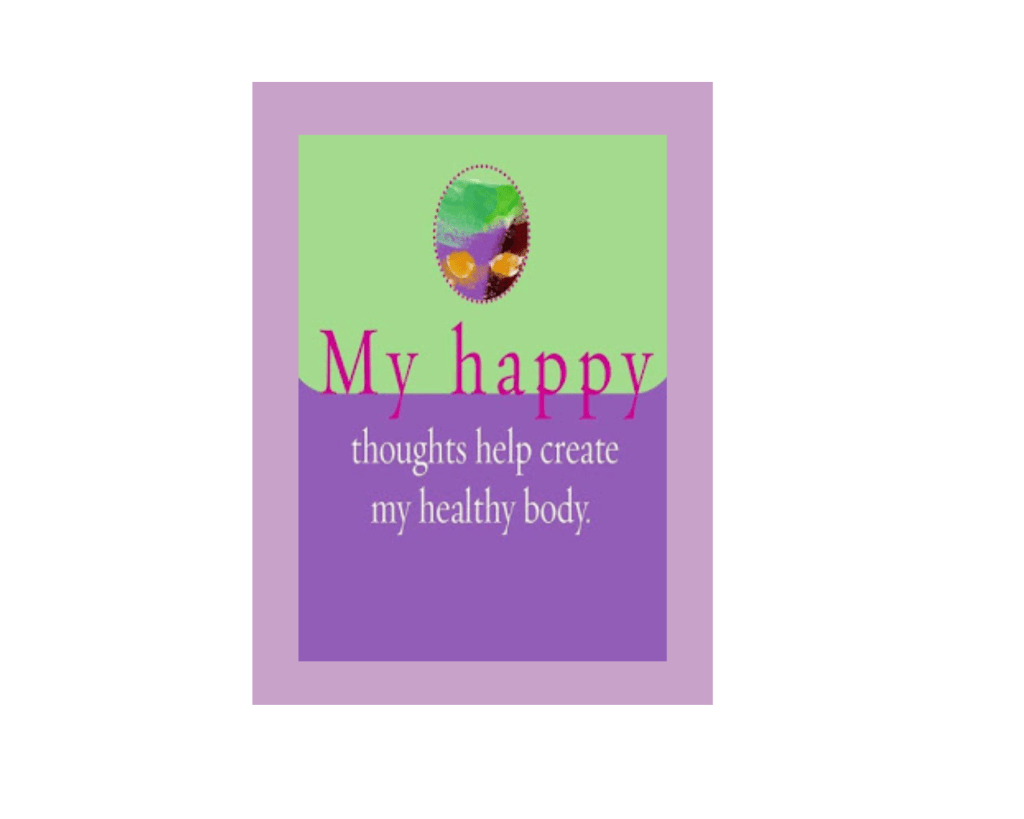
A vertical rectangle with a solid green background on the top half and a solid purple background on the bottom half. The top half, with the green background, has an oval shape that appears to have abstract green, purple, and yellow are in it. The serif text changes color - the first two words are magenta, and appear on the green half, and the rest of the words are white and appear over the purple background. The message says, "My happy thoughts help create my healthy body." I apparently didn't save any information about the creator or sharer of this one, but as you'll see in the blog post below, there are many instantiations available.
[A vertical rectangle with a solid green background on the top half and a solid purple background on the bottom half. The top half, with the green background, has an oval shape that appears to have abstract green, purple, and yellow are in it. The serif text changes color – the first two words are magenta, and appear on the green half, and the rest of the words are white and appear over the purple background. The message says, “My happy thoughts help create my healthy body.” I apparently didn’t save any information about the creator or sharer of this one, but as you’ll see in the blog post below, there are many instantiations available.]

As though people with “unhealthy” bodies just didn’t remember to think the right way about their genetic and physiological makeup.

As though people with “unhealthy” bodies have allowed someone else to exert sufficient control over their minds that they are not able to make appropriately “healthy” thought choices of their own.

As though the existence of people who have, in fact, elected to put their own health and well-being on the back burner in order to pay bills for their families or prioritize the needs of others – thereby “choosing” an “unhealthy” body – somehow cancels out the existence or the rights of people who tried to take good care of their bodies but “failed.”

As though people can’t experience depression and mental illness at the same time as physical health.

I recognize that I’m using lots of black-and-white, either/or scenarios, but that’s really what this breed of macro encourages.

This second macro tries to soften its message with the word “help,” but I guarantee the other version exists (“My happy thoughts create my healthy body”).

(I actually Googled the sentence without the word “help,” but it still turned up variations of this exact same quote with different backgrounds. Elsewhere, the actual quote is attributed to one Louise Hay.)

To conclude:

Happiness is sure nice, and it’s good to feel happy sometimes.

There are lots of other feelings to experience, though. Sometimes happiness isn’t as valuable as discomfort, even if nice white ladies want you to embrace your personal happiness as an ultimate and all-consuming goal.

People who seek power over your life often suck (including those who want the power to remind you how happy you should be all the time), so it’s up to you to remember to connect with your own happiness.

No one has the right to take your happiness away from you, but shitty people are going to keep trying, regardless of whether or not you’ve given permission. That is, you are not “giving” or “assigning” anyone power by acknowledging that your needs are at odds with their wants.

Sometimes it’s best to ignore these people, but sometimes you can’t ignore the consequences of their behaviors (I write from America in the year 2022 where the right to abortion is no longer protected by the constitution).

Your mental and physical health can absolutely inform and interact with one another in a range of fascinating ways, but thoughts aren’t magic.

Health (in whatever way it manifests according to a vast array of different bodies and circumstances) promotes the ability to have and maintain happy thoughts.

That is, we will do better to increase “happiness” in the world by providing more and better health care for all people in all circumstances than we will by telling people that they are obligated to be happy in order to properly preserve their health.

Your own personal happiness may be an inside job, but don’t let smug assholes convince you that what’s on the outside doesn’t count.

Successful Outcome

Content note: animated gifs

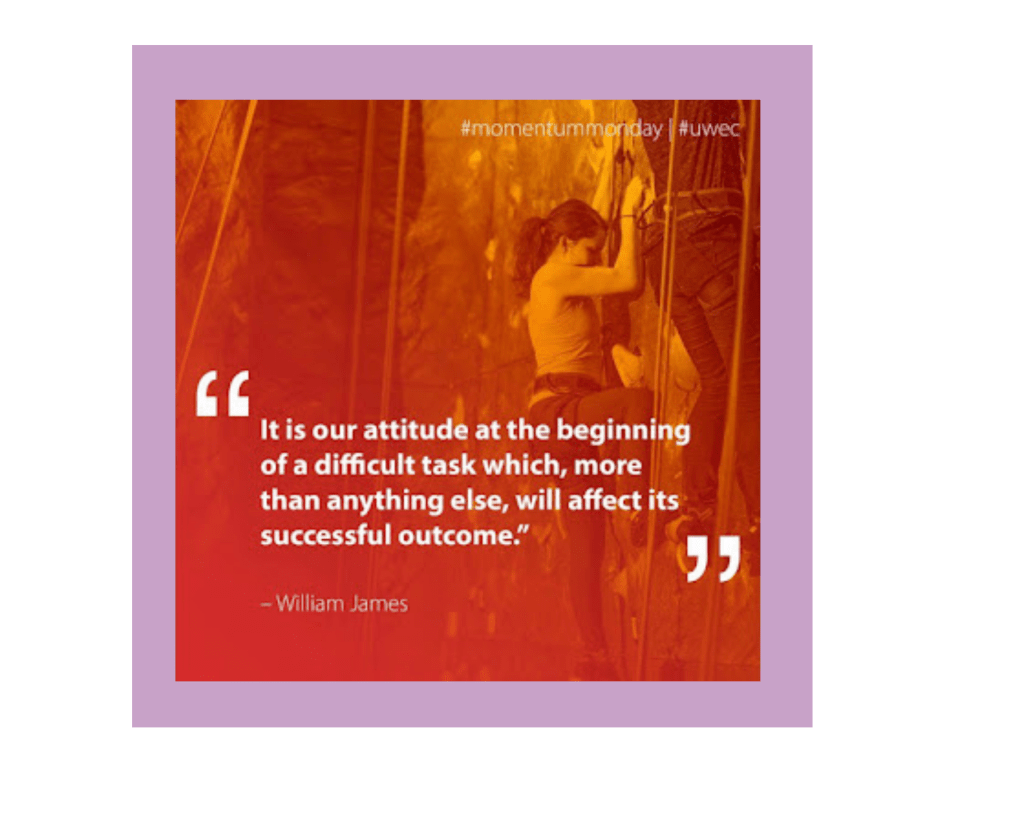
A square with an orange filter over a photograph of college students rappelling on a climbing wall. In the upper right hand corner are the hashtags #momentummonday and #uwec, the educational institution that shared the post. In white sanserif letters, it says, "It is our attitude at the beginning of a difficult task which, more than anything else, will affect its successful outcome." -William James
A square with an orange filter over a photograph of college students rappelling on a climbing wall. In the upper right hand corner are the hashtags #momentummonday and #uwec, the educational institution that shared the post. In white sanserif letters, it says, “It is our attitude at the beginning of a difficult task which, more than anything else, will affect its successful outcome.” -William James

I originally wrote this post in early 2020.

At that point, I had heard of coronavirus, but people were dismissing whispers about lockdowns.

More recently, here in mid-2022, I was reading the book Burnout: The Secret to Unlocking the Stress Cycle by Amelia and Emily Nagoski, and I was struck by their chapter on “persistence.”

The perspective they present there is much more nuanced and thoroughly researched than my blog post here (which makes sense, because they wrote a whole book), but I’ll go ahead and admit that I was chuffed to see a well-rounded argument by people I respect with some thematic parallels to my burned-out thoughts from two years ago.

Back in the before-times, I was feeling especially salty about this featured quote because I had just received a long-overdue confirmation of rejection for a job that I was extraordinarily confident about my ability to perform, that I was ridiculously prepared for, that I was eminently qualified for, and for which I made an exceptionally strong argument for myself for in both preliminary and final interview stages.

I also received my poorly-handled rejection notification the day after Elizabeth Warren dropped out of the 2020 presidential race.

It wasn’t a great day to see an inspirational quote about attitude.

My attitude had varied over the months of the academic job application and interview process, but overall, I remained uncharacteristically positive.

I mean, I was still fundamentally me.

Of course I experienced bouts of doubt and anxiety.

But for once, my professional self-doubt felt like a lie that could be countered with evidence.

When I saw the original advertisement for the position, I thought, “Well, that’s me. I can do all of that, and I can do it well.”

(It was far more common for me to read the bulleted Preferred Qualifications list and feel great about three of them, okay about four or five, ambivalent about a couple, and terrified by at least one.)

When I started pulling my materials together, I told myself, “I will turn in an application that they can’t ignore. They may not actually contact me for an interview, because that’s out of my hands, but by god, they’ll have to work hard to justify keeping me out of the running if that’s the case.”

And they contacted me pretty promptly to schedule an interview.

And when I prepared for the interview, I told myself, “I will not give them any reason to second-guess choosing my application, and by god, they’ll have to sweat if they don’t put me through to the next round.”

And I made it to the next round.

Every other time I had a campus visit, I’d leaned into a “fake it ’til you make it” approach to get me through, but this time, I just felt a qualified colleague.

It would be unfair for me to resent the fact that another person existed with pertinent qualifications, which they proceeded to show off to good advantage in their own interview. The person who got the job was presumably confident, prepared, and qualified, and capable of making a strong argument on their own behalf.

Awareness of this fact didn’t do much to alleviate the sting.

So, back to William James (and those who like to quote him out of context):

How does “attitude at the beginning” really come into play when we arrive at an unsuccessful outcome?

I admit that I threw myself a big old pity party when I got the rejection, and I stand by that. Pretending not to be bitter will only exacerbate bitterness.

I also admit that my above question originally arose from a place of resentment and frustration.

But once the emotional lava has hardened, the issue still stands: what’s the connection between attitude and success?

The quote in this macro is being used in service of this broader Power of Positivity enterprise that blames individuals’ thought patterns for individual failures (or successes), rather than engaging more meaningfully with the social infrastructures that reinforce patterns of success (or failure).

If we’re looking to define an attitude that helps to determine success, it seems like confidence, persistence, and resilience are good personal qualities to have, eh?

I don’t know Elizabeth Warren personally, and I’m in no position to ever speak meaningfully about her mental or emotional state.

But at least in terms of her public image, she remained engaged, forward-thinking, and determined. She shows it when she’s angry, but she remains broadly “positive,” and does not appear unconfident or underprepared.

Elizabeth Warren’s own attitude wasn’t the problem with her campaign. Her attitude was demonstrably on point.

Of course she’ll persist. Of course she’ll be resilient. Of course she isn’t going to stop working altogether. She knows the drill. She’ll stay on her feet.

But still.

Fucking hell.

I’ve focused a lot on that word “attitude” in the original macro, but here I’ll start folding in that idea of “successful outcome.”

A “successful outcome” for a job interview – both at the local and national level – is a job offer.

That’s what it looks like your own attitude is mirrored by that of a larger system (which may or may not be rigged in your favor). 

Now, I promise that I know that “not achieving a desired outcome” is not the same thing as either “failure” or “total lack of institutional support.”

When multiple people are competing for only one position, it’s obviously not possible for everyone to “succeed” in the sense outlined above, and so of course there’s going to be disappointment somewhere.

Toxic Positivity encourages us to elevate the lesson at the expense of acknowledging the disappointment, though. 

Sure, I get to practice resilience this way, and I can identify opportunities for growth, but “someone else got the job” still wasn’t a “successful outcome” for me. (Or Elizabeth Warren.)

It’s a reasonable outcome.

It’s a manageable outcome.

It’s not a total failure, and it’s not the end of the world.

I’ll persist. I’ll be resilient. I won’t stop altogether. I know the drill. I’ll stay on my feet.

We can’t all have successful outcomes all the time, and that’s normal.

Now, I think that’s a reasonable attitude to have at the disappointing conclusion of a difficult task.

Cognitively, I know that this is my baseline “actual” attitude, even though I may struggle to stick with it as circumstance and emotions fluctuate.

This “attitude determines outcome” framing doesn’t seem to encourage a healthy, balanced response to unsuccessful outcomes, but then again, what do I know from healthy?

There are a couple of ways to justify this relationship between “attitude determines outcome” and what “a successful outcome” actually looks like compared to an “unsuccessful” one.

1) Play with the definition of “attitude.” If you have an unsuccessful outcome (e.g., not getting the job, not winning the race, not nailing the performance, etc.), it must be because your initial attitude wasn’t truly what was needed for that particular kind of success in that particular situation. Your attitude was always the problem, rather than anything circumstantial, and you need to try harder to have a more situationally-appropriate attitude if you want to achieve your goals. (Okay, I’ve been a bit flippant there, but then again I never promised not to be.)

2) Play with the definition of “success.” If you don’t achieve your desired outcome (the job, the medal, the gig, etc.), it’s okay to retrofit your idea of success to accommodate whatever actually happened. That sounds a lot like the ol’ “Everyone’s a winner” schtick that never made anyone feel any better in elementary school.

“You succeeded because you tried.”

(Don’t tell Yoda.)

Animated gif of the shriveled green character Yoda from Star Wars (specifically The Empire Strikes Back, for the nerds) saying his iconic line, "Do or do no. There is no try."
Animated gif of the shriveled green character Yoda from Star Wars (specifically The Empire Strikes Back, for the nerds) saying his iconic line, “Do or do no. There is no try.”

Now, I’ve offered several either/ors here, and you know how I feel about binaries.

Of course success is not an absolute binary, and it’s reductive to treat most outcomes as “SUCCESS” vs. “FAILURE” with nothing in between.

At the same time, of course it’s disingenuous to act like “NOT SUCCESS” has so much overlap with “SUCCESS” that the difference is functionally negligible.

I have a background in social science research, but I’ve really only dabbled in psychology. I’ve spent more time engaging with popular psychology resources than digging into the academic theory and history of the discipline.

So I’ll admit that I wasn’t sure who William James was when I initially snagged this screenshot.

In fact, when I started writing, I was thinking of Henry James, and I was all ready to lay into him.

Wrong James, though. 

It turns out that William James is often referred to as “the father of American psychology.”

The history of the philosophical tradition of Pragmatism, as James defined it and as it has since evolved, wasn’t exactly light reading, and I’ll be upfront about the fact that I just don’t feel like summarizing it here.

And at any rate, this blog isn’t a great space to develop a lengthy and well-researched essay on the history of ideological debates that have influenced contemporary psychological practice. I’m just here to pick apart their outcomes.

I liked the sound of “pragmatism,” though, so I considered the possibility that his quotable quote was pulled from a context that could offer some illumination.

I briefly searched for that original context.

Early efforts to identify the source beyond the author’s name were fruitless. This sentence has been macroed a LOT:

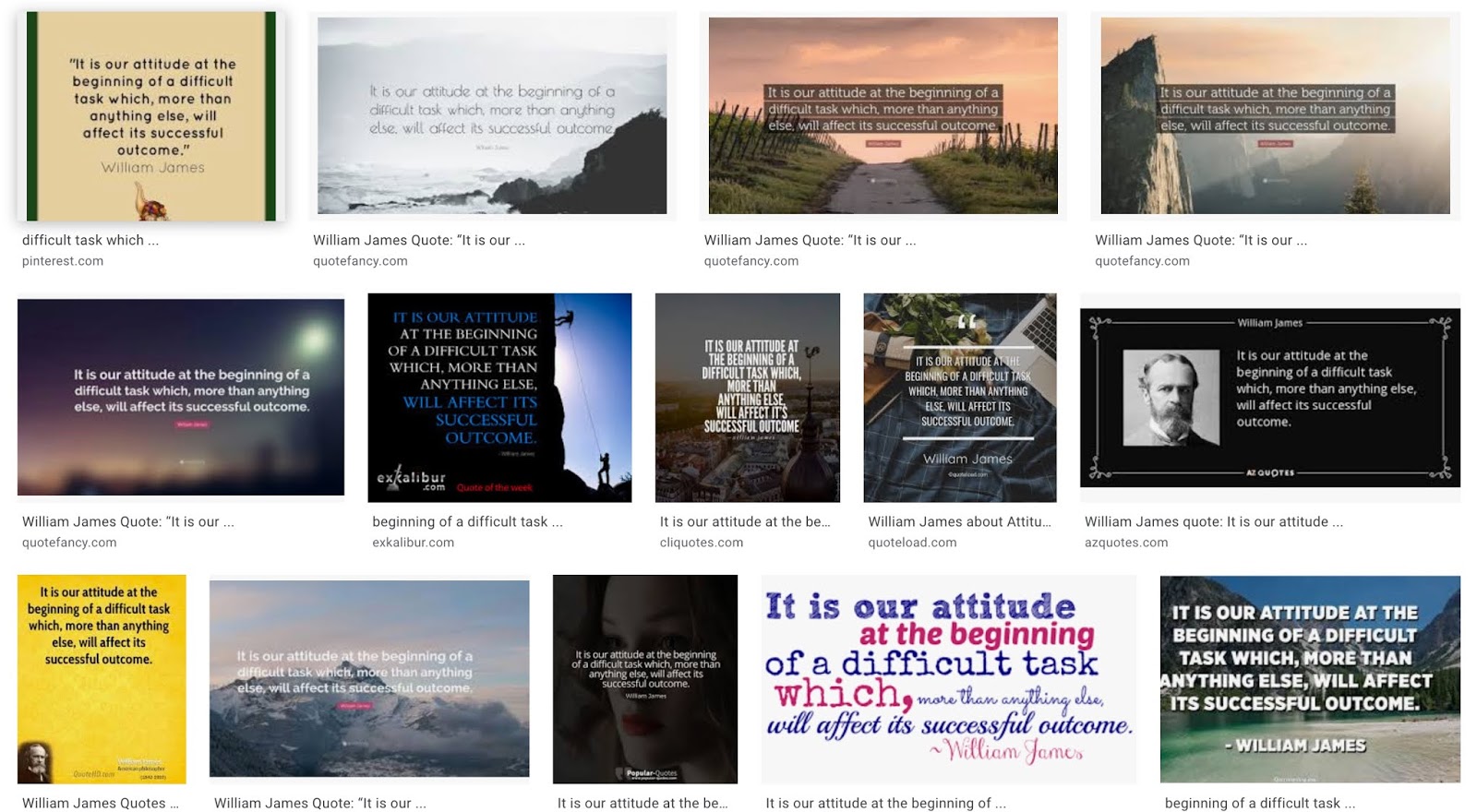
Screenshot of the many results of a Google image search for the William James quote "It is our attitude at the beginning of a difficult task which, more than anything else, will affect its successful outcome." There are many different treatments in terms of font, color scheme, and imagery. 14 are represented here, but that's just what fit in the screenshot.
Screenshot of the many results of a Google image search for the William James quote “It is our attitude at the beginning of a difficult task which, more than anything else, will affect its successful outcome.” There are many different treatments in terms of font, color scheme, and imagery. 14 are represented here, but that’s just what fit in the screenshot.

I have just a couple highlights to bring in from my very brief historical review.

“Pragmatism” as a movement has been paraphrased as “a return to common sense.”

Well, that sounds less promising. Naturally, I wondered whose senses were considered to be most common, and naturally, I have some hunches, William James, but we’ll table that for now.

(*cough* abled-ish financially secure cis het white dudes who were likely to have been raised with broadly Christian values if not beliefs *cough*)

I didn’t find the original context, but I came across another James quote that seems like a helpful expansion: “a belief can be made true by the fact that holding it contributes to our happiness and fulfillment.”

I.e., “fake it ’til you make it.”

It seems a little on the nose to me that the “father of American psychology” advocated for magical thinking that he preferred to rebrand as “pragmatism.”

Admittedly, I’ve presented a judgement about an influential figure and the significance of his entire career based on just a couple of Google searches and the brief perusal of a few articles. I stand 100% ready to be educated by the perspectives of those more familiar with his work (as I pretend that multiple people with relevant and informed opinions are reading this blog).

Shortly after writing an early draft of this post, I read a chapter from Barbara Ehrenreich’s Bright-Sided: How Positive Thinking is Undermining America that expanded more on the historical context that led to the emergence of William James’ psychological philosophy. In short:

it seems like James approached the then-emerging pseudoscientific fad known as “new thinking” (the idea that people could manifest things simply by thinking about them) with a reasonable degree of skepticism.

His original motivation seems to have been practical enough. I respect anyone who is driven by a desire to disprove popular bullshit; yet the outcome has led to terribly impractical results (i.e., more people in contemporary society who lump his eventual admission that “thinking positive thoughts can in some cases seem to correlate with positive outcomes” into the same kind of magical thinking he was contesting in the first place).

So in that sense, his optimistic attitude at the outset does not seem to have resulted in a particularly successful outcome for his theories.

Just sayin’.

I write a lot here about what I don’t believe and not as much about what I do believe.

I want to stress that I believe deeply in the value of acceptance.

I can and always will learn from disappointment.

I know my Bob Ross, y’all. 

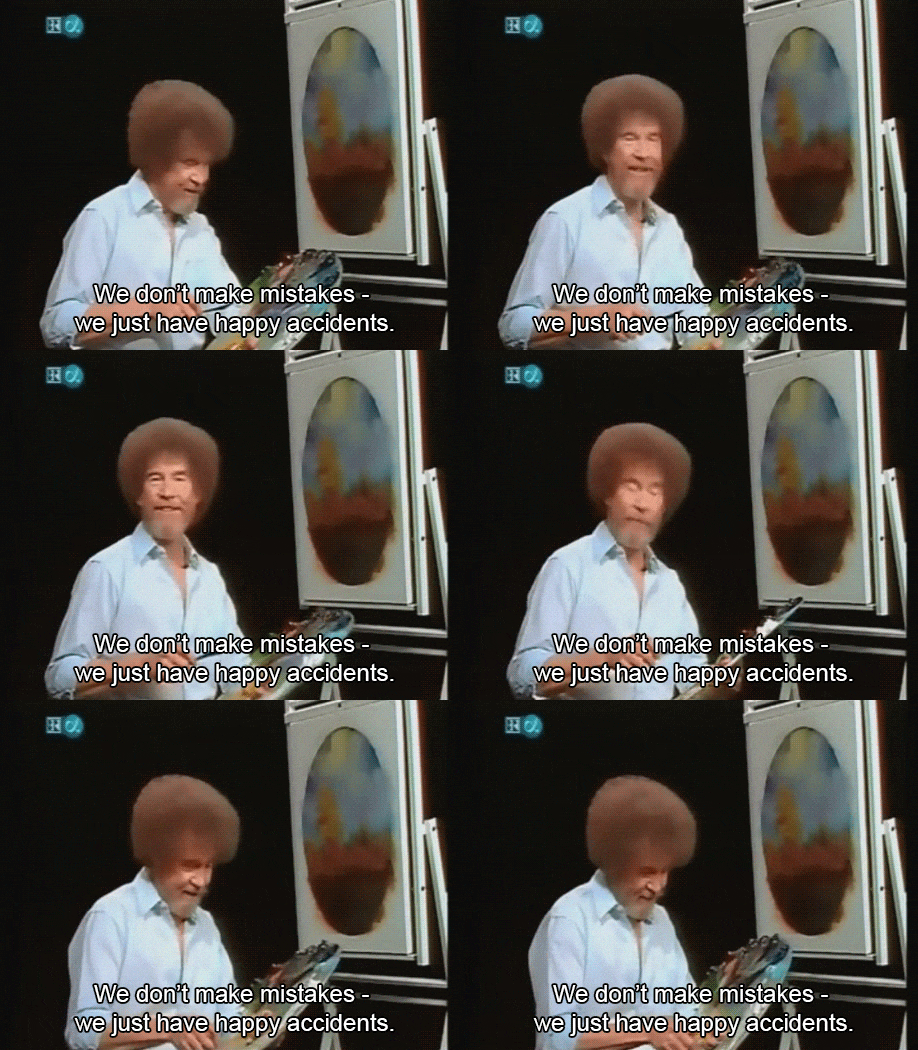
Animated gif of painter Bob Ross from his '90s TV show "The Joy of Painting," standing in front of a nature-scape with his palette in hand, saying, "We don't make mistakes - we just have happy accidents."
Animated gif of painter Bob Ross from his ’90s TV show “The Joy of Painting,” standing in front of a nature-scape with his palette in hand, saying, “We don’t make mistakes – we just have happy accidents.”

 I absolutely appreciate the value of being able to identify positive potential after a negative situation has unfolded.

I comprehend and respect the idea that the anticipation of success can have benefits that the anticipation of failure may not.

I recognize the ways in which negative thinking can perpetuate cycles of self-sabotage.

But.

Attitudes don’t exist in vacuums.

Having a good attitude IN A SYSTEM THAT PRIVILEGES AND PRIORITIZES YOUR ABILITY TO MAINTAIN THE IDEA THAT YOUR OWN ATTITUDE IS THE BEST ONE will, indeed, probably encourage successful outcomes.

You can have the best damn attitude in the world, but that’s not the primary thing determining your success. It just helps.

Know your strengths, know your limits, and know your value. That’s in your control.

But also know that there are plenty of folks out there who want you to be fully responsible for the “failures” that you encounter, just so that they can justify their own relative comfort and “success.”

I feel like this post turned out more ranty than usual. That’s not what I planned for when I started, but that’s where it ended up.

Unintended and unexpected outcomes are normal and fine.

It is possible to turn your mistakes into birds.

But that doesn’t have to mean that your attitude was always going to lay eggs in the first place.