
Successful Outcome

Content note: animated gifs
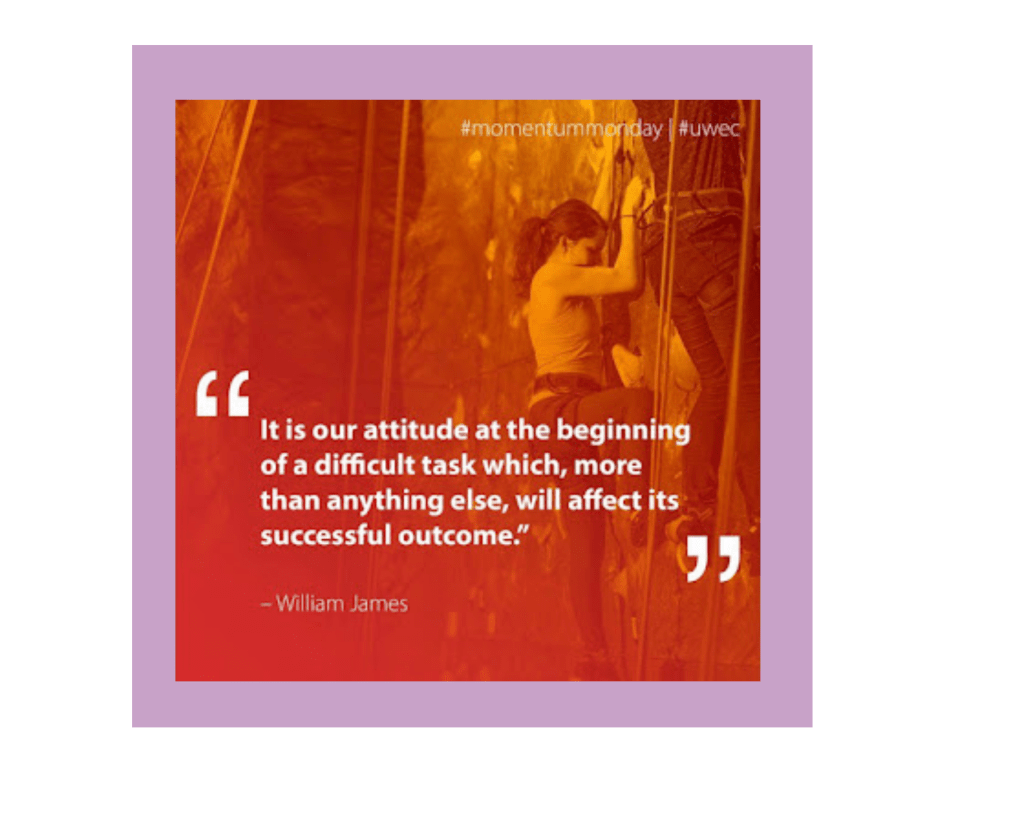
A square with an orange filter over a photograph of college students rappelling on a climbing wall. In the upper right hand corner are the hashtags #momentummonday and #uwec, the educational institution that shared the post. In white sanserif letters, it says, "It is our attitude at the beginning of a difficult task which, more than anything else, will affect its successful outcome." -William James
A square with an orange filter over a photograph of college students rappelling on a climbing wall. In the upper right hand corner are the hashtags #momentummonday and #uwec, the educational institution that shared the post. In white sanserif letters, it says, “It is our attitude at the beginning of a difficult task which, more than anything else, will affect its successful outcome.” -William James

I originally wrote this post in early 2020.

At that point, I had heard of coronavirus, but people were dismissing whispers about lockdowns.

More recently, here in mid-2022, I was reading the book Burnout: The Secret to Unlocking the Stress Cycle by Amelia and Emily Nagoski, and I was struck by their chapter on “persistence.”

The perspective they present there is much more nuanced and thoroughly researched than my blog post here (which makes sense, because they wrote a whole book), but I’ll go ahead and admit that I was chuffed to see a well-rounded argument by people I respect with some thematic parallels to my burned-out thoughts from two years ago.
Back in the before-times, I was feeling especially salty about this featured quote because I had just received a long-overdue confirmation of rejection for a job that I was extraordinarily confident about my ability to perform, that I was ridiculously prepared for, that I was eminently qualified for, and for which I made an exceptionally strong argument for myself for in both preliminary and final interview stages.

I also received my poorly-handled rejection notification the day after Elizabeth Warren dropped out of the 2020 presidential race.

It wasn’t a great day to see an inspirational quote about attitude.

My attitude had varied over the months of the academic job application and interview process, but overall, I remained uncharacteristically positive.

I mean, I was still fundamentally me.

Of course I experienced bouts of doubt and anxiety.

But for once, my professional self-doubt felt like a lie that could be countered with evidence.

When I saw the original advertisement for the position, I thought, “Well, that’s me. I can do all of that, and I can do it well.”

(It was far more common for me to read the bulleted Preferred Qualifications list and feel great about three of them, okay about four or five, ambivalent about a couple, and terrified by at least one.)

When I started pulling my materials together, I told myself, “I will turn in an application that they can’t ignore. They may not actually contact me for an interview, because that’s out of my hands, but by god, they’ll have to work hard to justify keeping me out of the running if that’s the case.”

And they contacted me pretty promptly to schedule an interview.

And when I prepared for the interview, I told myself, “I will not give them any reason to second-guess choosing my application, and by god, they’ll have to sweat if they don’t put me through to the next round.”

And I made it to the next round.

Every other time I had a campus visit, I’d leaned into a “fake it ’til you make it” approach to get me through, but this time, I just felt a qualified colleague.

It would be unfair for me to resent the fact that another person existed with pertinent qualifications, which they proceeded to show off to good advantage in their own interview. The person who got the job was presumably confident, prepared, and qualified, and capable of making a strong argument on their own behalf.

Awareness of this fact didn’t do much to alleviate the sting.

So, back to William James (and those who like to quote him out of context):

How does “attitude at the beginning” really come into play when we arrive at an unsuccessful outcome?

I admit that I threw myself a big old pity party when I got the rejection, and I stand by that. Pretending not to be bitter will only exacerbate bitterness.

I also admit that my above question originally arose from a place of resentment and frustration.

But once the emotional lava has hardened, the issue still stands: what’s the connection between attitude and success?

The quote in this macro is being used in service of this broader Power of Positivity enterprise that blames individuals’ thought patterns for individual failures (or successes), rather than engaging more meaningfully with the social infrastructures that reinforce patterns of success (or failure).

If we’re looking to define an attitude that helps to determine success, it seems like confidence, persistence, and resilience are good personal qualities to have, eh?

I don’t know Elizabeth Warren personally, and I’m in no position to ever speak meaningfully about her mental or emotional state.

But at least in terms of her public image, she remained engaged, forward-thinking, and determined. She shows it when she’s angry, but she remains broadly “positive,” and does not appear unconfident or underprepared.

Elizabeth Warren’s own attitude wasn’t the problem with her campaign. Her attitude was demonstrably on point.

Of course she’ll persist. Of course she’ll be resilient. Of course she isn’t going to stop working altogether. She knows the drill. She’ll stay on her feet.

But still.

Fucking hell.

I’ve focused a lot on that word “attitude” in the original macro, but here I’ll start folding in that idea of “successful outcome.”

A “successful outcome” for a job interview – both at the local and national level – is a job offer.

That’s what it looks like your own attitude is mirrored by that of a larger system (which may or may not be rigged in your favor). 

Now, I promise that I know that “not achieving a desired outcome” is not the same thing as either “failure” or “total lack of institutional support.”

When multiple people are competing for only one position, it’s obviously not possible for everyone to “succeed” in the sense outlined above, and so of course there’s going to be disappointment somewhere.

Toxic Positivity encourages us to elevate the lesson at the expense of acknowledging the disappointment, though. 

Sure, I get to practice resilience this way, and I can identify opportunities for growth, but “someone else got the job” still wasn’t a “successful outcome” for me. (Or Elizabeth Warren.)

It’s a reasonable outcome.

It’s a manageable outcome.

It’s not a total failure, and it’s not the end of the world.

I’ll persist. I’ll be resilient. I won’t stop altogether. I know the drill. I’ll stay on my feet.

We can’t all have successful outcomes all the time, and that’s normal.

Now, I think that’s a reasonable attitude to have at the disappointing conclusion of a difficult task.

Cognitively, I know that this is my baseline “actual” attitude, even though I may struggle to stick with it as circumstance and emotions fluctuate.

This “attitude determines outcome” framing doesn’t seem to encourage a healthy, balanced response to unsuccessful outcomes, but then again, what do I know from healthy?

There are a couple of ways to justify this relationship between “attitude determines outcome” and what “a successful outcome” actually looks like compared to an “unsuccessful” one.

1) Play with the definition of “attitude.” If you have an unsuccessful outcome (e.g., not getting the job, not winning the race, not nailing the performance, etc.), it must be because your initial attitude wasn’t truly what was needed for that particular kind of success in that particular situation. Your attitude was always the problem, rather than anything circumstantial, and you need to try harder to have a more situationally-appropriate attitude if you want to achieve your goals. (Okay, I’ve been a bit flippant there, but then again I never promised not to be.)

2) Play with the definition of “success.” If you don’t achieve your desired outcome (the job, the medal, the gig, etc.), it’s okay to retrofit your idea of success to accommodate whatever actually happened. That sounds a lot like the ol’ “Everyone’s a winner” schtick that never made anyone feel any better in elementary school.

“You succeeded because you tried.”

(Don’t tell Yoda.)

Animated gif of the shriveled green character Yoda from Star Wars (specifically The Empire Strikes Back, for the nerds) saying his iconic line, "Do or do no. There is no try."
Animated gif of the shriveled green character Yoda from Star Wars (specifically The Empire Strikes Back, for the nerds) saying his iconic line, “Do or do no. There is no try.”

Now, I’ve offered several either/ors here, and you know how I feel about binaries.

Of course success is not an absolute binary, and it’s reductive to treat most outcomes as “SUCCESS” vs. “FAILURE” with nothing in between.

At the same time, of course it’s disingenuous to act like “NOT SUCCESS” has so much overlap with “SUCCESS” that the difference is functionally negligible.

I have a background in social science research, but I’ve really only dabbled in psychology. I’ve spent more time engaging with popular psychology resources than digging into the academic theory and history of the discipline.

So I’ll admit that I wasn’t sure who William James was when I initially snagged this screenshot.

In fact, when I started writing, I was thinking of Henry James, and I was all ready to lay into him.

Wrong James, though. 

It turns out that William James is often referred to as “the father of American psychology.”

The history of the philosophical tradition of Pragmatism, as James defined it and as it has since evolved, wasn’t exactly light reading, and I’ll be upfront about the fact that I just don’t feel like summarizing it here.

And at any rate, this blog isn’t a great space to develop a lengthy and well-researched essay on the history of ideological debates that have influenced contemporary psychological practice. I’m just here to pick apart their outcomes.

I liked the sound of “pragmatism,” though, so I considered the possibility that his quotable quote was pulled from a context that could offer some illumination.

I briefly searched for that original context.

Early efforts to identify the source beyond the author’s name were fruitless. This sentence has been macroed a LOT:
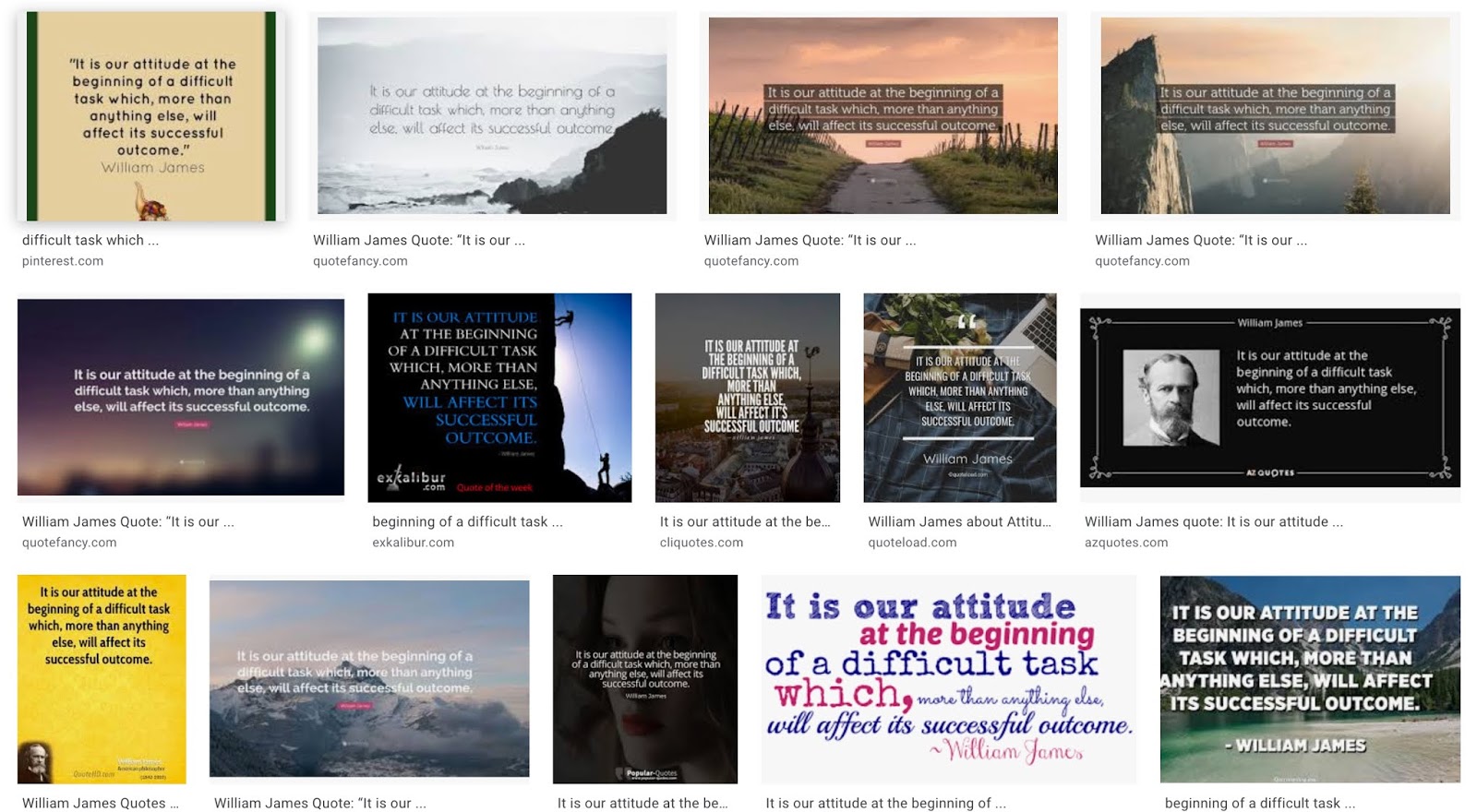
Screenshot of the many results of a Google image search for the William James quote "It is our attitude at the beginning of a difficult task which, more than anything else, will affect its successful outcome." There are many different treatments in terms of font, color scheme, and imagery. 14 are represented here, but that's just what fit in the screenshot.
Screenshot of the many results of a Google image search for the William James quote “It is our attitude at the beginning of a difficult task which, more than anything else, will affect its successful outcome.” There are many different treatments in terms of font, color scheme, and imagery. 14 are represented here, but that’s just what fit in the screenshot.

I have just a couple highlights to bring in from my very brief historical review.

“Pragmatism” as a movement has been paraphrased as “a return to common sense.”

Well, that sounds less promising. Naturally, I wondered whose senses were considered to be most common, and naturally, I have some hunches, William James, but we’ll table that for now.

(*cough* abled-ish financially secure cis het white dudes who were likely to have been raised with broadly Christian values if not beliefs *cough*)

I didn’t find the original context, but I came across another James quote that seems like a helpful expansion: “a belief can be made true by the fact that holding it contributes to our happiness and fulfillment.”

I.e., “fake it ’til you make it.”

It seems a little on the nose to me that the “father of American psychology” advocated for magical thinking that he preferred to rebrand as “pragmatism.”

Admittedly, I’ve presented a judgement about an influential figure and the significance of his entire career based on just a couple of Google searches and the brief perusal of a few articles. I stand 100% ready to be educated by the perspectives of those more familiar with his work (as I pretend that multiple people with relevant and informed opinions are reading this blog).

Shortly after writing an early draft of this post, I read a chapter from Barbara Ehrenreich’s Bright-Sided: How Positive Thinking is Undermining America that expanded more on the historical context that led to the emergence of William James’ psychological philosophy. In short:

it seems like James approached the then-emerging pseudoscientific fad known as “new thinking” (the idea that people could manifest things simply by thinking about them) with a reasonable degree of skepticism.

His original motivation seems to have been practical enough. I respect anyone who is driven by a desire to disprove popular bullshit; yet the outcome has led to terribly impractical results (i.e., more people in contemporary society who lump his eventual admission that “thinking positive thoughts can in some cases seem to correlate with positive outcomes” into the same kind of magical thinking he was contesting in the first place).

So in that sense, his optimistic attitude at the outset does not seem to have resulted in a particularly successful outcome for his theories.

Just sayin’.

I write a lot here about what I don’t believe and not as much about what I do believe.

I want to stress that I believe deeply in the value of acceptance.

I can and always will learn from disappointment.

I know my Bob Ross, y’all. 
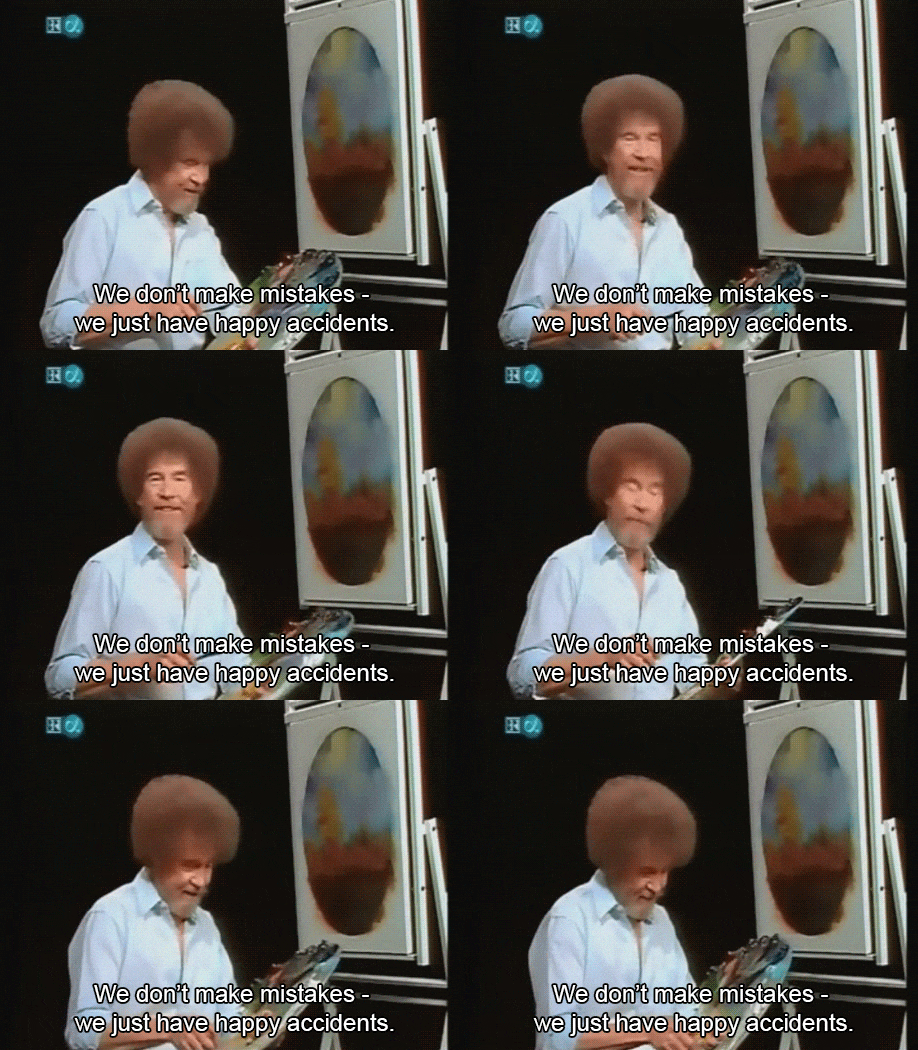
Animated gif of painter Bob Ross from his '90s TV show "The Joy of Painting," standing in front of a nature-scape with his palette in hand, saying, "We don't make mistakes - we just have happy accidents."
Animated gif of painter Bob Ross from his ’90s TV show “The Joy of Painting,” standing in front of a nature-scape with his palette in hand, saying, “We don’t make mistakes – we just have happy accidents.”

 I absolutely appreciate the value of being able to identify positive potential after a negative situation has unfolded.

I comprehend and respect the idea that the anticipation of success can have benefits that the anticipation of failure may not.

I recognize the ways in which negative thinking can perpetuate cycles of self-sabotage.

But.

Attitudes don’t exist in vacuums.

Having a good attitude IN A SYSTEM THAT PRIVILEGES AND PRIORITIZES YOUR ABILITY TO MAINTAIN THE IDEA THAT YOUR OWN ATTITUDE IS THE BEST ONE will, indeed, probably encourage successful outcomes.

You can have the best damn attitude in the world, but that’s not the primary thing determining your success. It just helps.

Know your strengths, know your limits, and know your value. That’s in your control.

But also know that there are plenty of folks out there who want you to be fully responsible for the “failures” that you encounter, just so that they can justify their own relative comfort and “success.”

I feel like this post turned out more ranty than usual. That’s not what I planned for when I started, but that’s where it ended up.

Unintended and unexpected outcomes are normal and fine.

It is possible to turn your mistakes into birds.

But that doesn’t have to mean that your attitude was always going to lay eggs in the first place.
The Stuff That Weighs You Down

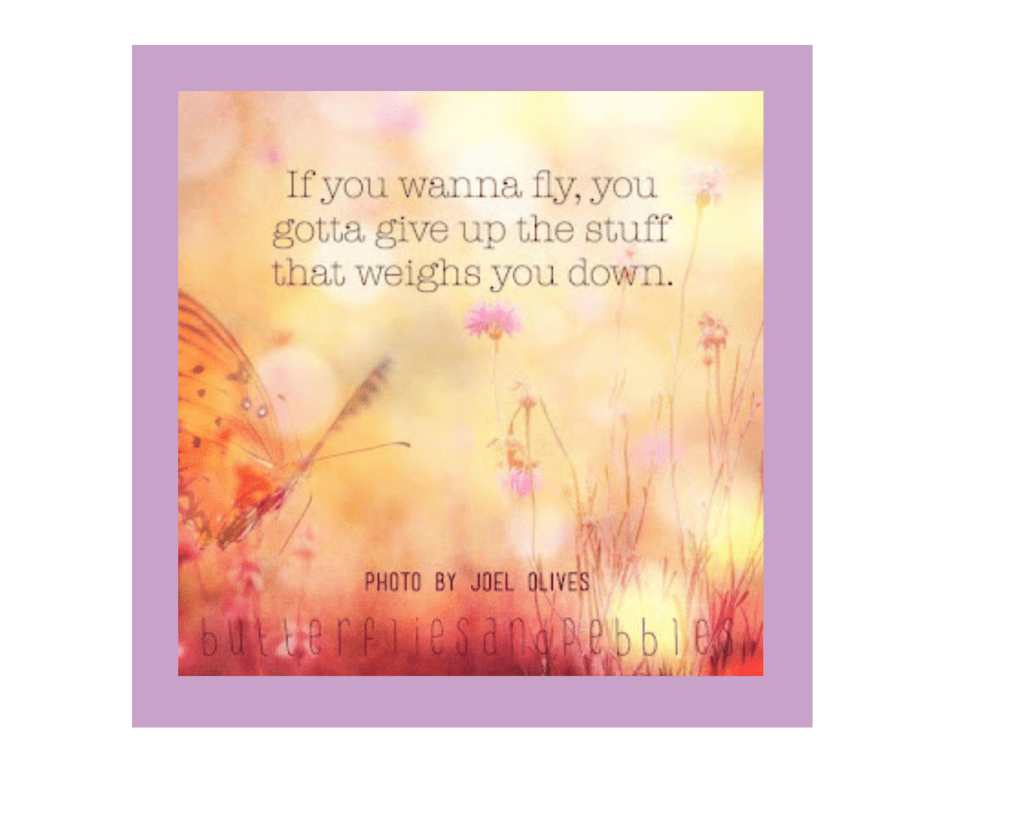
A photoshopped or filtered photo with a heavily saturated warm pastel color palette, featuring little spindly pink flowers, an orange butterfly on the left of the image, and some kind of light-colored circles that may be out-of-focus dandelion fluff or dust or sunlight reflections. The gray serif font in the middle reads, "If you wanna fly, you gotta give up the stuff that weighs you down." It also attributes the work to a photograph, saying "Photo by Joel Olives" in a new, darker gray sanserif font at the bottom, and lists what is presumably the name of a site or company, "Butterflies and Pebbles," in a third sanserif font across the bottom of the entire image.
A photoshopped or filtered photo with a heavily saturated warm pastel color palette, featuring little spindly pink flowers, an orange butterfly on the left of the image, and some kind of light-colored circles that may be out-of-focus dandelion fluff or dust or sunlight reflections. The gray serif font in the middle reads, “If you wanna fly, you gotta give up the stuff that weighs you down.” It also attributes the work to a photograph, saying “Photo by Joel Olives” in a new, darker gray sanserif font at the bottom, and lists what is presumably the name of a site or company, “Butterflies and Pebbles,” in a third sanserif font across the bottom of the entire image.

I love how this image feels positively weightless!

It’s like how the world would look if gravity wasn’t even a thing!

But I mean, still more fun than outer space. There’s oxygen here.

Does it really matter whether this gentle universal message is being shared by a physically healthy and mentally/emotionally supported person with a solid 401K and too many possessions, or if it’s being shared by a physically disabled and mentally ill person who is not entirely confident from month to month that they will be able to pay for all the things that they rely on for survival?

I mean, they both still have baggage to unload.

But poor people just also have extra baggage to unload before they can responsibly think about something like flight, amirite?

Okay, I have to push “pause” on the sarcasm button because I’m less comfortable leaving this open to minor misinterpretation than usual.

The point of invoking disability and poverty in this example is NOT to suggest that you, dear reader of any ability or financial status, are expected to feel sorry for “those people” on account of how their existence is.

Nor is the point of invoking disability and poverty to imply that you ought to be more grateful for all that you have, because “it could all be taken away in an instant.”

I’m not invoking disability and poverty as an appeal to pathos, or as a very special lesson, or as a cautionary tale.

I am using these relevant examples because CONTEXT MATTERS.

Allow me to offer a brief, honest anecdote in the interest of developing a thematically appropriate metaphorical framework.

One fine spring morning, not so very many years ago, I paused as I was about to open the latch of my back door and step outside.

There was a sparrow on the top step. I held my breath and hoped I wouldn’t scare it away.

It was just a magical little moment.

I marveled at the confluence of circumstances that had brought me and this little bird together for such a brief time.

Then the sparrow pooped on my stoop and flew away.

Of course, in order to take flight, birds freely and routinely give up the stuff that’s weighing them down without any regard for the mess it leaves behind.

Just look at how fluffy this picture is.

It’s like all you’ll ever have to throw away is cotton balls and glitter.

I get that the macro is not meant to be taken entirely literally, and that it’s referring to, like, emotional weight and not necessarily physical things.

Trust me, I read that message loud and clear.

But this macro wants you to perceive the relationship between you and your troubles to be like the relationship between a cute little sparrow bird and the way in which it’s perfectly poised to evacuate meaningless excess because physics (e.g., gravity) and biology (e.g., evolution) have been collaborating for millennia to bolster its precious body.

In life, one charming li’l stoop sparrow poops and takes flight and goes home to its cozy bird house and 2.5 chicks, and another adorable li’l flutter bucket gets snagged by a hawk and its untended eggs get eaten by a weasel.

That’s nature for ya.

But that doesn’t leave room for all the other factors that need to be accounted for in this metaphor, tho. Like society.

 animated gif from the ’90s movie “Billy Madison” (which is definitely a terrible movie but it burned so many quotes int0 my brain) of actor Adam Sandler saying “society” while doing air quotes with his fingers to explain a heavy-handed metaphor

Here’s where I’ll depart from any lingering evolutionary parallels, because social Darwinism is just racism, and we’re coming back around to the land of choices, folx. 

You’ve got to be able to choose to let go of the things that are weighing you down in order for this macro to work.

If you can’t choose to let go of something that\’s holding you back, you don’t get to fly.

For many folx who have access to appropriate treatment for any conditions that they are managing, though, it isn’t those disabilities or illnesses that are weighing them down. The heaviest barrier is the people around them who don’t understand that they won’t “get better” or “try harder” than they already are.

For folx who live with the most unpleasant realities of poverty on the daily, it’s not an option to just “give up” being poor. I’m pretty sure that the majority of people living beneath whatever the poverty line is defined as in their own neck of the woods would like to give up on debt and exhaustion in exchange for a nice long flight (or metaphorical flight of their preference).

It’s the people clinging to a dysfunctional system because it’s not terrible for them that prevent the system from letting go of what’s weighing it down.

Sometimes the stuff that’s weighing you down the most is not, in fact, coming from inside the house.

I mean, still check in on what’s coming from inside the house.

Poop away, my little birdies.

You may need to learn to poop more freely and efficiently, like that unencumbered and dropping-optimized stoop sparrow, and of course it’s okay if you need to practice that kind of jettisoning.

I firmly believe that we all have metaphorical emotional pooping to do, and that there is no shame in admitting this.

Just be careful about letting go of so much of what you’re carrying inside that you forget who fed it to you in the first place.

It’s not necessarily your little birdie poops that are contaminating rivers and polluting the groundwater, eh?

That metaphor got grosser than I originally anticipated.

Sorry-not-sorry.

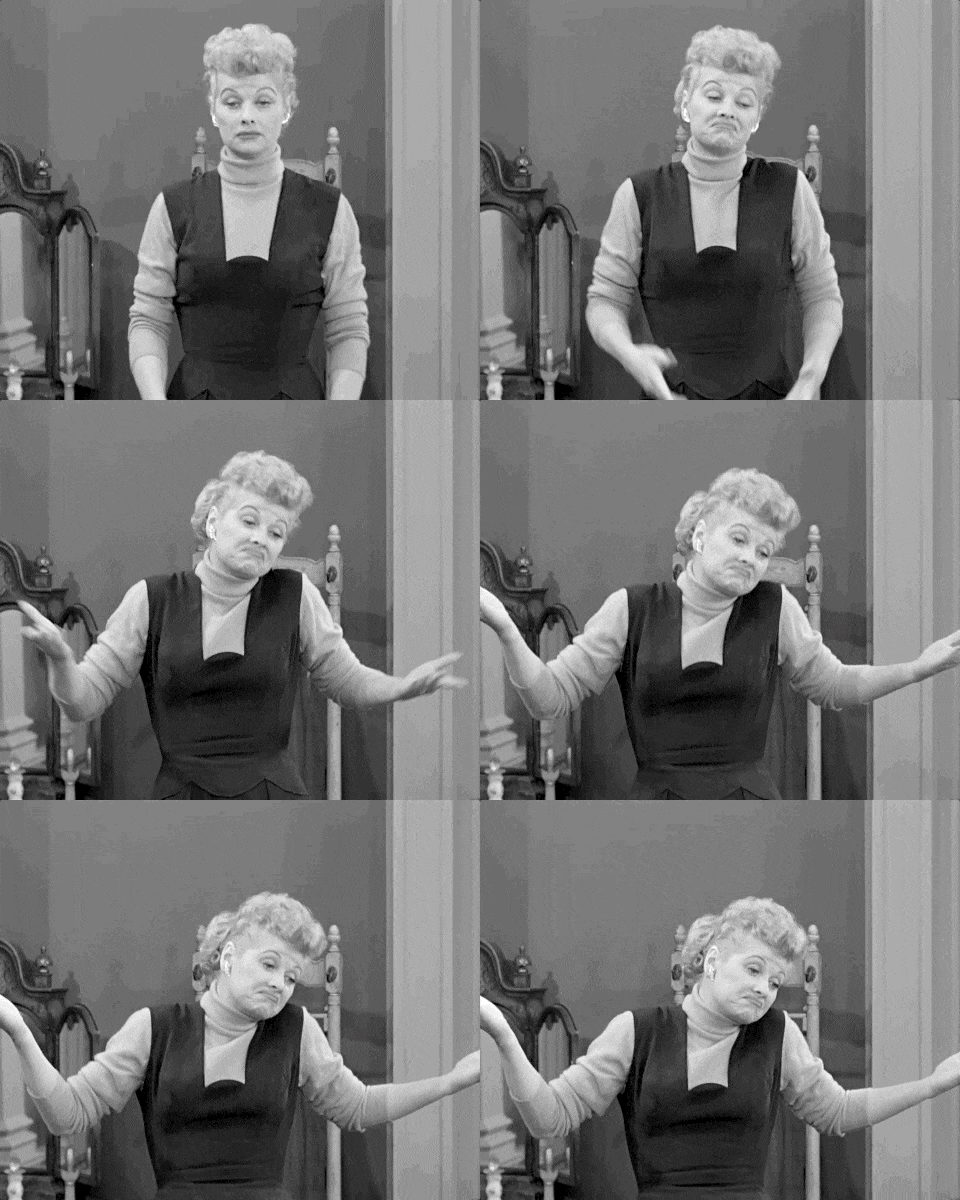
Animated gif of actor Lucille Ball, in character as “Lucy,” shrugging broadly and and squinching her face in a “Whaddaya do?” kind of expression

Like a Flat Tire

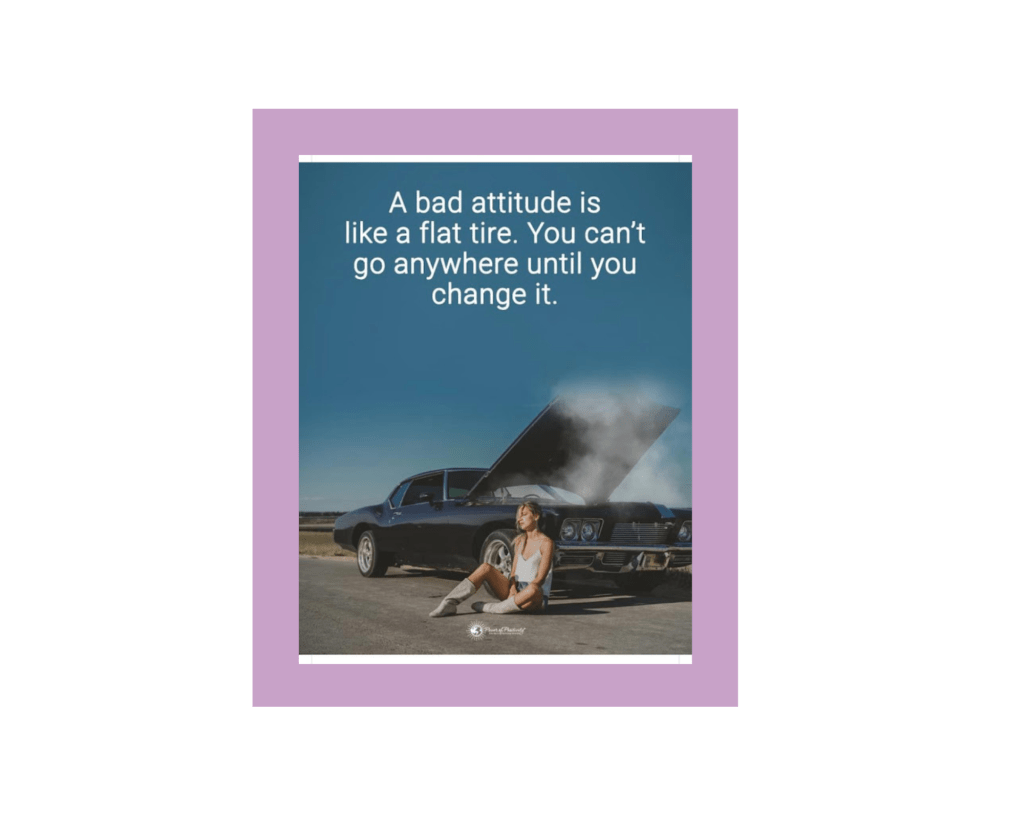
The top two thirds of the photo is just clear blue sky, with white sans serif letters over it that read, "A bad attitude is like a flat tire. You can\'t go anywhere until you change it." The bottom third of the photo is a navy blue muscle car (sorry, I can't tell the make or model, I don't know kinds of cars) with its hood popped open, with digital smoke coming from the engine. The car is pulled over to the side of a road in a flat landscape. A tan, thin, blonde person in a white tank top and jean shorts leans against the passenger side of the car (yes, sitting on the actual road, which seems inadvisable), looking dejected and frustrated. The source is Power of Positivity.
The top two thirds of the photo is just clear blue sky, with white sans serif letters over it that read, “A bad attitude is like a flat tire. You can’t go anywhere until you change it.” The bottom third of the photo is a navy blue muscle car (sorry, I can’t tell the make or model, I don’t know kinds of cars) with its hood popped open, with digital smoke coming from the engine. The car is pulled over to the side of a road in a flat landscape. A tan, thin, blonde person in a white tank top and jean shorts leans against the passenger side of the car (yes, sitting on the actual road, which seems inadvisable), looking dejected and frustrated. The source is Power of Positivity.

I don’t have a clear visual of both tires on the driver’s side, but this vehicle doesn’t appear to particularly lopsided.

And even if they were both as flat as pancakes, the state of those tires is functionally irrelevant in terms of forward momentum, because the engine is smoking.

It’s not the most convincing Photoshop on the smoke, but then again it’s actually comforting to know that it was added in post, in case this person was asked to pose in shorts on hot asphalt, leaning against a dark car in full sun. (It seems likely that they were also shot separately, but I am not an expert digital manipulation sleuth.)

The point is that all four tires could get changed as fuck, and this automobile would not be going anywhere.

I don’t think I could create a better representation of the characteristic gaslighting of Toxic Positivity if I tried.

See, this message insists that a specific thing has to be done, and done by the metaphorically stranded motorist that is you, at the expense of engaging with the more salient situational factor that you’ve clearly accepted is beyond your control.

(This is based on my interpretation of the driver’s look of defeated exhaustion as an acknowledgement that they aren’t in a position to fix the engine, rather than an indication of a bad attitude towards an unambiguously unfortunate circumstance.)

It may be that the creators of the macro, who probably just added text to an existing stock image, intended the driver to be an embodiment of a bad attitude. I don’t know.

But still, in that case, what the actual fuck does a different attitude accomplish in this situation?

Putting on a smile while you wait for AAA does just as much good as a changing a tire on a car that won’t start. Sure, it might feel better to do, and that’s enough reason to do it! But don’t pretend it’s going to solve the bigger problem.

I’ve been consciously avoiding gendered pronouns in my descriptions, which I generally try to do unless gender is central to my commentary, but that’s really the second elephant in the awkward room created by this macro, isn’t it?

(The first elephant, if you’re keeping track of elephants, is the fact that the folx who made this beauty couldn’t be bothered to find an actual image of a car with a flat tire, but also don’t think that this discrepancy should prevent you from accepting their feel-good life advice.)

Power of Positivity tends to paint with pretty broad strokes, and their consistent framing of whiteness and heterosexuality as default states of being is just the very tip of their victim-blaming iceberg.

So what the heck. Let’s make some irresponsible assumptions about gender, for old times’ sake.

Let’s suggest that we’re dealing with a conventionally attractive young white lady whose fancy hot rod broke down.

The image is basically a boring cis het dude’s wet dream.

Viewed through the lens of the straight male gaze, a lens I grew up believing was both normal and fine, I get the sense that this woman is meant to be seen as

a) helpless and

b) eager to smile when a thoughtful, helpful, handy man who just happened to be driving by informs her that she ought to change her attitude, and maybe also that she’d be much prettier if she just smiled.

Like, maybe she’ll be a little feisty at first, and maybe she’ll briefly show up Mr. Gosh-Are-You-Okay-Miss by having some advanced technical knowledge about what’s under the hood of this machine that dudes are always trying to explain to her, but you just know she’ll ultimately benefit from this totally-innocent-and-non-predatory-hashtag-not-all-men interaction.

Et voilà, I’ve just written Flat Tire, a new romantic comedy to be directed by Judd Apatow.

I assume you can figure out the other, wetter dream on your own.

At any rate, just a reminder that while it’s a good idea to be aware of what your own attitude is doing, the advice to focus on that exclusively is often a diversion from what’s causing your attitude to be “bad.”

And a reminder that context matters.

The place that’s pushing for you to buy tires probably doesn’t give a shit about your engine.

What You Feed Your Mind

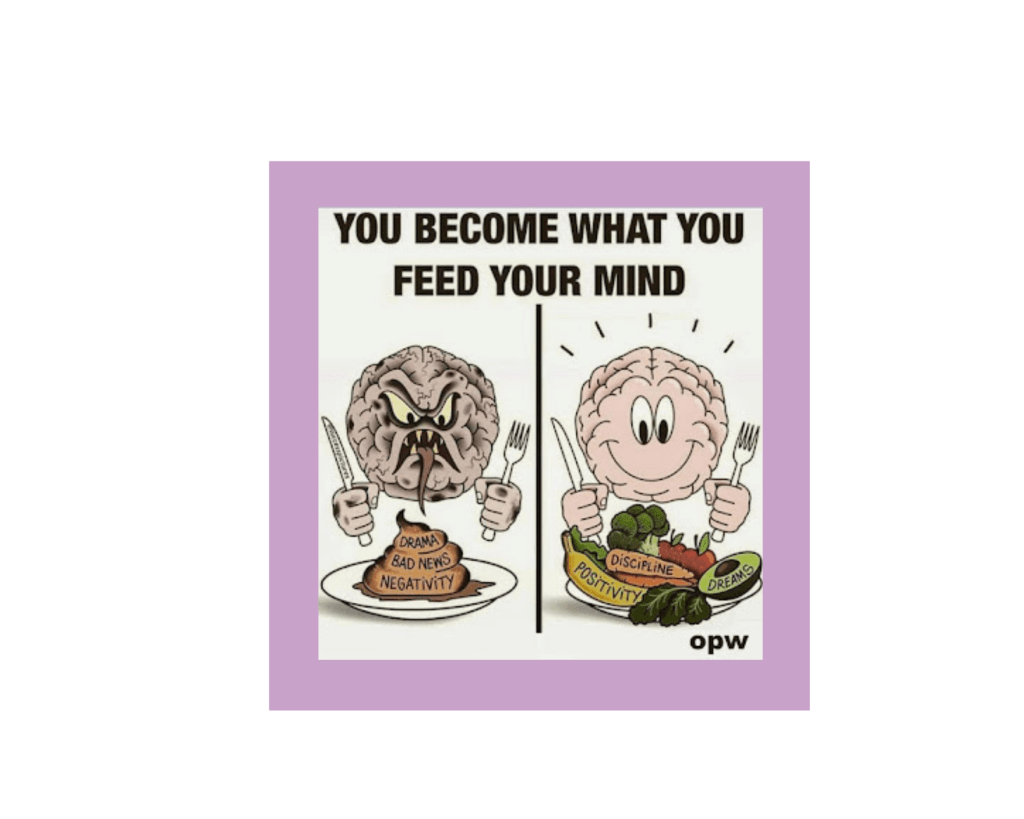
[A cartoon image of two pink cartoon brains with faces and floating hands. There is a black line between the two brains to separate them. The brain on the left is grotesque and scary, with angry eyes and a frowning, open mouth that reveals pointed teeth and a long pointy tongue. The brain and its floating hands are covered with either spots of dirt or bruises. The floating hands are clutching a knife and a fork, and the brain itself is hovering over a plate of what appears to be a pile of excrement (although the illustrator held off of making it too visually unpleasant so that the pile is more like the poop emoji or a swirl of chocolate soft serve ice cream). The poo has the words "Drama, Bad News, Negativity" written on it. The brain on the right is clean and happy, with a big smile on its face and excitement lines coming out of its head. The position is the same - clutching the eating utensils and hovering over a plate - but the plate is full of fresh produce: apples, broccoli, and lettuce, as well as a banana that says "Positivity," a carrot that says "Discipline," and an avocado that says "Dreams." The slogan, in black impact font at the top, reads, "You become what you feed your mind." It has the letters "opw" at the bottom, presumably for an organization but I can't determine what organization it is, and the bad brain's knife has a copyright for "successpictures" running down the blade.
[A cartoon image of two pink cartoon brains with faces and floating hands. There is a black line between the two brains to separate them. The brain on the left is grotesque and scary, with angry eyes and a frowning, open mouth that reveals pointed teeth and a long pointy tongue. The brain and its floating hands are covered with either spots of dirt or bruises. The floating hands are clutching a knife and a fork, and the brain itself is hovering over a plate of what appears to be a pile of excrement (although the illustrator held off of making it too visually unpleasant so that the pile is more like the poop emoji or a swirl of chocolate soft serve ice cream). The poo has the words “Drama, Bad News, Negativity” written on it. The brain on the right is clean and happy, with a big smile on its face and excitement lines coming out of its head. The position is the same – clutching the eating utensils and hovering over a plate – but the plate is full of fresh produce: apples, broccoli, and lettuce, as well as a banana that says “Positivity,” a carrot that says “Discipline,” and an avocado that says “Dreams.” The slogan, in black impact font at the top, reads, “You become what you feed your mind.” It has the letters “opw” at the bottom, presumably for an organization but I can’t determine what organization it is, and the bad brain’s knife has a copyright for “successpictures” running down the blade.

Ah, yes, the two food groups: steaming shit and fresh produce.

Why feast on the disappointing Poop of Negativity when the Avocado of Dreams is within reach of the fork you’re using to eat the deconstructed mishmash of the salad that is life?

A powerful reminder, to be sure.

I might be overthinking this*, but fruit turns into poop, right?

I promise I understand that the image is meant to emphasize the contrast between the brains and their diets rather than depicting any direct correlation between them, which is why we go from poop to fruit.

But still…

I’m just saying that the contents of that shit pile used to be something else.

It’s the circle of life.

I feel like the Angry Krang recognizes that its dreams and positivity have served their purpose, and it’s only left with bitter, smelly remnants to work with, but is still committing to feeding itself with whatever’s on hand, so, honestly, that looks a little more like the face of resilience to me.

Sub-question: are the pointy fangs and lizard tongue practical evolutionary adaptations for a coprophage?

Like I don’t know much about what kind of ecosystems are happening in Dimension X.

Maybe Angry Krang is a predator who is also willing to scavenge?

I’m very interested in the morphology of Happy Krang, because if it’s got the same tooth and tongue situation, I just don’t think that fruit and veg plate is going to be a walk in the park.

I like to think that this is literally explaining that some brains are herbivores and others are predators, and showing how they developed appropriate adaptations over time.

I suspect that this may be a case of divergent evolution, and that this image has actually been shared as a picture on the page “Science Diagrams That Look Like Shitposts” in an alternate universe.

*I am overthinking this

The Generation That Respected Our Parents

Content warning: reference to child abuse; guns; death

An image of a brick wall, with white text, mostly in a bulleted list, that reads, “I’m part of the generation that:
Respected Our Parents
Drank From a Garden Hose 
Stood for the Flag 
Played Outside 
Had Toy Guns 
Got Spanked 
And I SURVIVED
SHARE IF YOU DID TOO!” There is also a smiling Minion wearing goggles, from the “Despicable Me” franchise. The credits in the lower right-hand corner say “Minions - for the Old Folks.” Really.
An image of a brick wall, with white text, mostly in a bulleted list, that reads, “I’m part of the generation that:
Respected Our Parents
Drank From a Garden Hose 
Stood for the Flag 
Played Outside 
Had Toy Guns 
Got Spanked 
And I SURVIVED
SHARE IF YOU DID TOO!” There is also a smiling Minion wearing goggles, from the “Despicable Me” franchise. The credits in the lower right-hand corner say “Minions – for the Old Folks.” Really.

As an elder Millennial, I admit that the rhetoric of the whole Millennials (et al.) vs. Boomers (et al.) feud can feel irrelevant and reductive at times.

As much as I love the utility of an all-encompassing catchphrase, and respect parody in the service of iconoclastic comedy, “Okay, Boomer” is sometimes used in ways that force much more complicated issues into the framework of a simple generation gap.

So, I acknowledge that simple inter-generational snark has its limits.

Still, I’m going to paint with broad strokes today, because this macro has handed me an enticingly broad brush.

I’d almost like to believe that this was created by a 30-something with more qualifications and fewer prospects than most financially-secure 65+-year olds ever had to face, but ultimately I think it reads like a genuine artifact by and for “the Old Folks.”

Most of the bulleted items are clearly dog whistles, but I’m really hung up the “garden hose” one.

“Respect for parents” covers all manner of “kids these days” sins: majoring in English, not having kids when it sure seems to be the right time, enforcing healthy boundaries, being gay… the list goes on.

No respect.

In “stood for the flag,” we have a defense of all kinds of thoughtless patriotism, including implicit support for police brutality and the willingness (some might say obligation) to attempt to conceal the hardwood foundations of American racism beneath the questionable beige carpeting of respectability politics.

“Played outside” feels like general pearl-clutching about the Video Games, the Computers, and/or All Those Electronic Devices turning everyone into screen-obsessed couch potatoes (who also know how to set up All Your Electronic Devices).

“Had toy guns” could be an enormous and depressing post of its own, but we’ll just settle here for a general preference to minimize the scope and sociopolitical clout of the NRA.

That spanking bullet is good old Normalization of Child Abuse*.

And then what’s left is… non-traditional drinking apparatus.

Am I missing the dog whistle?

My best guess is that it’s somehow meant to be sissy (read: feminine-adjacent; read: weak; read: inferior) to NOT be willing to drink out of the garden hose, but I also have to admit that still feels like a stretch.

Just, has drinking out of a hose vs. a faucet really ever been a point of contention? It’s so oddly specific.

BOOMER: You look like someone who used a KITCHEN tap your whole life! Go ahead. Drink from this sun-hot rubber hose.

MILLENNIAL: I mean, I CAN, I’m not technically opposed to it, I just don’t see why…

B: DRINK IT!

M: …if I do, will you stop telling me to hit my kids?…

B: *shakes head slowly*

*maintains eye contact*

*proffers hose*

Also, the whole “Share if you survived!” thing feels unnecessarily cruel (but then again, I’m one of those Easily Offended Millennials, so what do I know?).

I think the intended meaning of “I survived” is just an effort to minimize the validity of all of these other debates.

Like, “Geez, no one DIED.”

Except… some people did.

Because of institutionalized racism.

Because of child abuse.

Because of both real and toy guns.

The dead ones just aren’t out there posting Minion memes.

Animated gif of Ted Danson on the show “The Good Place,” holding up a plush Minion doll in amazement

*This is actually old but it is not actually good

Happiness is Just Four Tricks Away! (Special Bonus Rant: Business Insider Edition)

Content note: animated gif

I don’t feel obligated to protect the identity of the original author here, since it’s just a widely available article.

He’ll be fine.

So, the original title of the piece we’re working with today is “I’m Taking Yale’s Class on Happiness – and Halfway Through, These 4 Tricks are Already Working.”

Good for you, buddy.

I knew there had to be a trick to substantive, lasting, soul-fulfilling happiness!

And it seems so right that a white dude named Justin should be the one to reveal those tricks to me.

After spending just a few weeks taking an course created by an elite institution.

You see, hacking happiness works like flying with pixie dust (an equally actual thing).

It’s just as simple as changing your habits.

I wonder which bad habit Justin started with first.

The “too much melanin” habit? Perhaps the “too much estrogen” habit? Maybe the “not enough money” habit, or the “neurodivergence” habit?

“Again, the point here is that these positive habits have been tested and proven to work, based on psychological science.”

The creator of the class he’s taking has “collected all the psychological science out there,” so I’m glad that’s been taken care of.

Mmmm. Delicious, objective science. Home of the placebo effect.

Which is totally irrelevant here.

The science is in, because science is about finding absolute answers and shutting down further inquiry, and the history of psychology research is also free from bias, caveats, or limitations.

Unrelated, maybe don’t look up “replication crisis.”

Anyway, it’s comforting to know that it only takes five weeks to get the gist of this happierness thing. That’s way faster results than I got from that cult I joined last year.

The four “tips and tricks” Justin has chosen to feature in this piece of substantive journalism for Business Insider, a publication with no investment in maintaining a docile and uncritical workforce, are:

  • Focus on Your Strengths
  • Invest in Experiences
  • Learn to Savor More
  • Express Gratitude and Spread Kindness

So simple. So practical. So efficient.

I’m sure some asshole could find a lovely sunset to superimpose this list onto, and then we’d really be in business.

Regardless of circumstance, happiness is equally available to anyone who follows these easy steps.

It doesn’t matter whether they were born already owning a yacht or if they’ve lived their entire lifetime without access to professional health care. It’s still true that both of those hypothetical people have strengths and things to be grateful for!

A cynical person might suggest that “happiness” as an end goal could be seen as a convenient diversion for rich people by rich people to avoid engaging with the real reasons that unhappiness is so persistent in the world in the first place, and maybe even as an excuse to blame unhappy people for their own failures rather than accepting at least partial complicity in perpetuating oppressive and exploitative systems.

But that’s just not backed by the entirely unflawed, objective, and apolitical science of psychology.

I wasn’t sure if there was any way I could savor this listicle masquerading as an article any more than I already did, but then I read the advice in the voice of the Hedonismbot from Futurama, and added the words “in bed” to the end of every sentence, as per fortune cookie tradition.

  • Focus on Your Strengths … in bed
  • Invest in Experiences … in bed
  • Learn to Savor More … in bed
  • Express Gratitude and Spread Kindness … in bed
Animated gif of the Hedonism Bot character from Futurama, eating bunches of grapes and saying “I apologize for nothing!”

Closing thoughts:

There is plenty of trustworthy research that supports some aspects of positive psychology.

And the goal of understanding how to help humans feel less bad about living their lives certainly has value.

And I grant that the kinds of suggestions provided in the article are purposefully framed to be as generalizable as possible, in order to be applicable across more circumstances and contexts, so that they aren’t as easily dismissed by a jerk like me saying, “That’s not actually practical for most people.”

Still, I can’t get over how it’s decontextualized to the point where the reasons why we need to study and practice something as fundamental as “experiencing good feelings” are secondary to the goal of “experiencing good feelings.”

The fact that positive psychology is so widely embraced and promoted by rich white people definitely gives me pause, when it is also largely a framework that blames disenfranchised individuals for not having felt or thought right.

On this blog I’ll frequently reference Barbara Ehrenreich’s book Bright-Sided: How Positive Thinking is Undermining America. In this excerpt, she describes some encounters she had with Martin Seligman, the “father of positive psychology.” She writes, “When one audience member proposed renaming positive psychology ‘applied behavioral economics,’ because ‘it’s popular in business schools and goes with high salaries,’ nobody laughed.” The popularity of positivity psychology and its disdain for ‘learned helplessness’ reminds me too much of social Darwinism as a means of justifying beliefs that disproportionately harm members of already marginalized populations.

I’m not here to question whether there’s merit in recognizing strengths, having experiences, savoring things, and expressing gratitude.

I advocate for all of these things.

Just, maybe feeling happy after understanding and practicing these habits isn’t as much a “trick” as it is a normal consequence of not ceding control of your good feelings to a ubiquitous conglomeration of rapacious systems that benefit from your misery.

Expect Nothing

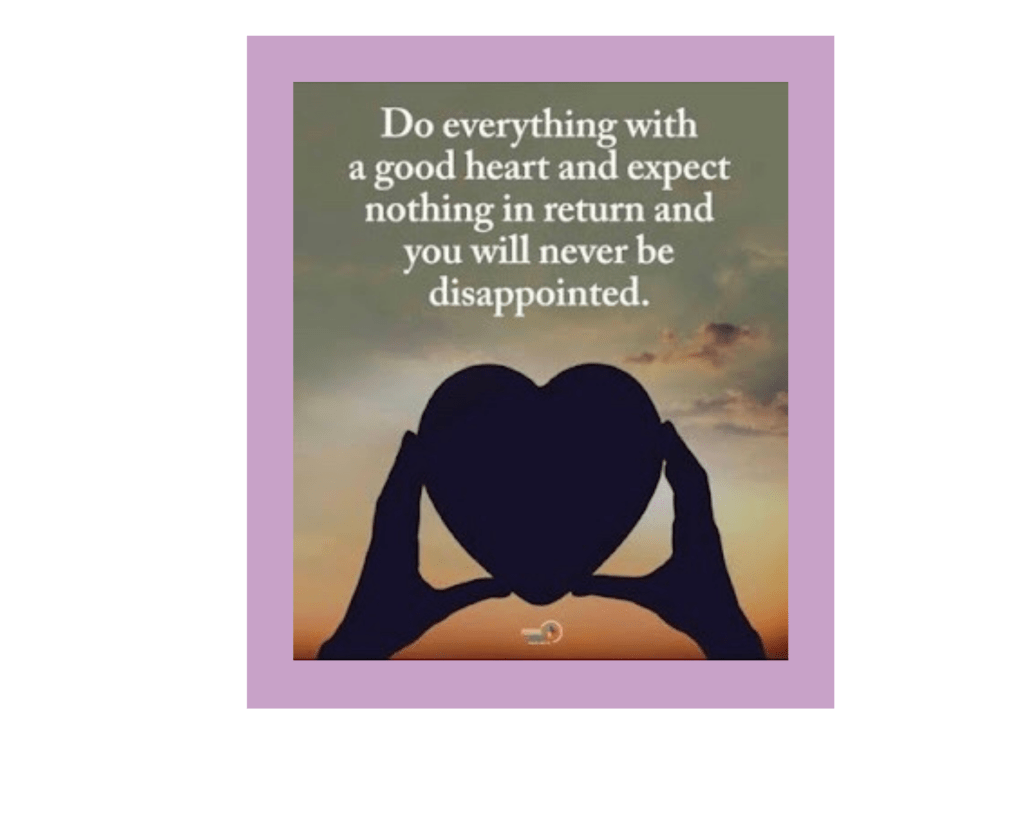
 A photo of a silhouette of two hands holding up something heart-shaped (the common Valentine's Day-style heart icon, not like the shape of a human heart, in case you needed the clarification) in front of a sunset. The heart is aligned with the sun, so the sunbeams and color gradation appear to be radiating from the heart. The white serif font says, "Do everything with a good heart and expect nothing in return and you will never be disappointed." The source is "Power of Positivity."
 A photo of a silhouette of two hands holding up something heart-shaped (the common Valentine’s Day-style heart icon, not like the shape of a human heart, in case you needed the clarification) in front of a sunset. The heart is aligned with the sun, so the sunbeams and color gradation appear to be radiating from the heart. The white serif font says, “Do everything with a good heart and expect nothing in return and you will never be disappointed.” The source is “Power of Positivity.”

Did you ever read The Giving Tree?

It’s the story of a tree that is happy to become a useless stump after a little boy has used up all its resources without ever reciprocating her kindness or apologizing for the impact of his actions.

The tree doesn’t feel disappointment or regret about all the apples it could have produced, because that would mean that it expected something in return from the person who stripped it of its vitality, and that would mean that the tree couldn’t really have been good-hearted!

We need the tree to be good-hearted in order to want it to be happy, because happiness should only belong to those who we think deserve it, right?

People who insist on interpreting that lovely little story as “unhealthy” just have bad, bitter hearts.

The message in this macro suggests that ultimately, it’s your motives that really matter more than your actions.  If your heart feels good when you do something, that is 100% of the battle.

Also, your (lack of) expectations should really outweigh other people’s actual responses to what you’ve done with all your good-heartedness.

Your expectation of no reciprocation or acknowledgment is more important than the possibility that the person/people you’re doing goodness at might want to a) do something nice for you in return or b) express dissatisfaction with what you so well-meaningly chose to do in the first place.

Why should their feelings matter? We’re talking about your inner peace!

At any rate, the real end game here is avoiding disappointment. Disappointment is the worst! You don’t want to have any more of that in your life than absolutely necessary, am I right?

Expectations lead to disappointment, which is bad, so don’t expect things.

Not having to learn how to deal productively with disappointment is an important part of becoming a well-rounded and responsible person.

While originally working on this post, I had the vague sense of having read that Shel Silverstein himself was kind of ambivalent about The Giving Tree. I thought that he may have viewed it as sad, or at least didn’t necessarily see it as the easy-breezy life advice it’s often taken for.

This New York Times article is the best I could come up with to validate my fuzzy semi-recollection, and the only relevant Silverstein quote it provides is simply that the book was “about a relationship between two people; one gives and the other takes.”

Not exactly a resounding endorsement of the tree’s caring nature, but also not a condemnation of the boy. 

It’s not ethical to speculatively diagnose people with mental illnesses (particularly dead people (and even more particularly dead people I never met)) and yet I would not be shocked if Silverstein struggled with depression.

His child-directed work typically counterbalances its fundamental darkness with humor, hope, and whimsy, but that darkness is pervasive.  Even his simplest pieces often have multiple layers, and the overall ethos of his poetry collections feels subversive in a way that is unlikely to have stemmed from a life of persistent contentment. 

My reason for bringing up his background is that the person behind the creation of The Giving Tree, a book that is famously used to reinforce the message from this macro, probably didn’t view it as a saccharine or straightforward text.

The fact that people tend to view the book as either sweet or wholly unsavory  just demonstrates our cultural tendency to disengage from nuance.

We can’t know his thoughts for sure, but it seems unlikely that The Giving Tree was just a weirdly earnest exception to his characteristically winking jadedness.

The poignancy of the ending isn’t because the tree always did the right thing or because the boy-turned-old-man learned a valuable lesson.

It’s sad because it’s an honest, descriptive representation of a common and bittersweet dynamic. 

The tree is a metaphor (gasp!) but the literal story rings true. Givers are at risk of giving themselves to death to takers who never questioned their own right to have.

It seems to me that the moral of the story is not to lionize either character, but to question them both. You don’t really want to be the dead, devoted stump or the oblivious ingrate. 

(Note: I actually don’t have a copy available for reference, so I’m relying on my memory. I don’t think there’s a message on the last page that says something direct like, “the moral of the story is…” but if there is, I grant that this would affect my interpretation.)

A few years ago, I revisited another short Silverstein favorite from my childhood: The Missing Piece Meets the Big O.

I cried a lot more than I expected to (which had been “not at all”).  

To summarize:

The Missing Piece is a little sentient triangular wedge that doesn’t know where it fits in. The world around it is populated by rolling Pac-Man-like circles. The eponymous Piece hopes to complete one of these circles by fitting perfectly into its empty slice-of-pie space. Once that happens, it will know where it belongs. There is always some reason why it’s not a good fit with the available options, though. At one point, the Missing Piece is picked up by a rolling Pac-Man with a gap that complements its shape. Together, they create a perfectly round circle and enjoy rolling happily along.

But that’s not the end.

Unexpectedly, the Missing Piece begins to grow. It no longer fits into what it thought was its intended place. Both Piece and Pac-Man are disgruntled. They had expected everything to stay the same, but once that becomes unsustainable, they go their separate ways. Or rather, the Pac-Man goes its own way, because the Missing Piece is shaped like a doorstop and has limited mobility. Then the Big O rolls by. It’s already a perfect circle with no evident gaps or missing bits. They get to talking, and the Missing Piece is drawn to the Big O, but there doesn’t appear to be a place for it to fit. The Big O is already complete and self-sufficient. The Piece asks if it can come along anyway, and the O simply states that they’re not currently able to move in the same way at the same pace. It’s matter-of-fact rather than condescending or discouraging. The O notes it would be nice to meet again some day, and then goes on its way. The Missing Piece proceeds to pull its angular body up until it flops over, time and again, and as it moves forward its pointy edges begin to wear off. It’s awkward and difficult and it takes some time, but the Missing Piece becomes a circle capable of rolling on its own. It no longer needs to wait for a perfectly complementary Pac-Man to pick it up and carry it around, and in this way, it’s able to rejoin the Big O. 

It’s possible to read this as a “pull yourself up by your bootstraps” narrative, but as with The Giving Tree, I think that’s too simplistic.

It would also be possible to read this as a suggestion to adapt yourself until you’ve become more palatable for someone you like, but that also misses the point.

This story is about co-dependence, self-determination, and agency.

Unspoken expectations also come into play. Part of the reason that the Piece is consistently disappointed with its own loneliness is that it isn’t really communicating its expectation of completion to the various Pac-Men it meets. The Piece expects them to complete it just as much as it completes them, which is a pretty big ask.

The Piece has presumably never seen wholeness and self-sufficiency represented as a viable option before, so it’s not entirely the Piece’s fault for concluding that it must have been incomplete.

The character of the Big O demonstrates the necessity of representation.

Once the Piece sees that it’s actually possible to travel around without having the perfect partner, that’s the choice it makes.

Its physical changes aren’t superfluous cosmetic accommodations as much as they are the practical consequences of changed behavior. 

So what does The Missing Piece have to do with The Giving Tree and this message of benevolent subservience?

Expectations, communication, and complexity.

Whether the author intended it or not, the absence of real, honest communication is one of the quiet little tragedies in The Giving Tree

Suggesting that “The tree made her choices, so if she didn’t want to be used up and hollowed out, she should have said so” is the kind of rationalization used by people who have been unreasonably demanding.

The boy never had to experience disappointment in his relationship with the tree because his requests were always indulged.

What if he had checked in on the tree more often? What if he had declined to accept something that she offered? It’s the fact that he isn’t shown to communicate any kind of awareness of the needs of others that leaves many readers cold. 

At the same time, it’s possible to interrogate the patterns of seemingly kind choices made by some people (or anthropomorphic trees) and call attention to the ways that they aren’t really all that helpful or supportive.

As always, context matters.

The tree never deflected by saying anything like, “I’d love to help you, but this isn’t a good time for me right now” or “I like to feel useful and needed, so it’s easy for me to say ‘yes’ to things that might actually overextend the resources I need to take care of myself.” 

She may well have been disappointed and felt abandoned if the boy didn’t ask such significant favors of her.

The macro message suggests that you should behave in ways that will help you avoid the disappointment of unmet expectations.

And it’s true that there can be value in lowering expectations, because maintaining unreasonably high or unspecified expectations can be incredibly frustrating and disappointing.

But disappointment is part of life. You can’t avoid it forever.

It happens, and then you need to move on.

The Giving Tree is often (mis)used as advice for avoiding disappointment.

The Missing Piece Meets the Big O is about moving forward after it happens.

And both stories are about the things we don’t say that might be better off said.

Happy Valentine’s Day!

The More Chances You Give

Content note: animated gifs

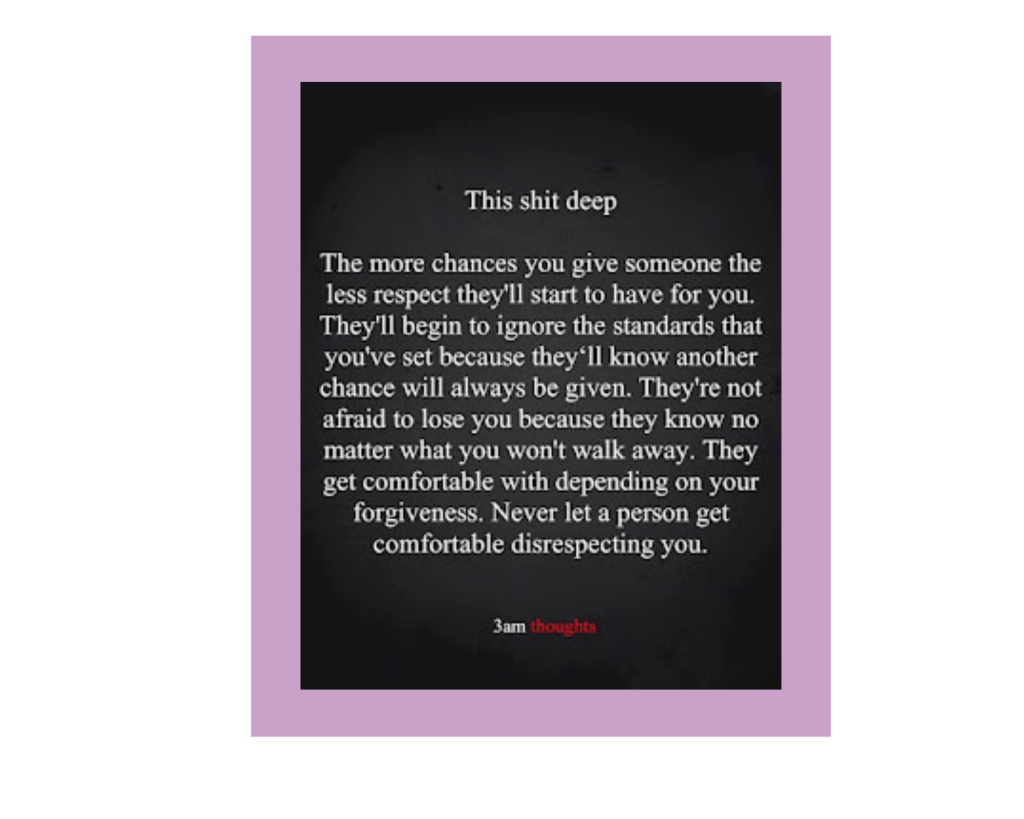
A black square with a large block of text in a white serif font. Centered at the top is the single line, "This shit deep." Then there is a space, and the rest of the message: "The more chances you give someone the less respect they'll start to have for you. They'll begin to ignore the standards that you've set because they'll know another chance will always be given. They're not afraid to lose you because they know no matter what you won't walk away. They get comfortable with depending on your forgiveness. Never let a person get comfortable disrespecting you." At the bottom, the source is attributed as 3 AM Thoughts, with the word "Thoughts" in a red font.
A black square with a large block of text in a white serif font. Centered at the top is the single line, “This shit deep.” Then there is a space, and the rest of the message: “The more chances you give someone the less respect they’ll start to have for you. They’ll begin to ignore the standards that you’ve set because they’ll know another chance will always be given. They’re not afraid to lose you because they know no matter what you won’t walk away. They get comfortable with depending on your forgiveness. Never let a person get comfortable disrespecting you.” At the bottom, the source is attributed as 3 AM Thoughts, with the word “Thoughts” in a red font.

Reading this macro made me think of the character Sir Didymus from Jim Henson’s Labyrinth

Animated gif of the dog muppet character Sir Didymus from the film Labyrinth, gesturing grandly with the words “The air is sweet… and fragrant” in white text across the bottom

You know, the aggressively confident guardian of unspecified values that he’d die to defend? 

The chivalrous gentleman who overcompensates for his diminutive stature by constantly asserting his dominance?

The scrappy li’l fella with no qualms about starting any beef with anyone at any time?     

Yep, that’s the one.

This post is for that hairy little Muppet. 

If you’re not familiar with the story of Labyrinth, it’s not entirely unlike The Wizard of Oz.

A plucky young lady goes on a magical journey of self-discovery, along the way gathering various supportive companions who are actually personifications of her inner struggles and desires.

In Oz, Dorothy’s motley trio perceive themselves as cowardly, foolish, and heartless, but later reveal themselves to be respectively brave, clever, and compassionate.

Henson’s then-contemporary fairy tale is a bit darker and a bit more introspective.

Whether it was intentional or not, heroine Sarah’s companions appear to be a trio of maladaptive coping mechanisms. 

Even at their worst, Sarah treats her neurotic friends with empathy and understanding, and she stays patient with them when they lean on problematic behaviors under pressure.  

Before it’s all said and done, our teenage protagonist needs a one-on-one sexually-charged power struggle with David Bowie*, but we’ll keep the focus on her little band of misfits. Each of them is able to achieve some kind of closure in the prelude to the big dance party at the end.

Hoggle represents self-doubt. He doesn’t think he has any real value, so his vulnerable and genuine offer to help if he’s needed – with the implicit understanding that he’s worth being needed, and that he can show up for his friends – demonstrates considerable growth.   

Ludo is a people-pleaser. He gets his sense of self-worth from being helpful to others, so it’s important for him to be able to hang back and not take on the burden of Sarah’s conflict. (His character is actually far less problematic than the other two, but I shoehorned him into this analysis for consistency. Also, wouldn’t it make sense for a people-pleaser to fade into the background in the presence of more assertive personalities?)

And Sir Didymus? 

He’s pure ego, and he learns to back the fuck off. 

Didymus would never hesitate to swoop in to save the day. But in his final scene, he recognizes that he can’t. It’s more heroic for him to stand aside, and he does this admirably (if regretfully). 

So. 

Again, Didymus, this post is for you.

(Please note that the therapist voice below is used for comedic effect, and so some instances that sound condescending in this ostensibly entertaining parody would not be appropriate in real life.)

I can tell how sincere you are when you say, “Never let a person get comfortable disrespecting you.” You have always upheld this value tenaciously, haven’t you?

I wonder what might happen, though, if we reconsidered some of your language choices.

I’d like to know whether you define “disrespect” as an inner feeling that you have, like a sense of a lack of deference, or if you define “disrespect” as a behavior or action that someone else does, like looking at you the wrong way.

If “disrespecting you” is an action, then I understand how you might feel compelled to reciprocate with action. 

One available action is certainly screaming wildly and charging at your antagonists with a lance.

You’ve made a lot of points that way, haven’t you?

I wonder if you might have some concerns about porous boundaries, because those can turn into poor boundaries, and then everyone feels like they can just traipse through your bog willy-nilly.

So let’s agree that it’s reasonable to be protective of your space.

But I’d like to propose another framing. If you never let anyone get comfortable making mistakes around you, they’re never going to get comfortable around you, period. Because everyone makes mistakes.

And if people feel defensive because they’re afraid they might get attacked, their behavior might be more likely to come across as disrespectful to you.

So maybe we can be open to the possibility that everyone isn’t always trying to disrespect you.

I know you’re brave enough to handle that. 

If by “disrespecting you,” you simply mean a feeling that someone might have about you (like, say, Ambrosius), maybe we can examine the difference between what you can control and what you can’t.

I’m afraid that you can’t control whether people feel respect for you or not.

That’s hard, fuzzy buddy.

That isn’t because you did anything wrong or didn’t try hard enough. I can see how hard you’re always trying, every day. 

Your own behavior does play a role in others’ perception of you, but their reactions to your behavior are affected by a lot of things that you simply can’t fight off.

I want to let you know that you’re so strong for sitting with your discomfort without yelling or barking. I heard a little growl, and that’s okay, too.

Before we finish today, I’d like to consider your idea that offering second chances is a sign of weakness, and that people are bound to disrespect you and take advantage of you if you forgive them. 

Can we really examine the implications of that?

“They get comfortable depending on your forgiveness.”

Is comfort really so bad, Didymus?

Should everyone be expected to agonize over the prospect of your displeasure? 

I remember how you went after sweet old Ludo just as hard as you went after that horde of goblins. But all Ludo was trying to do was cross a bridge to help his friend, while the goblins were really planning to hurt you.

I’d say that I understand why Ludo and Sarah might have been unhappy with you. And I also think that you appreciated having their forgiveness. 

Have you been hurt by someone before, Didymus?

You don’t have to answer that right now. Just think about it when you can.

I know how much you love being a good guy, I really do.

But what’s “good” in some situations isn’t necessarily always “good.”  

And what’s toxic in some situations isn’t necessarily always toxic.

I mean, you literally live in a toxic swamp. And you love it, and that’s okay.

I understand how it can be comforting to have control over the definition of whose behavior is really toxic, so you be fully confident in asserting your own authority and telling them that their chances are up.

Sometimes people have ignored your firmly established boundaries. And some people might expect an unreasonable amount of accommodation from you. 

But we still have consider another very challenging possibility here, Diddy: your behavior can be toxic, too.

Be honest: do you think you give Ambrosius enough space to express his feelings?

Does he really have to be afraid in order for you to feel secure? 

You don’t have answer that out loud, either. 

That’s a lot of big questions for one day. You’ve been so patient and so strong. 

It’s okay if you need to fight off a few goblins when you get home. 

And it might be even more brave to remember to say “thank you” to your friends who gave you a second chance.

*Please let this be what happens to us all when we die

Your Enemies Can’t Swim

A photo of mostly dark gray cloudy sky, with a turbulent sea at the bottom. White sans serif text reads, “I asked God, ‘Why are you taking me through troubled water?’ He replied, ‘Because your enemies can’t swim.’” The sharing source is “Purpose of Life.”

Holy shit.

I’ve never loved that “Footsteps in the Sand” poem, but…

* spoiler for the Jordan Peele movie Us*

…but this macro is like encountering the twisted subterranean soul twin of “Footsteps in the Sand,” and then realizing that it was mainstream American Christianity all along.

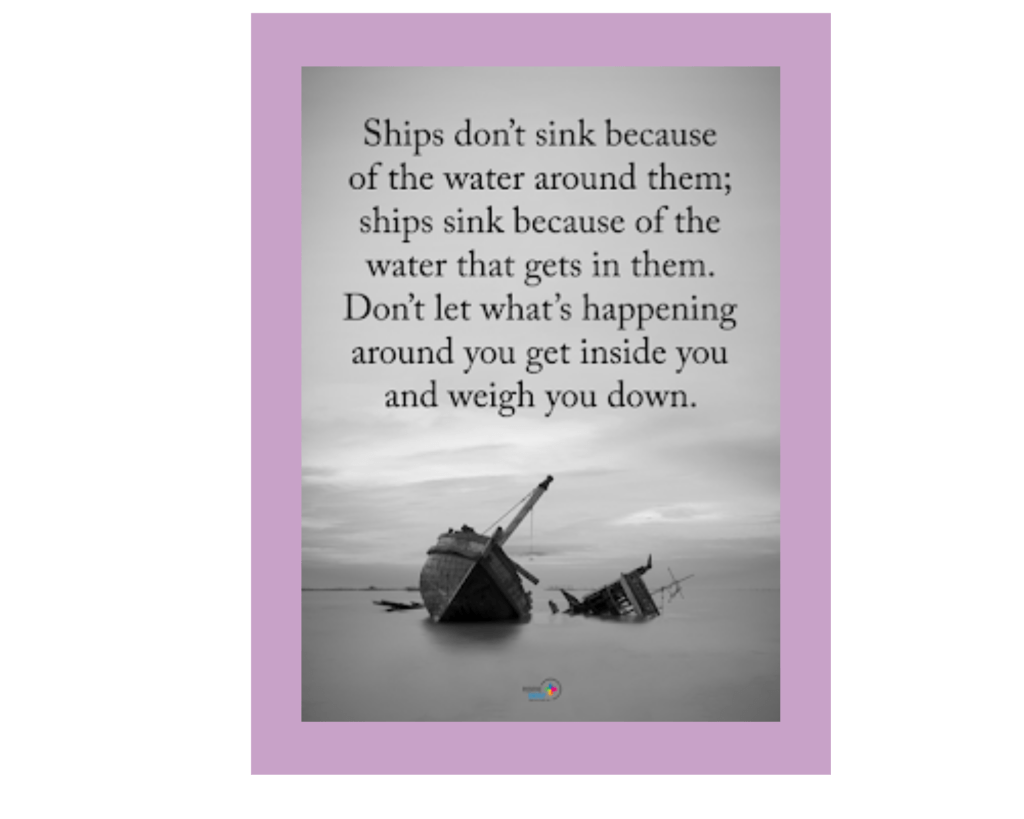
A black and white photo of a shipwreck on a beach at high tide. The ship is in the bottom third of the image, and the rest is mostly cloudy sky. In the sky space, there is black serif text that says, "Ships don't sink because of the water around them; ships sink because of the water that gets in them. Don't let what's happening around you get inside you and weigh you down." The source is "Power of Positivity."
A black and white photo of a shipwreck on a beach at high tide. The ship is in the bottom third of the image, and the rest is mostly cloudy sky. In the sky space, there is black serif text that says, “Ships don’t sink because of the water around them; ships sink because of the water that gets in them. Don’t let what’s happening around you get inside you and weigh you down.” The source is “Power of Positivity.”

Ships sink because they let themselves sink.

The Edmund Fitzgerald just wasn’t trying hard enough.

And don’t even get me started on the Titanic. 

Boo-hoo, poor me, my hulls are all breached!” 

But did it really think about the signals it was sending when that iceberg starting hitting on it? I think maybe somebody wanted to become synonymous with catastrophic hubris.

A Strong Woman

A narrow wooden boardwalk runs through the center of a grassy plain. There are hills or small mountains in the distance. The sky is foggy and gray, and a person in jeans and a red coat is walking on the boardwalk, away from the camera. The black serif font reads, "A strong woman knows she has strength enough for the journey, but a woman of strength knows it is in the journey where she will become strong." The source is "Power of Positivity."
A narrow wooden boardwalk runs through the center of a grassy plain. There are hills or small mountains in the distance. The sky is foggy and gray, and a person in jeans and a red coat is walking on the boardwalk, away from the camera. The black serif font reads, “A strong woman knows she has strength enough for the journey, but a woman of strength knows it is in the journey where she will become strong.” The source is “Power of Positivity.”

And only the truly BEST women* understand that contrived comparisons designed to enable self-superior back-patting by devaluing other women for failing to reach arbitrary benchmarks recently created by internet randos are in fact the STRONGEST of all contrived comparisons.

What is the point of this weird hair-splitting between “women of strength” and “strong women” in the first place?

I mean, aside from encouraging strong women to second-guess the merit of one of their defining assets and instead shift their focus to petty trait-based competition with other women.

Also that boardwalk looks a little more like a “path” to me than a “journey,” but I’m not here to nitpick.**

An Instagram post with a black square featuring white handwriting font. The font alternates between script and print. Before the quotation is the tag @peacefulmindpeacefullife. The quote says, "Behind every strong woman is a story that gave her no other choice." -Nakeia Homer
An Instagram post with a black square featuring white handwriting font. The font alternates between script and print. Before the quotation is the tag @peacefulmindpeacefullife. The quote says, “Behind every strong woman is a story that gave her no other choice.” -Nakeia Homer

Usually I pick on these inspirational macros for framing everything in the world as a choice, so you’d think I’d be happy to see a different spin on that message, but of course I’m never happy about anything (on account of how I choose to be angry and sad all of the time). 

“I choose to be happy.” 

“I choose to be successful.”

“I choose to be healthy.”

“It’s not like there are any systems in place that disproportionately favor the success and stability of people with my particular demographic characteristics! Nope, I am just really good at making the right choices.”

I resist the lie at the heart of the emphasis on choice (in this context) because it’s usually just denial and/or rationalization.

Among other things, people want to believe that society is fundamentally just, and that those who do the “right” things will be rewarded and that those who do “wrong” will be held accountable. Safe people want to believe that they are safe for a reason.

This enables the denial of structural inequality, which is kind of a theme on this blog.

So.

On the surface, this quote isn’t quite playing the “success is a personal choice” game.

It should be an acknowledgement of feminine resilience, right? 

In principle, I understand how I should feel both inspired by the women and angry at the unspoken circumstances.

And yet.

With this framing, I get the sense that strong women did not, in fact, choose to become strong.

It just kind of happened.

Which feels just as problematic as the idea that poverty “just happens” because those people made poor choices. 

Can something that is almost unavoidably dictated by circumstance be intentional? Is “the only choice” really a choice, at that point? 

It’s almost like this quote reverses the typical roles of personal agency and the influence of circumstance that we often see in the “they made their choices” trope.  

Like, “the cards were so stacked against this person that they wouldn’t be here if they weren’t truly exceptional.”

I looked up the person that the quote itself is attributed to, and I want to give her the benefit of the doubt. I’m still a little suspicious of some of her messaging, but I’m also suspicious of messages in general, and in the end she is just living her life and doing her job.

For now I’ll just acknowledge that this quote is decontextualized, and it could very well be part of a more cohesive point.

So to review: instead of emphasizing the centrality of free will and choice, this message (that has presumably been isolated from its original context) accepts the existence of situations in which choice is not the only important factor, but to the extent that circumstance occludes choice.

The blog / podcast You Are Not So Smart by David McRaney explores the psychology behind common fallacies and cognitive distortions, so naturally I’m into it.

This post about “Survivorship Bias” really rocked my world.

The basic fallacy is the belief that “You should focus on the successful if you wish to become successful.” However, “When failure becomes invisible, the difference between failure and success may also become invisible.” 

McRaney relates a story about fighter planes in WWII.

The American military was looking to improve the design of these planes so that more of them would make safe returns. Engineers were examining the damage to planes that had safely made it back to base, but it was the statisticians who recommended that they would learn more from the planes they didn’t have access to: that is, the planes that had been shot down in action. 

The engineers had noted that the returned-but-damaged planes had sustained a lot of damage around the wings, and they were hoping to reinforce that area, but the stats folx pointed out that those planes had been able to make the journey in spite of heavy wing damage. The wings were fine. 

By focusing their attention on the success stories, they were creating a misleading narrative. The salient information was in the failures. What had caused them to go down? That’s where they would learn to prevent more crashes. 

“Behind every strong woman is a story that gave her no other choice.”

Only success is represented here. 

(With the reading that at least on some level, the quote suggests that success = strength and implies that failure = weakness.)

However weakness and failure are defined in this situation is invisible, and that’s a problem because un-strong women apparently did have some options available.

So even though this quote appears to reverse the framing of “choice,” the outcome is more or less the same old refrain: 

Non-success stories were chosen by those who did not choose success.

Failure was an option, and yet success was not exactly a choice. 

Amirite, ladies?!?

*When the word “women” (or its variants) is used without any additional commentary on this blog, it means all women, without having to specify trans women as a subcategory of women, because trans women are women, full stop. HOWEVER I am still including explanatory footnotes because plenty of sites also use unqualified sex and gender terms to indicate their acceptance of a binary understanding of sex and gender. And that sucks.

**Yes, I am.