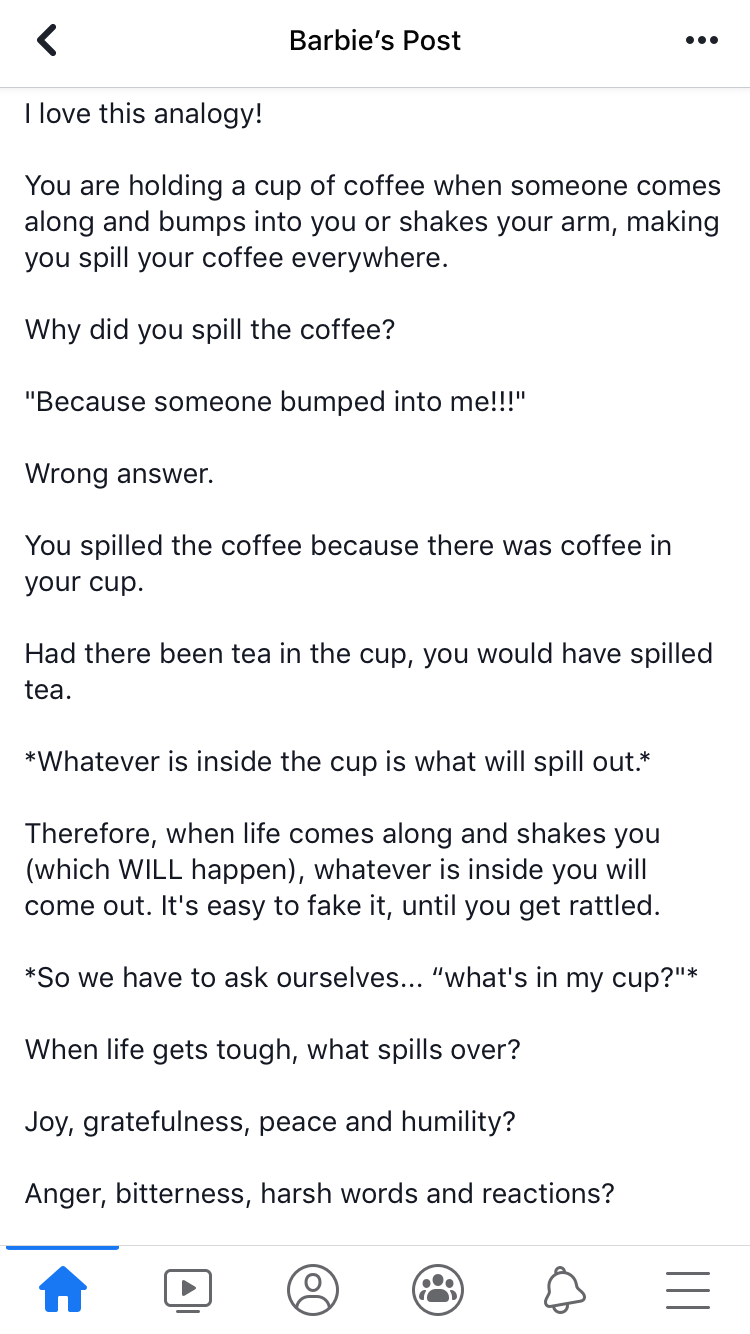

The story is transcribed in the post below.
For convenience, the full text from the image above is transcribed here, with a bit of additional commentary before the complete post.
“I love this analogy!
You are holding a cup of coffee when someone comes along and bumps into you or shakes your arm, making you spill your coffee everywhere.
Why did you spill the coffee?
‘Because someone bumped into me!’
Wrong answer.
You spilled the coffee because there was coffee in your cup.
Had there been tea in the cup, you would have spilled tea.
*Whatever is inside the cup is what will spill out.*
Therefore, when life comes along and shakes you (which WILL happen), whatever is inside you will come out. It’s easy to fake it, until you get rattled.
*So we have to ask ourselves… ‘what’s in my cup?’*
When life gets tough, what spills over?
Joy, gratefulness, peace and humility?
Anger, bitterness, harsh words and reactions?
Today let’s work towards filling our cups with gratitude, forgiveness, joy, words of affirmation; and kindness, gentleness and love for others.
(Shared from a friend whose cup is full of goodness and inspiration.)”
The post is from Facebook and is attributed to a Barbie, who I think is the original writer whose post went viral. I always remove identifiable information that connects the post back to people I know who just shared content they didn’t create.
At first, I wasn’t sure why I was so annoyed.
Since I responded with irritation, though, it must mean that I am full of irritants?
Post hoc ergo propter hoc.
Or, maybe I was irritated because I don’t need any more shame surrounding the experience of having regular emotions. It’s actually a normal human thing to experience “negative” emotions and act in ways that reflect them.
Like, generally don’t be a dick to people on purpose, but that’s very different from letting someone know that their actions (bumping into you) had a consequence that created a problem for you (spilled coffee).
The moral of the story seems like a shallow interpretation of various philosophies that require a great deal of self-awareness, commitment, and self-control.
Although to be fair, I’m sure that the majority of people sharing this on their Facebook pages are already boddisatvas, so do I really have a leg to stand on?
I’m just over here with my cup full of criticism, unable to experience joy or gratefulness.
I went ahead and paraphrased the underlying message that was getting to me:
if you’ve ever regretted your behavior in a stressful situation, that’s a reminder that you haven’t figured out how to empty your brain of the toxic feelings that make you bad at being a good person, and it means that you still have to learn how to create more consistently not-unpleasant feeling experiences inside your brain and heart.
The message here suggests that the bumper is irrelevant. The responsibility is all yours. You were carrying a cup full of coffee – what did you expect would happen?
It’s likely that most people would experience initial surprise and dismay after being unexpectedly bumped, regardless of the context, but the follow up to that bump as an expression of anger (“Weren’t you even looking?”) or empathy (“Are you okay?”) really does depend on the context and manner in which the bumping occurred.
Broadly, I do not advocate for yelling at people before attempting to practice compassionate curiosity.
I do, however, think that it’s unreasonable to talk about life as though simply “not feeling mad” is a perfectly viable option for anyone in any context experiencing incidental or serious inconveniences.
The fairly sound advice to manage your own reactions rather than manipulating those around you into behaving differently is often twisted to mean “other people’s actions don’t matter,” but of course they do.
I mean, does this coffee situation seem like a wholly innocent accident? Was the bumper clearly distracted and/or being careless? Was the bumper actively being an asshole?
The repetition of the message that “other people’s actions don’t matter” enables people to act like their own actions also don’t have consequences that negatively affect others.
That cup metaphor really isn’t cutting it for me, either.
In life, that “bump or shake” outlined in the anecdote is inevitable, and I agree with their choice to go all-caps on WILL.
Shit happens. Life is pain.
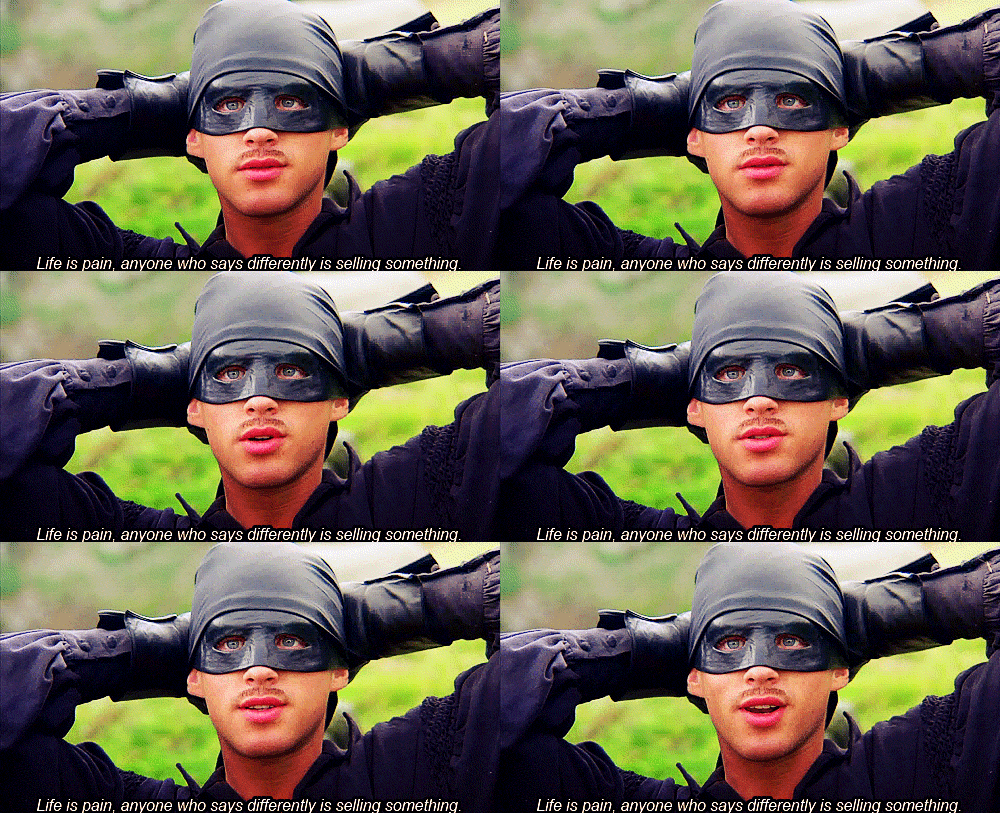
Animated gif of actor Carey Elwes as The Man in Black in the film “The Princess Bride,” mouthing the words “Life is pain,” with a caption that reads, “Life is pain; anyone who says different is selling something.”
If we rigorously stick to the cup of coffee metaphor, what does a “good” outcome look like?
I understand that the metaphor is meant to end at “what’s in your cup” rather than “what happens after it’s out of your cup,” but I just think that’s a weak extension, since the advice that you allegedly learn something about what’s in your cup only becomes transparent once it’s spilled all over the place.
I’d say that whether you’ve spilled coffee, tea, or a cocktail, the spilled version of a metaphorical liquid is always going to be less good than it was while it was in a container.
Commit to your metaphors, people.
What does a spill of “joy, gratefulness, peace and humility” even translate to in terms of beverages?
Is it water that turns into wine?
Is it water that happens to land on a fresh food stain and gently erase it without a Tide pen?
Is it coffee that miraculously guides itself into an exhausted person’s cup?
The cup in the story is a diversion from the aftermath of the spill, but it’s important to address cleanup at some point, eh?
Maybe the implication is that you should actually carry nothing in your cup, in order to avoid unfortunate spills.
Honestly, that feels like a legitimately Buddhist interpretation of the presented story, even though it’s also probably not the intended takeaway.
The moral of this little story is only focused on what’s inside the cup, to the willful exclusion of the realities that exist outside the cup, because if what’s inside is okay, then what happens outside should be okay, too.
And here we are again: consequences don’t matter as much as feelings.
You have either positive or negative feelings inside of you, and it can only be one kind or the other, and spilling them doesn’t matter if they’re the right kinds of feelings.
The spilled coffee of kindness apparently doesn’t stain as badly as the spilled coffee of resentment.
Real talk: let’s not discount the idea that we can reveal fundamental truths about who we are during trying times.
But that’s just another reason that this metaphor is so inaccurate.
This little story describes coffee that spills everywhere, and the chosen image shows a pretty dramatic splatter range.
The kinds of high-stakes scenarios that extend us beyond our habitus and force revelations about our true selves are not comparable to incidental elbow bumps that cause a few drops of coffee to spill harmlessly onto the boardwalk, or maybe make your hand temporarily sticky.
We’re talking about spraying a wide and erratic black coffee pattern across your new white shirt. We’re talking about soaked socks and squelchy coffee feet. We’re talking about staining the clothes of innocent bystanders who didn’t even have coffee in the first place. We’re talking about wasted money, which, even for a cheap cup of coffee, is much less negligible for some than for others. We’re talking about shorting out your phone.
All that isn’t just mildly inconvenient. It fucking sucks.
But the expository text suggests that little “oopsy!” bumps and big “aw, fuck” bumps are basically comparable in terms of your reactions.
My cup can often be found to be brimming with a steamy, frothy blend of anxiety, depressive rumination, self criticism, and sweet hazelnut-flavored indecision, precariously poured over a generous double shot of hot, black, simmering rage.
And yet under some of the most severely stressful circumstances in my life, I’ve found myself to be focused, calm, helpful, decisive, and efficient.
It would be nice to believe that this is because underneath the angry latte of my coping mechanisms, I’m actually filled with healthy, delicious virtue.
But I don’t think that’s true.
My anxiety exists to prepare me for intensity and chaos.
However, I don’t really live a lifestyle or have a career that actually calls for finely-honed disaster response skills. It’s exceptional when I have to engage with a real situation that resembles my brain’s preemptive catastrophizing.
I suspect that at least part of the reason I’m able to be proactive, calm, and magnanimous in dire circumstances is that I have already anticipated dire circumstances.
In other words, I think I’ve (sometimes) been able to comport myself gracefully in the midst of life’s major bumps because I’m full of anxiety, and not because I was so much more full of patience and compassion than the people futilely having panic attacks around me.
I’m not advocating for flipping the fuck out over minor inconveniences. But, sometimes when a minor inconvenience is your last straw for the day, it’s okay to just go ahead and let that anger out of your system in the way that it emerges, without worrying about whether you’re handling it responsibly or elegantly.
For most humans, emotions aren’t, like, discrete and distinct from the rest of our lived experience. There’s a huge difference between pretending to not have the feelings that you’re actually having, and accepting that your feelings might not reflect the best performance of your ideal best self at any given moment.
I don’t love ending with pithy advice, but it’s sort of hard to avoid in this self-help-adjacent genre, so here goes.
You’re not a joyless ingrate for getting mad and then sounding mad, and sweetness doesn’t exist without the co-existence of bitterness.
Your reactions to things are not wrong or bad. They just are.
Sure, take stock of your behavior. Are you consistently lashing out or punching down after minor setbacks? Then check yourself! Talk it out! Do a therapy thing, whatever that means for you! Try to discover the functional roots of at least some of your issues!
But maybe don’t aim to have an empty cup that never inconveniences anyone else. Go ahead and carry around stuff that you know has the potential to make a mess sometimes, and be prepared to actually deal with the aftermath instead of vaguely philosophizing about how you wouldn’t have made a mess if you’d been a better person in the first place.
Those are some harsh words, Barbie. But I assure you that they didn’t spill accidentally – I intentionally elected to pour them out this way.




 Pith Rant
You must be logged in to post a comment.